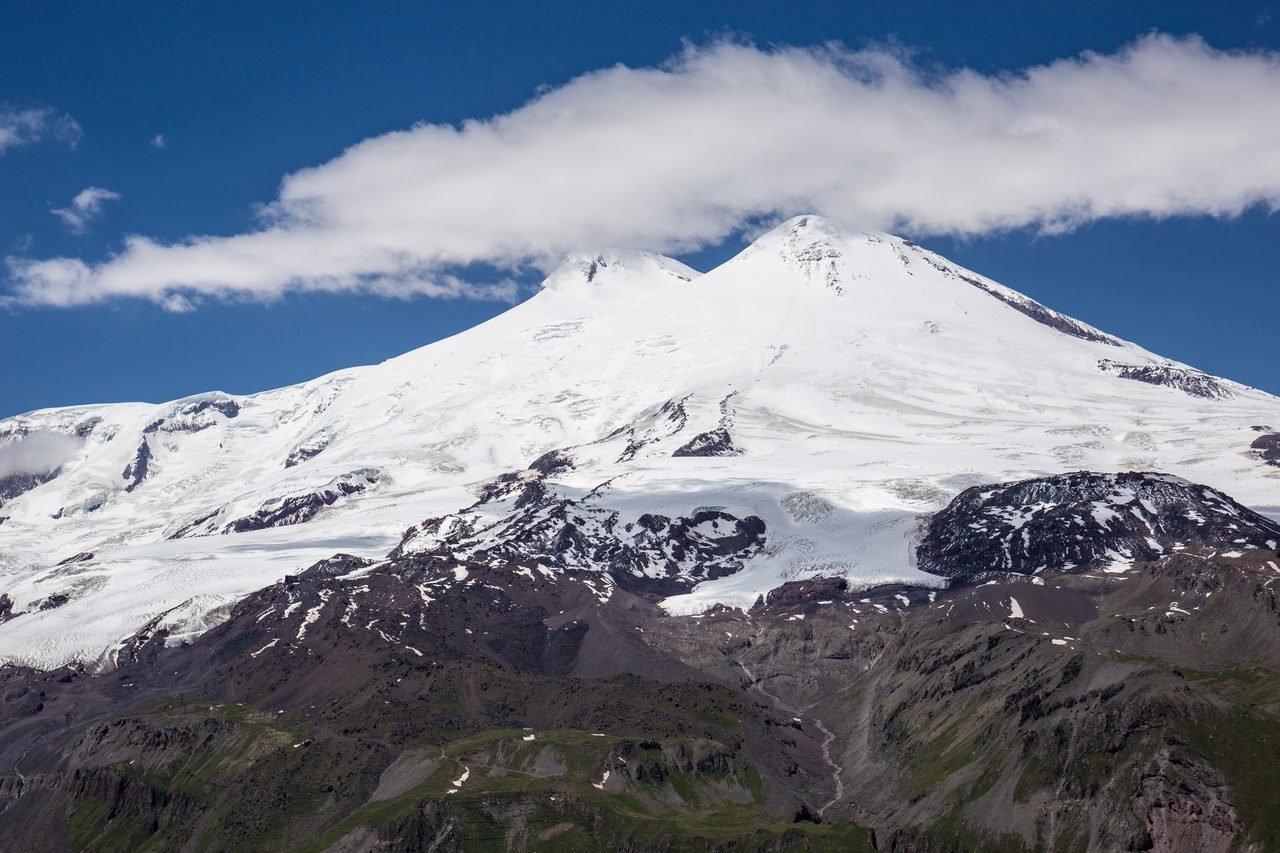
Why Elbrus punishes underprepared climbers
Elbrus is one of the most attempted of the Seven Summits, and a popular first high-altitude objective for ambitious amateur climbers. That is exactly the trap. The South route asks for crampons, an ice axe, and basic glacier travel skills, and nothing harder. Climbers read "non-technical" and assume "not hard". On Elbrus, the altitude and the weather, not the terrain, are what stop people.
The first failure mode is altitude. At 5,642m (18,510 ft), the West summit sits above the 3,000 to 5,000m band most amateur climbers have trained in. Fit people who arrive without real acclimatisation lose a large share of their sea-level capacity, and that is before altitude sickness symptoms begin. The second is the day itself. Summit day commonly runs 10 to 16+ hours round trip, often starting in the dark and cold, and parties that move slower than the schedule allows simply run out of time. The third is the weather: severe and fast-changing, with the saddle between the two summits a known navigation hazard in poor visibility. The fourth is the false sense of safety from an easy-looking route - climbers who turn back rarely do so because the ground was too steep. They turn back because they were not ready for the altitude, the cold, or the hours.
None of this is bad luck. Every one of these failure modes is trainable.
The training demand profile
Elbrus loads five physiological systems in different ways. A real preparation plan trains all five, not just the obvious one.
Altitude reality check
Be honest with yourself here: Elbrus at 5,642m (18,510 ft) is a high-altitude objective. It sits above the 3,000 to 5,000m band most amateur climbers train for, so acclimatisation and altitude readiness matter even more here than on a 4,000m (13,100 ft) peak. Training builds the engine. Altitude is its own thing, and no algorithm replaces real exposure. Practically, the standard approach is a multi-day acclimatisation rotation built into the trip, climbing high and sleeping lower as you go, with high accommodation around 3,800 to 4,100m (12,500 to 13,500 ft) as the staging point. Spend training time at altitude in the months before if you can reach it, and a hypoxic tent at home can help with haematological adaptation. The deeper guide is in altitude acclimatisation guide.
A weekly distribution that works
The polarised principle applies: most of the week at low intensity, one hard session, one long mountain day (Seiler & Kjerland, 2006). A representative week, 12 weeks out from an Elbrus summit:
- Mon · easy 60 min Z2
- Tue · threshold intervals or VO2max, 4 x 4 min Z4-Z5
- Wed · rest or 30 min mobility
- Thu · long Z2 hike, 2-3 hours with 600-800m (2,000-2,600 ft) vertical, weighted pack
- Fri · easy 45 min Z2 + eccentric strength (step-downs, weighted lunges)
- Sat · long mountain day, 4-6 hours mixed Z2 with vertical and surges
- Sun · 1.5-2.5h Z2 on tired legs (back-to-back loading)
Roughly 80% of weekly volume sits at Z1-Z2, with one hard intensity session and one back-to-back load. Vertical accumulates progressively across the block. The single ≥8-hour rehearsal day lands 4-6 weeks before the trip, not in the final taper. The deeper rationale is in our heart rate zones for mountaineering guide.
How TTM tunes the plan to Elbrus
Five things the algorithm calibrates to your peak
- Fitness target · Elbrus is set to a fitness threshold our model associates with completing the route safely with margin. Your plan is engineered to reach that level by your summit date.
- Altitude readiness · Because 5,642m (18,510 ft) sits above the band most amateurs have trained in, the plan front-loads the aerobic engine and leaves clear room for a proper acclimatisation rotation on the trip.
- Vertical accumulation target · The plan distributes climbing volume progressively week by week, with recovery weeks built in, rather than in a few heroic sessions.
- Summit-day rehearsal · The long-day component is calibrated to Elbrus's 10 to 16+ hour summit day. The plan schedules a real ≥8-hour single training day in the 6-week window before your trip, not earlier.
- Descent eccentric load · Eccentric strength and downhill repeats are programmed in, calibrated to a long descent on tired legs (LaStayo et al., 2003), not bolted on afterwards.
When you tell TTM your objective is Elbrus and your summit date, the plan is built backwards from that date with all five demands engineered in. TTM then recalibrates the plan every Sunday against your actual training data, so the build stays matched to how you are really progressing. You do not need to assemble the pieces yourself.
Common questions about training for Elbrus
How hard is it to train for Elbrus?
Elbrus is technically a non-technical walk-up, but at 5,642m (18,510 ft) it is a serious high-altitude objective and the training is not casual. The terrain on the South route does not need climbing skill beyond crampons, an ice axe, and basic glacier travel.
What altitude work matters for Elbrus (5,642m / 18,510 ft)?
At 5,642m (18,510 ft) the air holds roughly half the oxygen of sea level, and Elbrus sits above the 3,000 to 5,000m band most amateur climbers have trained in.
How long is summit day on Elbrus?
Summit day on the South route commonly runs 10 to 16+ hours round trip, often starting in the dark from high accommodation around 3,800 to 4,100m (12,500 to 13,500 ft).
Does an Elbrus plan need to be personalised to me?
Yes, in five specific ways: your starting fitness, which sets where the build begins; your summit date, which sets where the taper lands; vertical accumulation distributed progressively across the block; one 8+ hour rehearsal day placed 4 to 6 weeks out; and altitude readiness given that Elbrus at 5,642m (18,510 ft) sits above the band most amateurs have trained in.
Can I train for Elbrus with a full-time job?
Yes. The polarised distribution fits a busy schedule better than threshold-heavy plans, because most training is low-intensity work that fits early mornings or evenings.
Tools and deeper reading
Take this further
- Summit Readiness Simulator · Test if you are ready for Elbrus today. Free, science-backed, 90 seconds. Enter your peak, your summit date, and your current fitness; get a readiness score.
- Altitude Acclimatisation Guide · The climb-high-sleep-low rule, the per-night ascent ceiling, altitude sickness warning signs, and the three real acclimatisation strategies.
- Heart Rate Zones for Mountaineering · The polarised 80/20 distribution, why Z2 dominates, how to find your zones, and the common mistakes that turn long days into junk-zone tempo.
- The Science Behind TTM · Banister's fitness-fatigue model, polarised distribution, altitude physiology, eccentric load - the peer-reviewed research the adaptive algorithm is built on.
- Muscular Endurance for Mountaineering · The pillar guide on the quality that turns gym strength into legs that last a summit day. Pair with the free Muscular Endurance Calculator to score where you stand.
The takeaway
Elbrus is rarely a terrain problem. The route is non-technical, but at 5,642m (18,510 ft) the altitude, the cold, and the 10 to 16+ hour summit day make it a serious objective. The climbers who summit reliably are the ones whose training matched the mountain's actual demand profile across all five dimensions - and who respected the altitude. The athletes who turn around usually trained the easy parts and ignored the hard ones.