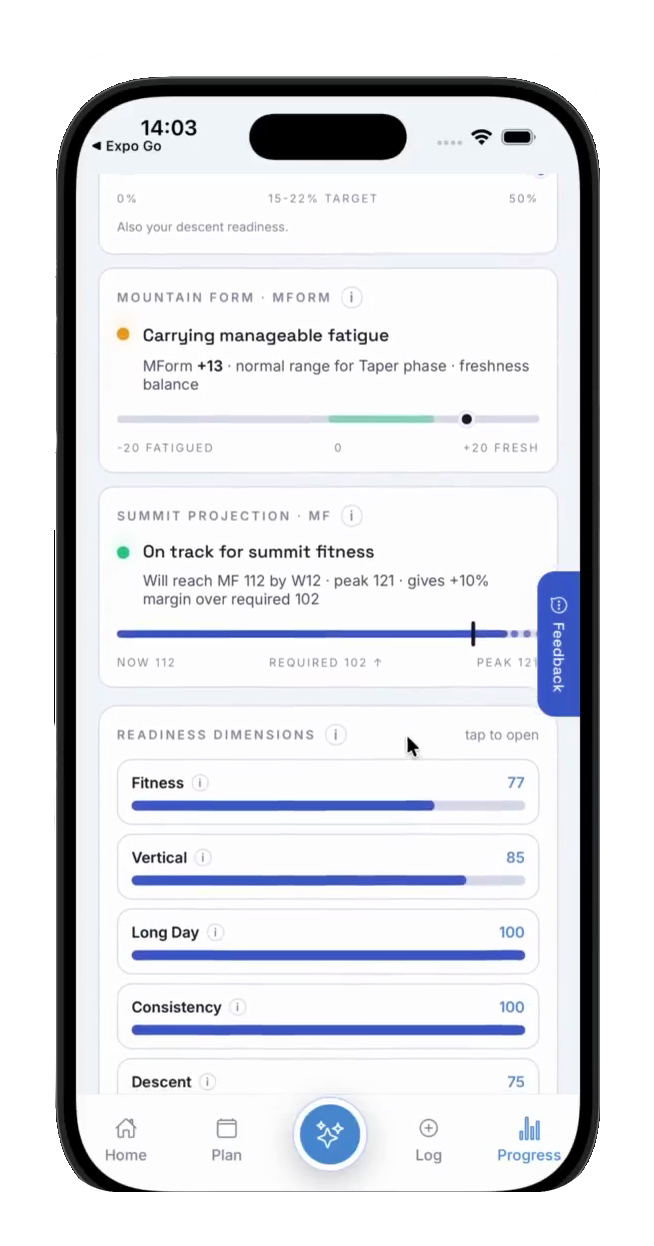
Here's exactly what happens when you join TTM - step by step, from telling us your objective to standing on top of it.
Start by telling the AI your target - the altitude, the date, where you live and train, your current fitness level, and any history. No forms to fill. A conversation.
The AI asks the right questions, identifies the gaps, and maps your current cardiovascular baseline to what your objective actually demands at altitude. In minutes, it knows more about your readiness than a generic training plan ever will.
The Prescription Engine generates your full training plan from first principles - not a modified generic program, but a periodized build structured specifically around your altitude target, your available weeks, and your current Chronic Training Load (CTL).
It uses 3:1 periodization blocks - three progressive weeks followed by a recovery week - to drive Chronic Training Load (CTL) upward while managing fatigue. The taper is calculated to arrive on summit day with your fitness peaked and your fatigue cleared.
Connect Strava once and forget about it. Every session you complete syncs automatically - TTM sees your actual heart rate, actual duration, actual Training Stress Score. Not what was planned. What actually happened.
Each morning, your AI coach checks in: your Summit Readiness Score (SRS) for the day, what the session is and why it's prescribed, and what your Strava data from yesterday is telling the model. Each evening, a coached debrief on what it means for your trajectory.
Every Monday, the Prescription Engine runs a full recalculation. It compares what you actually did against what was planned, recalculates your Chronic Training Load (CTL) trajectory, and rebuilds the remaining weeks accordingly.
Missed sessions? The plan shifts forward. Exceptional week? The taper calculation adjusts. High fatigue detected? Intensity drops before your body tells you it needs to. This isn't a static programme - it's a living model that reflects your actual physiology at every point.
Summit day isn't a guess anymore. Your Summit Readiness Score (SRS) on the morning of your attempt reflects 24 weeks of real training data, your actual Chronic Training Load (CTL) at peak, and a taper timed by the algorithm to leave your fatigue cleared and your fitness intact.
You'll know - down to a number - how your cardiovascular system compares to what that altitude demands. The mountain doesn't care how hard you trained. TTM makes sure you trained right.
Most training apps adjust difficulty based on how you feel. TTM adapts based on what your physiology is actually doing - and calculates the consequence for your summit date before you even notice the change.
Generic apps track fitness. TTM tracks whether your fitness is sufficient for your specific altitude - and recalibrates every week until it is.
| Feature | TTM | Generic Training App | AI Chat Coach |
|---|---|---|---|
| Scientifically modelled CTL / ATL | ✓ | ✗ | ✗ |
| Summit Readiness Score for your altitude | ✓ | ✗ | ✗ |
| Urban vertical training protocols | ✓ | ✗ | ~ |
| Auto-taper calculated to summit day | ✓ | ✗ | ~ |
| Weekly plan recalculation from real data | ✓ | ✗ | ✗ |
| Strava / wearable auto-sync | ✓ | ✓ | ✗ |
| Progressive adaptation detection | ✓ | ✗ | ✗ |
| Go / no-go readiness assessment | ✓ | ✗ | ~ |
| Mountain-specific altitude physiology | ✓ | ✗ | ✗ |
Join early access and get a personalised program built from day one - not a template, a prescription based on your exact objective and physiology.