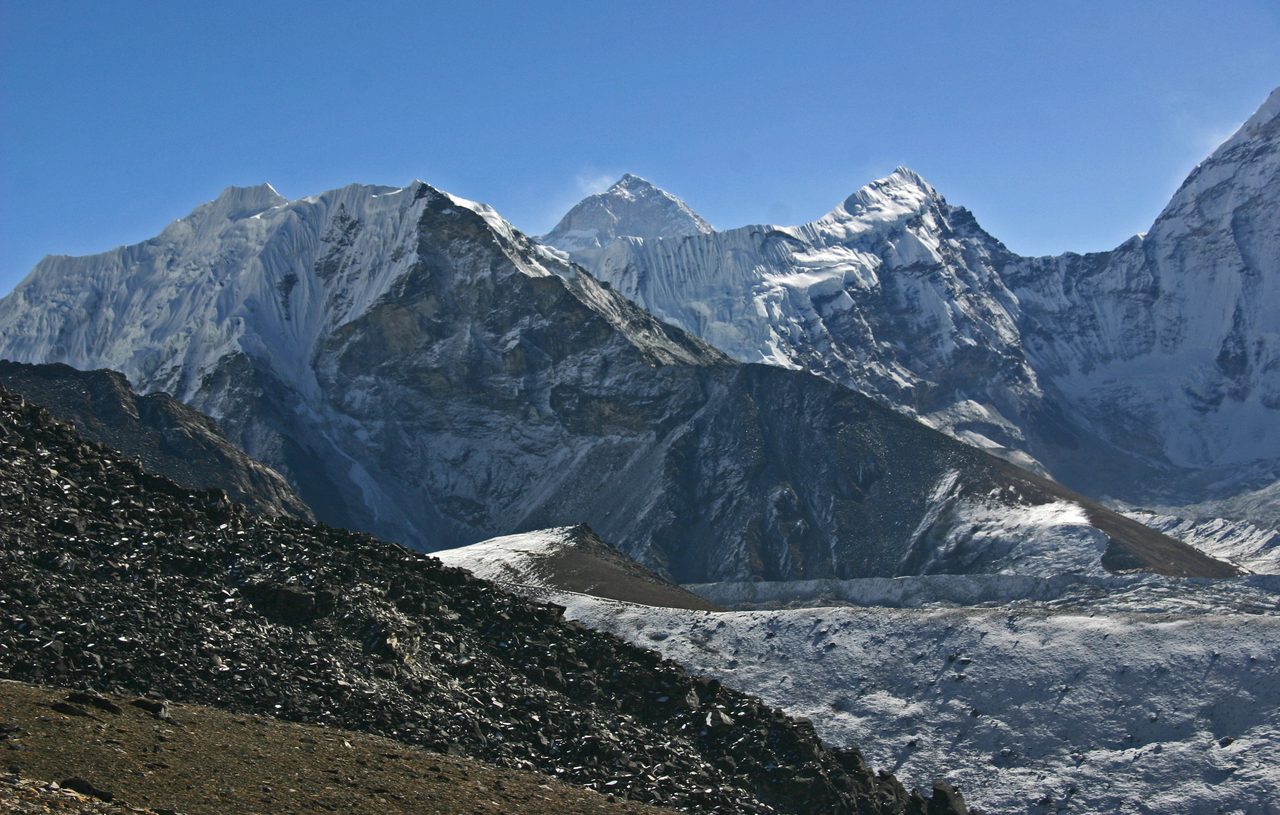
Why Island Peak punishes underprepared climbers
Island Peak is one of Nepal's most popular trekking peaks and is widely described as suitable for novice climbers - but "suitable for novice climbers" at 6189m (20,305 ft) still demands real preparation. Most climbers who turn around or struggle do so for three repeated reasons.
The first is altitude under-preparation. Climbers who compress the Khumbu acclimatisation itinerary, skip rest days, or push too fast to high villages feel the 6000m+ summit hard. The second is the headwall. The crux of the route is a sustained 200m (650 ft) fixed-rope climb at 40-50 degrees, requiring jumar use on the way up and abseil/rappel on the way down. Climbers who have never used a jumar before the trip move slowly and lose the weather window. The third is summit-day duration. 10-14 hours of moving at altitude, often starting at 1-2 AM, asks for a deeper engine than many trekkers arrive with.
The training demand profile
Island Peak loads five systems. TTM trains four; the fifth is fixed-rope and basic snow skill that comes from a guide service or course.
Altitude reality check
Training builds the engine. Altitude is its own thing - and on Island Peak, altitude is decisive. At 6189m (20,305 ft) you have around 48 percent of sea-level oxygen. The standard Khumbu acclimatisation itinerary is the answer. Most parties take 12-18 days from arrival in Kathmandu to summit day: trek-in through Lukla and the high villages (Namche Bazaar at 3440m / 11,286 ft is a critical acclimatisation stop), rest days, a warm-up peak (Chhukhung Ri at 5546m / 18,196 ft is the classic Island Peak warm-up), then approach to base camp. Skipping any of this drops summit rates sharply. The deeper guide on this is in our altitude acclimatisation guide.
A weekly distribution that works
The polarised principle applies. A representative week, 12 weeks out from an Island Peak attempt:
- Mon · easy 60 min Z2
- Tue · threshold or VO2max intervals, 4 x 4 min Z4-Z5
- Wed · rest or 30 min mobility + hangboard / dead-hang work
- Thu · Z2 hike with daypack, 2-3 hours, 600-900m (2,000-3,000 ft) of vertical
- Fri · easy 45 min Z2 + eccentric strength
- Sat · long mountain day, 5-7 hours mixed Z2 with vertical
- Sun · 2-3 h Z2 on tired legs
Roughly 85 percent of weekly volume at Z1-Z2. The 8-10 hour rehearsal day lands 4-6 weeks before the trip. See heart rate zones for mountaineering for the rationale.
How TTM tunes the plan to Island Peak
Four things the algorithm calibrates to your peak
- Fitness target · Reflects 10-14 hours at 6000m+ with a fixed-rope crux.
- Vertical accumulation target · Around 20,000-24,000m (66,000-79,000 ft) across the build.
- Summit-day rehearsal · 8-10 hour single training day 4-6 weeks out, ideally with an early start.
- Descent eccentric load · Calibrated to 1100m (3,600 ft) of descent including the rappel.
The fixed-rope/snow-skill layer and the Khumbu acclimatisation itinerary come from elsewhere. TTM does not teach jumar technique or design trek schedules.
Common questions about training for Island Peak
How do I build endurance for Island Peak's 10-14 hour summit day at 6000m+?
Island Peak summit day from base camp is 10-14 hours roundtrip with ~1100m (3,600 ft) of vertical gain, including a 200m (650 ft) fixed-rope headwall and a narrow summit ridge.
What altitude work matters for Island Peak (6189m / 20,305 ft)?
Real. At 6189m (20,305 ft) you have around 48 percent of sea-level oxygen.
Does an Island Peak plan need to be personalised to me?
Yes, in five specific ways: your starting fitness, your trip start date (where the taper lands), the progressive pack weight build, one 8-10 hour rehearsal day placed 4-6 weeks out, and the descent eccentric load calibrated to 1100m (3,600 ft) of mixed-terrain descent on tired legs after rappelling the fixed-rope headwall.
Can I train for Island Peak with a full-time job?
Yes. The bigger constraint than weekday training is the 12-18 day Khumbu itinerary itself; you need real time off for the trip.
What does comprehensive Island Peak prep actually cover?
Three layers. (1) Fitness: an aerobic engine for 10-14 hours at 6000m+, leg endurance, eccentric descent strength, and one 8-10 hour rehearsal day.
What strength work does Island Peak training need?
Targeted and leg-focused, with a small grip component. Eccentric leg strength (weighted step-downs, slow-tempo split squats, controlled downhill repeats) builds resilience for the 1100m (3,600 ft) of descent on tired legs at altitude.
Can I prepare for Island Peak from sea level without high-altitude terrain?
Yes, with one constraint: at 6189m (20,305 ft) altitude exposure cannot be faked. The aerobic engine, leg endurance, descent eccentric load, and grip work can all be trained anywhere with hills, stairs, or a treadmill on incline.
How is Island Peak different from Mera Peak?
Both are Nepal trekking peaks in the Khumbu region with multi-day approach trekking. Differences: Mera Peak (6476m / 21,247 ft) is higher but technically simpler - a long glacier walk with one fixed-rope section near the summit.
Tools and deeper reading
Take this further
- Summit Readiness Simulator · Test if you are ready for Island Peak today.
- Training for Mera Peak · The classic pair. Often done in the same Khumbu trip.
- Altitude Acclimatisation Guide · Critical reading for any 6000m+ objective.
- Eccentric Descent Training · Why descent on tired legs at altitude wrecks quads.
- Heart Rate Zones for Mountaineering · How Z2 at altitude feels at sea level.
- The Science Behind TTM · The peer-reviewed research the adaptive algorithm is built on.
- Muscular Endurance for Mountaineering · The pillar guide on the quality that turns gym strength into legs that last a summit day. Pair with the free Muscular Endurance Calculator to score where you stand.
The takeaway
Island Peak is rarely a willpower problem. It is a fitness + altitude + fixed-rope problem. The climbers who summit reliably are the ones who trained the engine for 10-14 hours at altitude, respected the Khumbu acclimatisation itinerary, and arrived jumar-competent. The mountain finds the gap.