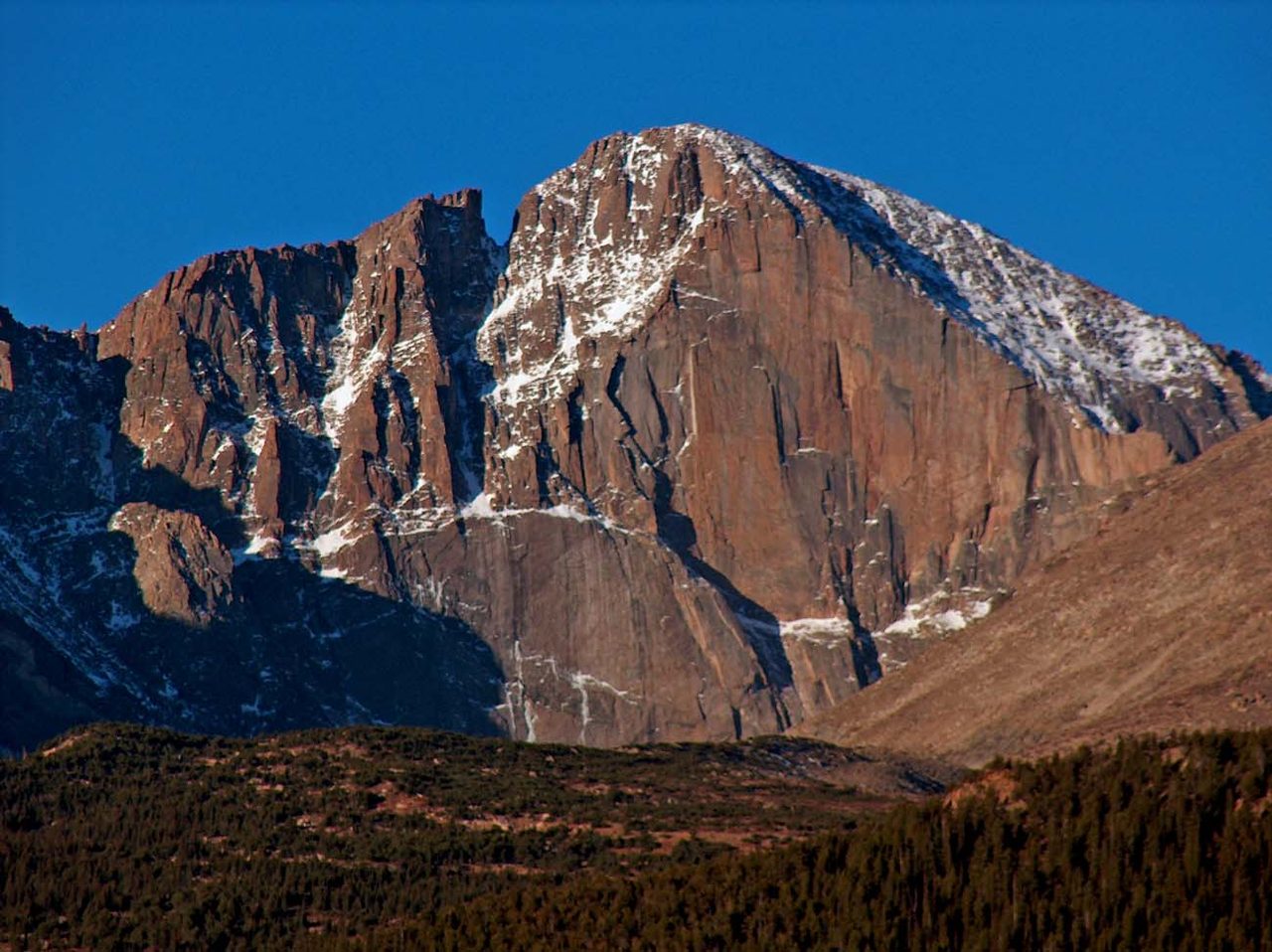
Why Long's Peak punishes underprepared climbers
Long's Peak is the crown jewel of Rocky Mountain National Park and one of the most attempted 14ers in Colorado. The Keyhole Route is the standard summer line - a 14.5 mile (23.3 km) round trip with 5,100 ft (1,554m) of vertical gain, taking 10-15 hours for most parties. The National Park Service is explicit: "The Keyhole Route is not a hike. It is a climb that crosses enormous sheer vertical rock faces, often with falling rocks, requiring scrambling, where an unroped fall would likely be fatal."
Climbers who turn around or get into trouble usually fail on one of three things. The first is fitness: 14.5 miles with 5,100 ft of gain in a single day, much of it above 3500m (11,500 ft), asks more than most weekend hikers have done. Climbers run out of gas before the Keyhole and have to turn around. The second is scrambling competence and exposure: the Narrows and the Homestretch demand confidence on exposed Class 3 terrain. Climbers who freeze at the Narrows often retreat. The third is the late start. Afternoon thunderstorms in Colorado are routine and lethal at altitude; parties who summit after 11 AM are exposed.
The training demand profile
Long's Peak loads five systems. TTM trains four; the fifth is scrambling competence and weather literacy.
Altitude reality check
At 4346m (14,259 ft) you have around 61 percent of sea-level oxygen at the summit. The trailhead is already at 2825m (9,270 ft), so the climb spends almost all its hours at altitude that matters for sea-level climbers. Strategies that help: arrive in Estes Park or the Boulder area 2-3 days early to sleep above 1500m (4,900 ft) and tag a smaller 14er or 13er day-hike (Mt Bierstadt at 4287m / 14,065 ft, Mt Evans at 4348m / 14,265 ft, or Quandary Peak at 4351m / 14,275 ft) 2-3 days before Long's. Drink water aggressively from arrival. Climbers driving up from low altitude the day before often feel the summit harder than necessary. The deeper guide on this is in our altitude acclimatisation guide.
A weekly distribution that works
The polarised principle applies. A representative week, 10 weeks out from a Long's Peak attempt:
- Mon · easy 60 min Z2
- Tue · threshold intervals, 4 x 4 min Z4-Z5
- Wed · rest or 30 min mobility
- Thu · Z2 hike with daypack, 2-3 hours, 700-1000m (2,300-3,300 ft) of vertical
- Fri · easy 45 min Z2 + eccentric strength
- Sat · long mountain day, 5-7 hours with real vertical and scrambling if possible, daypack
- Sun · 2-3 h Z2 on tired legs
Roughly 85 percent of weekly volume at Z1-Z2. 8-10 hour rehearsal day 4-6 weeks before the trip. See heart rate zones for mountaineering for the rationale.
How TTM tunes the plan to Long's Peak
Four things the algorithm calibrates to your peak
- Fitness target · Reflects 10-15 hours of single-day movement with 5,100 ft of vertical and Class 3 scrambling.
- Vertical accumulation target · Around 22,000-26,000m (72,000-85,000 ft) across the build, with scrambling sessions where possible.
- Summit-day rehearsal · 8-10 hour single training day on hilly or scrambling terrain, 4-6 weeks out.
- Descent eccentric load · Calibrated to 1554m (5,100 ft) of descent on mixed scrambling and trail.
Scrambling competence and Colorado-thunderstorm literacy come from elsewhere. TTM does not teach Class 3 movement or read the afternoon forecast.
Common questions about training for Long's Peak
How do I build endurance for Long's Peak's 10-15 hour single-push day?
Long's Peak via the Keyhole Route is a 14. 5 mile (23.
What altitude work matters for Long's Peak (4346m / 14,259 ft)?
Modest for climbers who live at altitude, real for sea-level visitors. At 4346m (14,259 ft) you have around 61 percent of sea-level oxygen at the summit.
Does a Long's Peak plan need to be personalised to me?
Yes, in four specific ways: your starting fitness, your trip date (where the taper lands), the vertical accumulation distributed across the build, and one 8-10 hour rehearsal day on hilly or scrambling terrain placed 4-6 weeks out. Long's Peak rewards leg endurance with vertical and a high tolerance for sustained scrambling on exposed terrain. An adaptive plan re-shapes the build around weeks you missed.
Can I train for Long's Peak with a full-time job?
Yes. Long's Peak is one of the most working-week-friendly serious objectives because it is a single-day climb (no high camp, no multi-day load).
What does comprehensive Long's Peak prep actually cover?
Three layers. (1) Fitness: an aerobic engine for 10-15 hours of moving with 5,100 ft (1,554m) of climb plus the same of descent, leg endurance, and one 8-10 hour rehearsal day.
What strength work does Long's Peak training need?
Modest, leg-focused, with a small core component. The 1554m (5,100 ft) of descent on tired legs across scrambling terrain is the main strength demand.
Can I prepare for Long's Peak from sea level without alpine terrain?
Yes. Long's Peak is sea-level-friendly because the demand is fitness-and-scrambling rather than glacier work or technical alpine.
How is Long's Peak different from Alps 4000m peaks?
Three differences. First, no glacier and no rope team: Long's is a scrambling route in mountain boots or approach shoes, not a snow climb.
Tools and deeper reading
Take this further
- Summit Readiness Simulator · Test if you are ready for Long's Peak today.
- Training for Mt Hood · The closest peer comparison: single-day, fitness-heavy, with one technical section. Different hazard profile.
- Altitude Acclimatisation Guide · How to absorb the altitude jolt of a sea-level-to-14er trip.
- Eccentric Descent Training · Why descent destroys quads on scrambling terrain.
- Heart Rate Zones for Mountaineering · Pacing fundamentals for a 10-15 hour single push.
- The Science Behind TTM · The peer-reviewed research the adaptive algorithm is built on.
- Muscular Endurance for Mountaineering · The pillar guide on the quality that turns gym strength into legs that last a summit day. Pair with the free Muscular Endurance Calculator to score where you stand.
The takeaway
Long's Peak is rarely a technique-only problem and rarely a fitness-only problem. It is fitness + scrambling + timing. The climbers who summit reliably are the ones who trained the engine to last 10-15 hours, arrived comfortable on Class 3 rock, started in the dark, and turned around when the clouds built. The mountain finds the gap.