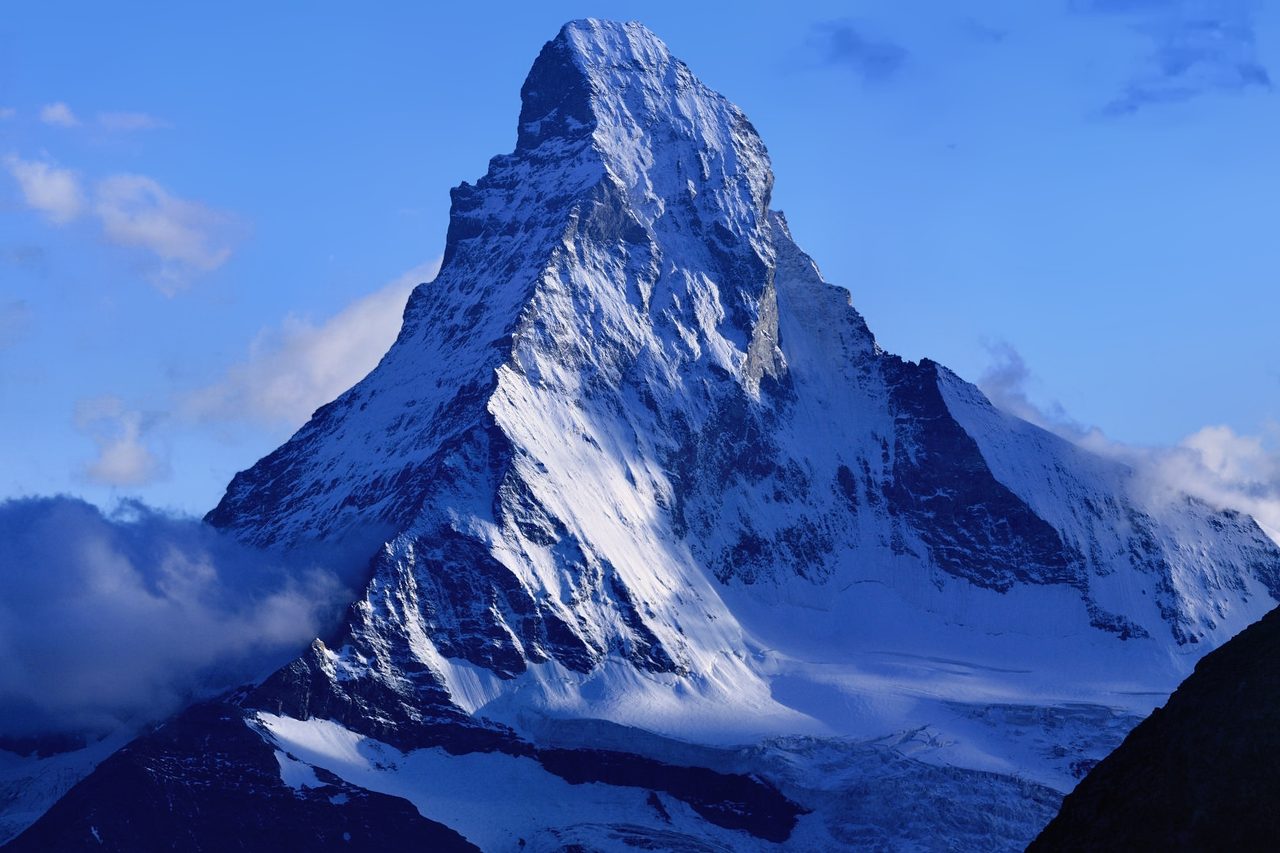
Training for the Matterhorn takes about 12 to 16 weeks, and technical readiness matters as much as fitness. Summit day is 9 to 12 hours of nearly non-stop climbing at 4478m (14,692 ft), with 1220m (4,000 ft) of scrambling around UIAA III / 5.4 in mountain boots, so you need to be aerobically deep, fast on your feet, and competent on exposed rock.
Why the Matterhorn punishes underprepared climbers
Guided success rates on the Hornli Ridge run 70 to 80 percent (Alpine Guides, Adventure Consultants and other major operators all cite figures in this range). The rest turn around for one of four reasons, almost every time.
The first is insufficient fitness for sustained technical climbing. A 9 to 12 hour day of micro-movements, hand-and-foot placements, and route decisions burns capacity faster than any walk-up. The second is exposure intolerance: the ridge is sustained, narrow, and high above the Hornli glacier on one side and Zmutt on the other; climbers who have not done enough exposed terrain freeze up. The third is descent fatigue: most accidents on the Matterhorn happen on the way down, when tired legs and dulled attention meet 4.5 to 5.5 hours of downclimbing technical rock in mountain boots. The fourth is overestimation of ability, sometimes paired with a guide turning the party back at the Solvay Hut (4003m / 13,133 ft) when speed is too slow for the weather window.
None of this is bad luck. All four failure modes are trainable, in a particular order.
Physical benchmarks to hit before the Matterhorn
The Matterhorn loads five systems in different ways than a glacier-walk peak. A real preparation plan trains all five. The first three are pure fitness and live in TTM's domain. The fourth and fifth are technical and acclimatisation work you build separately.
Altitude and terrain reality check
Training builds the engine. Altitude is its own thing. At 4478m (14,692 ft) you have around 60 to 65 percent of sea-level oxygen. That is enough to make exposed technical climbing feel meaningfully harder than at home, especially the route-finding sections on the upper ridge. The Zermatt valley is itself a working acclimatisation venue. The standard approach is to spend a few days on lower 4000m (13,100 ft) peaks before the Matterhorn attempt. The Breithorn (4164m / 13,661 ft) is the classic warm-up: short, mostly walked, ideal for one altitude exposure day. Pollux (4092m / 13,425 ft) and Castor (4228m / 13,871 ft) add technical practice in glaciated terrain. A night at the Hornli Hut (3260m / 10,696 ft) before summit day is standard practice and worth taking seriously. The deeper guide on this is in our altitude acclimatisation guide.
How long does it take to train for the Matterhorn?
The block runs backwards from your summit date, with technical readiness woven in alongside physical prep. Six phases, each with a distinct target and a testable end.
- Weeks 1-4 · Aerobic base plus scrambling. 4-6 hours per week at Zone 1-Zone 2. Add one weekly scrambling session on real rock (up to UIAA II). Goal: aerobic engine and comfort with exposure. End-of-phase test: 90 min Zone 2 with less than 5% HR drift.
- Weeks 5-8 · Base plus strength plus indoor technical. One strength session per week (back squat, deadlift, weighted lunge, weighted step-ups). Add one indoor climbing session per week at UIAA III or 5.6-5.7 in comfortable shoes. Long day extends to 3-4 hours with 600-800 m vertical. End-of-phase test: 5 x 5 back squat at 1.25 x bodyweight AND UIAA III on-sight indoors.
- Weeks 9-11 · Muscular endurance plus downclimb practice. Convert strength into sustained work: 4-6 hour Zone 2 days with 800-1,200 m vertical, add eccentric step-downs, and add outdoor multi-pitch alpine rock at PD to PD+ grade. End-of-phase test: 45 min Zone 2 Stairmaster plus 500 weighted step-ups in the same session, plus at least one clean PD-graded alpine rock day.
- Weeks 12-13 · Peak simulation on technical terrain. One 8-10 hour rehearsal day on an AD-graded alpine route with full pack and 1,200+ m vertical, back-to-back with a 4-hour day the day before. End-of-phase test: the rehearsal day itself, completed with movement quality holding late.
- Week 14 · Altitude plus rock at height. Book a 3-4 day rotation at 3,000+ m on a 4000m peak (Weissmies, Allalinhorn, Breithorn). Test both altitude tolerance and technical movement above 4,000 m. Volume drops 20-30% but intensity is preserved.
- Weeks 15-16 · Taper. Volume drops 30-50%. Keep one short intensity session and one easy Zone 2 day. One indoor climbing session per week to keep the hands sharp. Arrive at Zermatt fresh with the fitness and technique you built still expressed.
If your window is shorter than 12 weeks, physical prep compresses but technical alpine days do not. If you have no PD or AD alpine days in your history, extend the block. TTM's algorithm runs the physical side backwards from your summit date. The technical alpine days you must schedule separately.
A weekly distribution that works
The polarised principle applies: most of the week at low intensity, one hard session, one long mountain day, plus a technical-skill day where the calendar allows. A representative week, 12 weeks out from a Matterhorn attempt:
- Mon · easy 60 min Z2
- Tue · threshold or VO2max intervals, 4 x 4 min Z4-Z5
- Wed · rest or 30 min mobility + hangboard / dead-hang work for finger endurance
- Thu · steep Z2 hike, 2-3 hours, 700-1000m (2,300-3,300 ft) of vertical, light pack
- Fri · easy 45 min Z2 + eccentric strength (step-downs, weighted lunges)
- Sat · long mountain day, 5-7 hours with vertical and exposed scrambling if possible
- Sun · 1.5-2.5 h Z2 on tired legs OR a multi-pitch rock day in mountain boots
Roughly 85 percent of weekly volume sits at Z1-Z2, with one hard intensity session and one back-to-back load. Vertical accumulates progressively across the block. The single 8-10 hour rehearsal day, ideally on scrambling terrain, lands 4-6 weeks before the trip, not in the final taper. The deeper rationale is in our heart rate zones for mountaineering guide.
Technical skills you must bring to the Matterhorn
TTM trains the body. It does not teach climbing. The Matterhorn is AD (Assez Difficile / Fairly Difficult) in the French alpine system and rewards technical readiness on top of physical readiness. These are the competencies you need before Zermatt. Build them separately, book a certified guide, or extend the block to develop them properly.
- Comfort climbing UIAA III / III+ in mountain boots. Roughly YDS 5.4-5.5, on real rock with a small pack, no gym shoes. Not a place to learn to climb.
- Downclimbing at UIAA III on tired legs. The Hornli descent is half the day. Practice downclimbing repeatedly on training peaks before Zermatt.
- Short-roping and moving-together technique. Guided ascents move as a rope team of two. Learn to move continuously without stopping to belay every pitch.
- Route-finding on a complex mixed ridge. The Hornli is not a straight line. Weather calls, turn-around thresholds, judgement under altitude-blunted cognition.
- Sustained exposure management. Nine to twelve hours of exposure on both sides of a narrow ridge. Not a training substitute for it. Time on exposed alpine ridges first.
- Glacier travel on the approach. Rope-team spacing, crampon proficiency on the approach to the Hornli Hut, awareness of the loose rock on the lower route.
- 8-12 alpine climbing days across the year at PD to AD grade before the Matterhorn attempt. Multi-pitch alpine rock experience is not optional.
If any of these are new, the honest answer is a guided ascent through Zermatt or a season of PD to AD alpine climbing in the Alps first. Weissmies, Allalinhorn, the Breithorn traverse, and the Wildspitze are appropriate training peaks. TTM's plan gets you physically ready. The mountain rewards technical readiness on top of that.
How TTM tunes the plan to the Matterhorn
Five things the algorithm calibrates to your peak
- Fitness target · The Matterhorn fitness target reflects a sustained 9-12 hour technical day. Comparable to a Mont Blanc engine, with a slightly higher demand on vertical efficiency. The plan is engineered to hit that number by your summit date.
- Vertical accumulation target · Vertical accumulation across the build is calibrated to the Hornli Ridge's concentrated gain. The plan distributes that volume progressively, with recovery weeks every 4th.
- Summit-day rehearsal · The Long Day Score is calibrated to the Matterhorn's 9-12 hour technical day. The plan schedules a real 8-10 hour single training day in the 6-week window before your trip, not earlier.
- Descent eccentric load · The Descent Readiness Score is calibrated to 4.5-5.5 hours of downclimbing technical rock. Eccentric strength and downhill repeats are programmed in, not bolted on.
- Schedule shaping for technical days · The plan respects scheduled alpine rock days and multi-pitch sessions, reshaping the week so technical work and fitness work compound rather than collide.
When you tell TTM your objective is the Matterhorn and your summit date, the plan is built backwards from that date with all five fitness-side demands engineered in. The technical layer (rock skills, alpine experience, route familiarity) you bring from outside or build alongside with a qualified guide. TTM does not pretend to teach climbing.
Matterhorn difficulty: what the grade actually means
The standard Matterhorn difficulty grade is AD (Assez Difficile / Fairly Difficult) in the French alpine system for the Hornli Ridge, the most-climbed route. That is a serious grade for an amateur mountaineer. It sits above PD (Peu Difficile / Slightly Difficult) where Mont Blanc and most first-4000m peaks live, and below D (Difficile). The rock scrambling is UIAA III / III+ in mountain boots (roughly YDS 5.4-5.5), with sustained exposure on both sides of the ridge, loose rock in places, and 1220m (4,000 ft) of technical ground on both the ascent and the descent. The difficulty comes less from any single move and more from doing 9-12 hours of continuous technical climbing at altitude while route-finding on an intricate ridge, half of it on tired legs on the way down. Bad weather changes the grade instantly. This is why fitness alone is not enough for the Matterhorn: alpine experience and comfort with sustained exposure are non-negotiable, and the training plan has to prepare the athlete for the descent load as much as the ascent.
Common questions about training for the Matterhorn
How long does it take to climb the Matterhorn?
Summit day on the Hornli Ridge is 9-12 hours of nearly non-stop technical climbing: roughly 5-5.5 hours up and about the same back down, covering 1220m (4,000 ft) of technical ground. That is the number most people are asking about. The honest answer for the whole objective is longer. You sleep at the Hornli Hut at 3260m (10,696 ft) the night before, and a sensible trip adds acclimatisation days and warm-up peaks in the same valley first, so most climbers budget the better part of a week in Zermatt rather than a single day. The training implication matters more than the clock: 9-12 hours of sustained technical movement, with half of it descending on tired legs, is what the plan has to prepare you for.
How do I build endurance for the Matterhorn's 9-12 hour summit day?
The Matterhorn summit day is 9-12 hours of nearly non-stop technical climbing with minimal rest.
What altitude work matters for the Matterhorn (4478m / 14,692 ft)?
At 4478m (14,692 ft) altitude is significant but not decisive. The deeper problem is doing technical climbing and route-finding while at 60-65% of sea-level oxygen.
Does a Matterhorn plan need to be personalised to me?
Yes, in five specific ways: your starting fitness, your summit date (where the taper lands), the total vertical accumulation distributed across the build, one 8-10 hour rehearsal day on technical terrain placed 4-6 weeks out, and the descent eccentric load.
Can I train for the Matterhorn with a full-time job?
Yes, but the technical-skill piece often becomes the bottleneck, not the fitness piece. The polarised distribution fits busy schedules: 60 min Z2 Monday, threshold intervals Tuesday, easy 45 min Friday with eccentric strength, long mountain day Saturday (5-7 hours with vertical), back-to-back Sunday.
What does comprehensive Matterhorn prep actually cover?
Three layers, not one. (1) Fitness: an aerobic engine deep enough for 9-12 hours of climbing, vertical accumulation training, eccentric descent strength, and one 8-10 hour rehearsal day.
What strength work does Matterhorn training need?
Targeted, eccentric-heavy, with a small grip and core component. The biggest single priority is descent resilience.
Can I prepare for the Matterhorn from sea level without alpine terrain?
Partly. The aerobic engine, vertical accumulation, descent eccentric load, and grip/core work can all be trained anywhere with hills, stairs, a treadmill on incline, and an indoor climbing wall.
How is Matterhorn training different from Mont Blanc training?
Three differences. First, technical layer: Mont Blanc by the Gouter is a fitness-and-altitude climb; the Matterhorn is fitness, altitude, AND sustained UIAA III / 5.5 climbing for hours.
Tools and deeper reading
Take this further
- Summit Readiness Simulator · Test if you are ready for the Matterhorn today. Free, science-backed, 90 seconds. Enter your peak, your summit date, and your current fitness; get a readiness score.
- Altitude Acclimatisation Guide · The climb-high-sleep-low rule, the 300-500m (1,000-1,650 ft) per-night ceiling, AMS warning signs, and the three real acclimatisation strategies.
- Eccentric Descent Training · Why the 1220m (4,000 ft) Hornli descent destroys quads, and the specific eccentric work that prevents the late-day breakdown that ends most Matterhorn attempts.
- Heart Rate Zones for Mountaineering · The polarised 85/15 distribution, why Z2 dominates, how to find your zones, and the common mistakes that turn long technical days into junk-zone tempo.
- The Science Behind TTM · Banister's model, polarised distribution, altitude physiology, eccentric load - the peer-reviewed research the adaptive algorithm is built on.
- Muscular Endurance for Mountaineering · The pillar guide on the quality that turns gym strength into legs that last a summit day. Pair with the free Muscular Endurance Calculator to score where you stand.
The takeaway
The Matterhorn is rarely a willpower problem and rarely just a fitness problem. It is a specificity-and-skill problem. The climbers who summit reliably are the ones whose fitness matched the demand profile across the five dimensions, whose alpine rock skill was already there when they arrived, and whose pre-acclimatisation gave them oxygen to think with at hour 9. The climbers who turn around almost always undertrained one layer and assumed the other two would carry them. The mountain finds the gap.