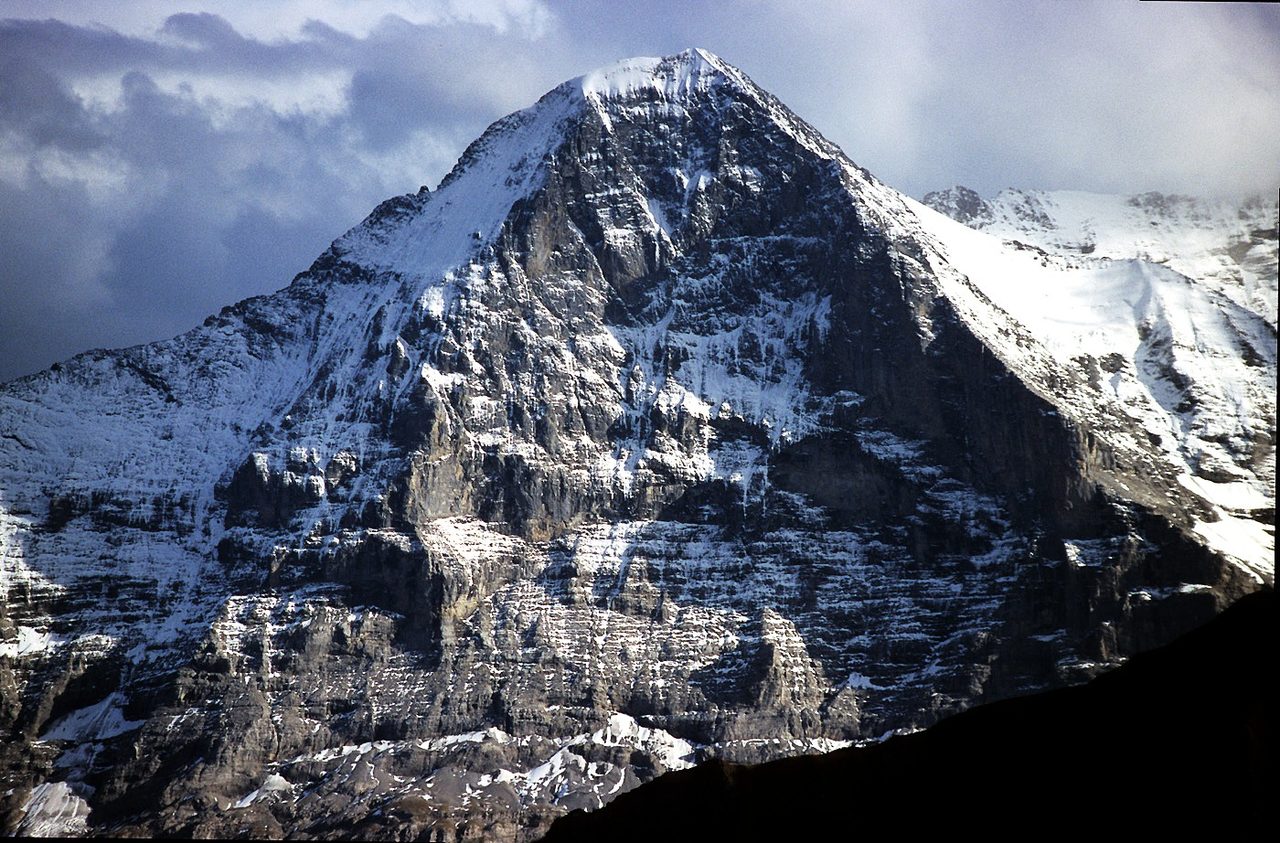
A note on which Eiger route this guide is written for
Route honesty
This guide is written for the Mittellegi Ridge (AD+ 4a) and to a lesser extent the West Flank. TTM does NOT train climbers for the famous North Face (Heckmair route, TD/ED), which is elite alpine territory and demands skills, experience, and risk tolerance that an adaptive fitness platform does not address. If you are aiming at the North Face, this is not the right guide. If you are aiming at the Mittellegi or West Flank with a guide, read on.
The Eiger has three reasonable lines for the kind of climber TTM serves. The Mittellegi Ridge is the iconic AD+ alpine ascent: 615m (2,020 ft) of mixed ridge climbing from the Mittellegi Hut (3355m / 11,006 ft), with three gendarmes, exposed sections, and rock up to UIAA III-IV in mountain boots. The West Flank is the easier line - a long snow-and-scree slope that some parties use to descend or, in good conditions, to ascend. The South Ridge is rarely chosen as a normal route. The North Face is famous and largely off-limits for the audience this site is built for.
Why the Eiger punishes underprepared climbers
The Eiger's Mittellegi Ridge is considered one of the great classic alpine ridges of the Bernese Oberland - and one of the more demanding lines an AD+ climber can choose. Climbers turn around or get into trouble for three repeated reasons. The first is technical mismatch: climbers who trained for a PD glacier walk and arrive on the Mittellegi are out of their depth on the gendarmes. The second is exposure: the ridge is narrow and airy, with rock moves above significant drops. The third is timing: the traverse from Mittellegi Hut to summit and then down the South Ridge or West Flank takes 7-9 hours; parties who start late get caught in afternoon weather.
The training demand profile
The Eiger loads five systems. TTM trains four. The fifth - AD+ alpine skill - is decisive and comes from elsewhere.
Altitude reality check
At 3967m (13,015 ft) the Eiger is just below the 4000m mark. Altitude is rarely the decisive factor on this peak. The Mittellegi Hut night at 3355m (11,006 ft) provides adequate acclimatisation for most climbers. Sea-level climbers who feel altitude-sensitive may want to warm up on a lower Bernese Oberland peak (Mönch is the obvious choice, same area, similar access) before the Eiger attempt. The deeper guide on this is in our altitude acclimatisation guide.
A weekly distribution that works
The polarised principle applies. A representative week, 12 weeks out from an Eiger attempt:
- Mon · easy 60 min Z2
- Tue · threshold or VO2max intervals, 4 x 4 min Z4-Z5
- Wed · rest or 30 min mobility + hangboard work
- Thu · Z2 hike, 2-3 hours, 700-1000m (2,300-3,300 ft) of vertical
- Fri · easy 45 min Z2 + eccentric strength
- Sat · long mountain day, 5-7 hours with scrambling or via ferrata if possible
- Sun · 2-3 h Z2 on tired legs OR a multi-pitch alpine rock day in mountain boots
Roughly 85 percent of weekly volume at Z1-Z2. The 8-10 hour scrambling rehearsal lands 4-6 weeks before the trip. See heart rate zones for mountaineering for the rationale.
How TTM tunes the plan to the Eiger
Four things the algorithm calibrates to your peak
- Fitness target · Reflects a 7-9 hour technical traverse with sustained ridge climbing.
- Vertical accumulation target · Comparable to Mont Blanc with extra scrambling sessions weighted in.
- Summit-day rehearsal · 8-10 hour single day on scrambling terrain, 4-6 weeks out.
- Descent eccentric load · Calibrated to mixed-terrain descent across rock and snow.
The AD+ alpine skill, the route selection (Mittellegi vs West Flank vs hard never), and the decision to use a guide all come from elsewhere. TTM does not teach gendarme negotiation.
Common questions about training for the Eiger
Which Eiger route does TTM train for?
The Mittellegi Ridge (AD+ 4a) is the standard alpine ascent and the route this guide is written for. The West Flank is the easier line and is sometimes used for descent; it can also be climbed as the simplest ascent but requires care.
How do I build endurance for the Eiger's Mittellegi Ridge?
The Mittellegi Ridge from the Mittellegi Hut (3355m / 11,006 ft) to the summit (3967m / 13,015 ft) is ~615m (2,020 ft) of climbing in 4 hours of intensive ridge climbing, with traverse from Mittellegi to Jungfraujoch totalling 7-9 hours in good conditions.
What altitude work matters for the Eiger (3967m / 13,015 ft)?
Modest by Alps standards. At 3967m (13,015 ft) the Eiger is technically below the 4000m mark. Altitude is rarely the decisive factor; the route's difficulty is what asks the most of climbers. The Mittellegi Hut night at 3355m (11,006 ft) provides adequate acclimatisation for most. Sea-level climbers may want to warm up on a lower peak in the Bernese Oberland first.
Does an Eiger plan need to be personalised to me?
Yes, in five specific ways: your starting fitness, your summit date (where the taper lands), the vertical accumulation distributed across the build, one 8-10 hour rehearsal day on scrambling terrain placed 4-6 weeks out, and the descent eccentric load calibrated to the descent route you choose (back along the ridge, traverse to Jungfraujoch via the South Ridge, or down the West Flank).
Can I train for the Eiger with a full-time job?
Yes, but the technical-skill piece is usually the bottleneck rather than the fitness piece. Training time fits a normal week; the harder constraint is accumulating 8-12 alpine days at PD to AD grade in the year before the attempt to be ready for the Mittellegi's exposed ridge climbing.
What does comprehensive Eiger prep actually cover?
Three layers, heavily weighted to alpine skill. (1) Fitness: an aerobic engine for 4-9 hours of sustained alpine climbing depending on route choice, vertical efficiency, descent strength, and one 8-10 hour rehearsal day.
What strength work does Eiger training need?
Targeted, with a meaningful grip and core component. The Mittellegi Ridge has sustained rocky moves, three gendarmes, and exposed ridge sections - climbers use their hands a lot.
Can I prepare for the Eiger from sea level without alpine terrain?
Partly. The aerobic engine, leg endurance, descent eccentric load, and core/grip work can all be trained anywhere with hills, stairs, a treadmill on incline, and an indoor climbing wall.
How is the Eiger different from the Matterhorn?
Both are AD-grade exposed ridge climbs at iconic peaks. The Matterhorn (Hornli Ridge) is a sustained 1220m (4,000 ft) of climbing over 9-12 hours; the Eiger's Mittellegi Ridge is shorter (615m / 2,020 ft, 4 hours from hut) but more concentrated in technical climbing on rock.
Tools and deeper reading
Take this further
- Summit Readiness Simulator · Test if you are ready for the Eiger today.
- Training for the Matterhorn · The closest peer: AD exposed ridge with sustained rock. Useful comparison.
- Training for Mönch · A natural warm-up peak in the same area with the same Jungfraujoch access.
- Altitude Acclimatisation Guide · Climb-high-sleep-low rule and AMS warning signs.
- Eccentric Descent Training · Why descent destroys quads on mixed terrain.
- The Science Behind TTM · The peer-reviewed research the adaptive algorithm is built on.
- Muscular Endurance for Mountaineering · The pillar guide on the quality that turns gym strength into legs that last a summit day. Pair with the free Muscular Endurance Calculator to score where you stand.
The takeaway
The Eiger is rarely a willpower problem and rarely a fitness-only problem. It is an alpine-skill problem with a fitness foundation. The climbers who summit reliably are the ones who arrived AD+ ready, used a UIAGM/IFMGA guide, picked the right route for their experience, and treated the technical layer as decisive. The mountain finds the gap.