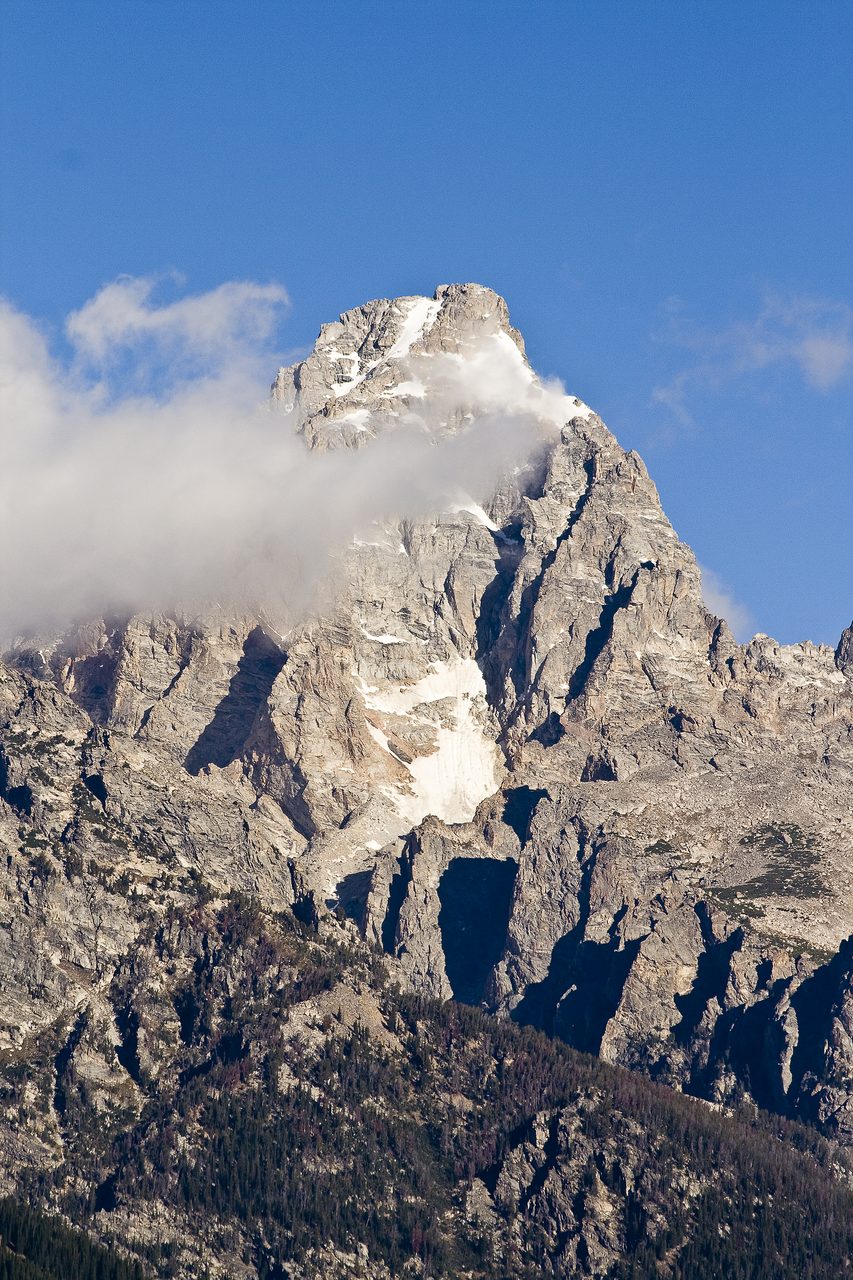
Training for the Grand Teton takes about 12 to 16 weeks. At 4199m (13,775 ft) summit day is genuine multi-pitch alpine rock climbing with a rappel descent after a long approach, so it demands aerobic endurance, rock-climbing competence, and comfort moving fast on exposed granite, not hiking fitness.
Why the Grand Teton punishes underprepared climbers
The Grand Teton has a reputation as the finest mountaineering objective in the contiguous United States, and it earns that reputation by stacking demands. The standard Owen-Spalding route is roughly 5.4 alpine rock with 12 to 14 pitches of mixed scrambling and roped climbing; the most popular variation, the Upper Exum Ridge, climbs at about 5.5 and is considered one of the great alpine rock routes in North America. None of that is a walk-up.
Most parties fail for a small set of reasons. The first is the approach: approximately 9.7 km (6 mi) one way from Lupine Meadows to the Lower Saddle at about 3,475m (11,400 ft), with significant elevation gain and a heavy pack. Legs arrive cooked at high camp. The second is summit day itself: an 8 to 12 hour round trip from the Saddle that is real alpine rock with route-finding, exposure, and helmets-on movement. The third is weather: afternoon storms in the Tetons are common and they do not negotiate. The fourth is the descent, which on the Owen-Spalding is a multi-pitch rappel sequence, often slow with parties stacked, and then a long downhike back to the trailhead on tired legs.
None of this is bad luck. Every one of those failure modes is trainable.
Physical benchmarks to hit before the Grand Teton
The Grand Teton loads five trainable systems in different ways. A real preparation plan trains all five, not just the obvious one.
Altitude and terrain reality check
At 4,199m (13,775 ft), the Grand Teton is high enough that altitude is real but not the main constraint. The Lower Saddle, your high camp, sits at approximately 3,475m (11,400 ft), so you are sleeping high and waking up to climb higher. If you live near sea level, expect a noticeable hit to perceived effort, route-finding speed, and recovery between pitches. The deeper guide on this is in altitude acclimatisation guide.
How long does it take to train for the Grand Teton?
The block runs backwards from your climb date. Five phases, each with a distinct target.
- Weeks 1-4 · Aerobic base. Build the deep engine that keeps a long day efficient.
- Weeks 5-8 · Base plus strength. Add eccentric leg strength and progressive weighted carries.
- Weeks 9-11 · Muscular endurance. Long days with vertical and a building pack.
- Weeks 12-13 · Peak simulation. A long mountain day near your summit-day length, 4-6 weeks out.
- Week 14 · Altitude and skills. Time high where you can, plus the specific mountain craft the Grand Teton needs.
- Weeks 15-16 · Taper. Volume drops; skills stay sharp; arrive fresh.
A weekly distribution that works
The polarised principle applies: most of the week at low intensity, one hard session, one long mountain day. A representative week, 12 weeks out from a Grand Teton summit:
- Mon · easy 60 min Z2
- Tue · threshold or VO2max intervals, 4 x 4 min Z4-Z5
- Wed · rest or 30 min mobility
- Thu · long Z2 hike, 2-3 hours with 600-800m (2,000-2,600 ft) vertical, weighted pack
- Fri · easy 45 min Z2 + eccentric strength (step-downs, weighted lunges)
- Sat · long mountain day, 4-6 hours mixed Z2 with vertical, or a multi-pitch rock day with approach
- Sun · 1.5-2.5h Z2 on tired legs (back-to-back loading)
Roughly 80 percent of weekly volume sits at Z1-Z2 with one hard intensity session, in line with the polarised model (Seiler and Kjerland, 2006). Vertical accumulates progressively. The alpine-rock rehearsal day lands 4 to 6 weeks out, not in the final taper. The deeper rationale is in our heart rate zones for mountaineering guide.
Technical skills you must bring to the Grand Teton
TTM trains the body. the Grand Teton is a technical objective - bring these skills or climb with a certified guide.
- Confident movement on steeper snow, ice or rock at the route's grade, up and down.
- Rope work: pitching, belaying and secure anchors where the ground demands it.
- Composure on exposed, committing terrain.
- The judgement to retreat or abseil cleanly if conditions turn.
How TTM tunes the plan to the Grand Teton
Five things the algorithm calibrates to your peak
- Fitness target · The Grand Teton is set to the threshold our model associates with completing the route safely with margin. The plan is engineered to hit that number by your summit date.
- Vertical accumulation · A weekly vertical curve distributed progressively across the build, with recovery weeks every fourth week.
- Alpine-rock summit-day rehearsal · A real multi-pitch climbing day with approach is scheduled in the 6-week window before your trip, not earlier.
- Descent eccentric load · Eccentric strength and downhill repeats are programmed in, calibrated to a rappels-plus-downhike day (Banister et al., 1975; LaStayo et al., 2003).
- Pack-load tolerance · Loaded long days build progressively, so the approach to the Lower Saddle is not the first time your hips and feet meet the weight.
When you tell TTM your objective is the Grand Teton and your summit date, the plan is built backwards from that date with all five demands engineered in. The algorithm recalibrates weekly, each Sunday, based on the training you actually did. You do not assemble the pieces yourself.
Common questions about training for the Grand Teton
How fit do I need to be to climb the Grand Teton?
Fit enough to carry a 12 to 16 kg pack approximately 9. 7 km (6 mi) and 1,700m+ (5,500 ft+) of gain to the Lower Saddle at 3,475m (11,400 ft), sleep there, and then climb 12 to 14 pitches of alpine rock and rappel back down, all in 8 to 12 hours of summit-day movement at altitude.
How long should I train for the Grand Teton?
Plan for 12 to 16 weeks of structured training, longer if you are starting from a low base or have no recent multi-pitch climbing. The Grand Teton stacks two demands at once: a long approach under load and a real alpine rock day.
Does altitude matter on the Grand Teton at 4,199m (13,775 ft)?
It matters, but it is not the main constraint. The Lower Saddle at 3,475m (11,400 ft) is your high camp, and the summit reaches 4,199m (13,775 ft).
What strength training should I do for the Grand Teton?
Targeted, eccentric-heavy, low-volume. The biggest strength priority is descent resilience: rappels plus a long downhike from the Lower Saddle back to Lupine Meadows is what destroys quads at the end of the day.
How is Grand Teton training different from training for a Cascades volcano?
The biggest difference is summit day. A Cascades volcano is a snow and glacier slog; the Grand Teton is an alpine rock climb.
Tools and deeper reading
Take this further
- Peak Progression Planner · See where the Grand Teton sits in a full progression and the graded paths around it, from a fast line to a cautious foundation.
- Summit Readiness Simulator · Test whether you are ready for the Grand Teton today. Free, science-backed, about 90 seconds.
- Training for Mountaineering · How TTM builds personalised mountaineering training plans backwards from your summit date, recalibrated each Sunday.
- Train for Long's Peak · A Class 3 Colorado 14er, the exposed Keyhole Route at altitude.
- Train for Mt Rainier · The most glaciated peak in the lower 48, a multi-day glacier objective.
- Altitude Acclimatisation Guide · The four acclimatisation training protocols and how to fit them into your build.
- Muscular Endurance for Mountaineering · The pillar guide on the quality that turns gym strength into legs that last a summit day. Pair with the free Muscular Endurance Calculator to score where you stand.
The takeaway
The Grand Teton is an iconic American alpine objective for a reason. It is rarely a fitness problem in the abstract; it is a specificity problem. The climbers who summit cleanly are the ones whose training matched the mountain's actual demand profile across all five dimensions: aerobic engine, vertical, alpine-rock rehearsal, descent strength, and pack-load competence. Train one or two of those well and you can still turn around at the Lower Saddle. Train all five and you give yourself a real shot at the summit.