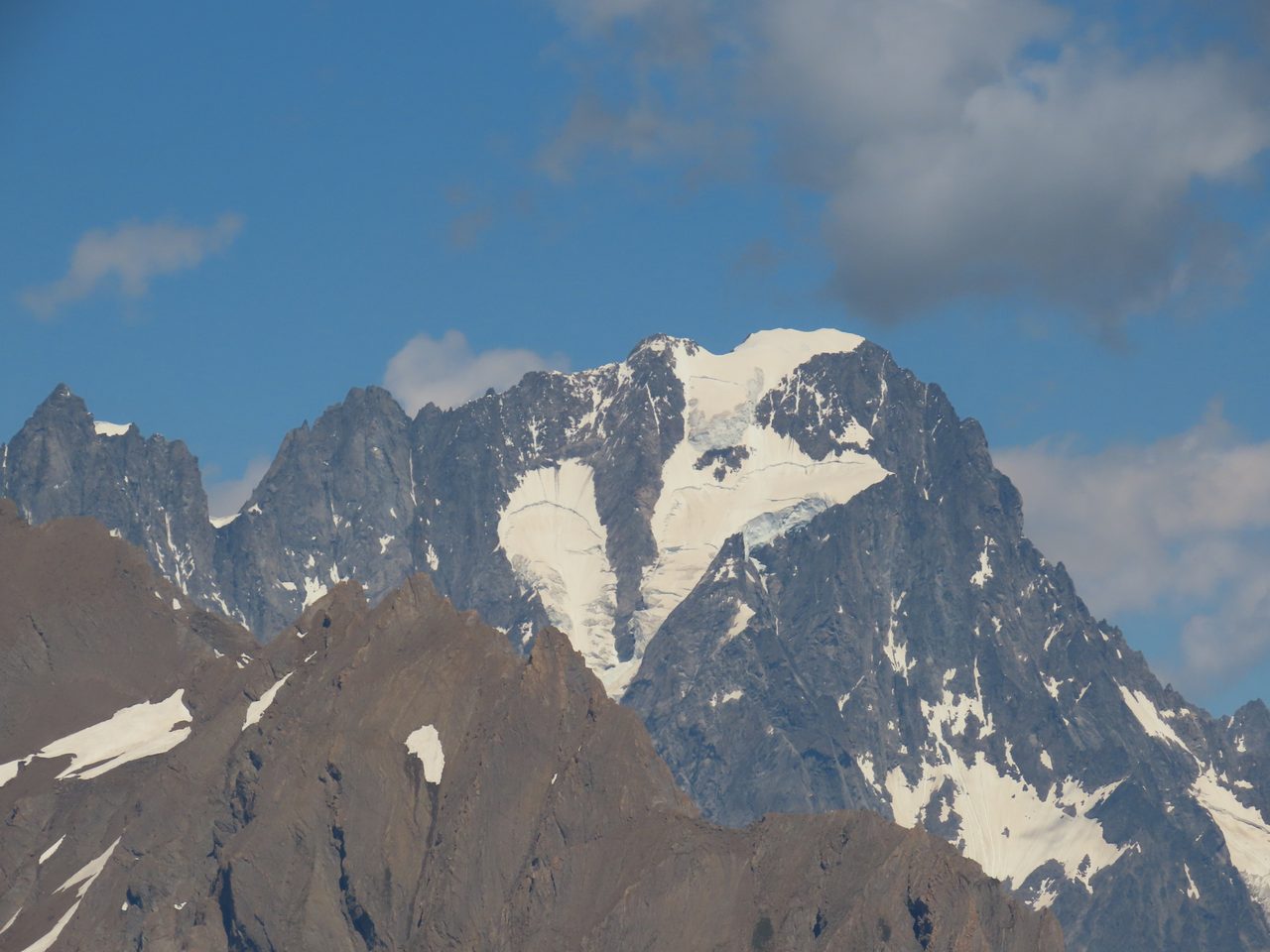
Training for the Grandes Jorasses takes about 12 to 16 weeks, and it is a serious technical objective. The summit at Pointe Walker (4208m / 13,806 ft) caps a long mixed day of glacier, snow and rock with an exposed descent off one of the great ridges of the Mont Blanc massif, so it demands deep aerobic fitness plus real alpine climbing competence.
Why the Grandes Jorasses punishes underprepared climbers
The Grandes Jorasses is not a first 4,000m objective. The summit ridge holds several named tops; Pointe Walker, the high point at 4,208m (13,806 ft), was first reached on 30 June 1868 by Horace Walker with guides Melchior Anderegg, Johann Jaun, and Julien Grange. The Italian-side normal route from the Refuge Boccalatte is graded AD: a mixed line of glacier travel, snow slopes, and exposed rock that asks for steady movement on terrain you cannot rush.
The mountain punishes the underprepared in three predictable ways. The first is timeout. A normal-route summit day from the hut is typically 10 to 14 hours round trip, and parties who do not move efficiently on mixed ground run out of weather window. The second is altitude. At 4,208m (13,806 ft) you have roughly 62 percent of sea-level oxygen, and climbers without acclimatisation lose fitness sharply above 3,500m (Bartsch and Saltin, 2008). The third is descent. The way down the normal route is long, exposed, and almost entirely eccentric load on already tired quads.
None of these are bad luck. All three are trainable.
Physical benchmarks to hit before the Grandes Jorasses
The Grandes Jorasses loads five physiological systems in different ways. A real preparation plan trains all five, not just the obvious one.
Altitude and terrain reality check
Training builds the engine. Altitude is its own thing. At 4,208m (13,806 ft) you have around 62 percent of sea-level oxygen, and the only honest way to adapt is to spend time up there (Bartsch and Saltin, 2008). Practically, three options: spend time at 3000m+ (9,800 ft+) on other Alpine peaks in the weeks before, use a hypoxic tent at home (real for haematological adaptation, less so for ventilatory), or build a 2 to 3 day acclimatisation rotation into the trip itself before pushing for Pointe Walker. The deeper guide on this is in altitude acclimatisation guide.
How long does it take to train for the Grandes Jorasses?
The block runs backwards from your climb date. Five phases, each with a distinct target.
- Weeks 1-4 · Aerobic base. Build the deep engine that keeps a long day efficient.
- Weeks 5-8 · Base plus strength. Add eccentric leg strength and progressive weighted carries.
- Weeks 9-11 · Muscular endurance. Long days with vertical and a building pack.
- Weeks 12-13 · Peak simulation. A long mountain day near your summit-day length, 4-6 weeks out.
- Week 14 · Altitude and skills. Time high where you can, plus the mountain craft the Grandes Jorasses needs.
- Weeks 15-16 · Taper. Volume drops; skills stay sharp; arrive fresh.
A weekly distribution that works
The polarised principle applies: most of the week at low intensity, one hard session, one long mountain day (Seiler and Kjerland, 2006). A representative week, roughly 12 weeks out from a Grandes Jorasses attempt:
- Mon · easy 60 min Z2
- Tue · threshold intervals or VO2max, 4 x 4 min Z4 to Z5
- Wed · rest or 30 min mobility
- Thu · long Z2 hike, 2 to 3 hours with 600 to 800m vertical, weighted pack
- Fri · easy 45 min Z2 + eccentric strength (step-downs, weighted lunges)
- Sat · long mountain day, 4 to 6 hours mixed Z2 with vertical and surges
- Sun · 1.5 to 2.5h Z2 on tired legs (back-to-back loading)
Roughly 80 percent of weekly volume sits at Z1 to Z2, with one hard intensity session and one back-to-back load. Vertical accumulates progressively across the block. The single 8 to 10 hour rehearsal day lands 4 to 6 weeks before the trip, not in the final taper. The deeper rationale is in our heart rate zones for mountaineering guide.
Technical skills you must bring to the Grandes Jorasses
TTM trains the body. the Grandes Jorasses is non-technical, but a big mountain day still asks for real mountain sense.
- Navigation and pacing over a long day.
- Foul-weather and altitude judgement.
- A steady, efficient uphill rhythm at altitude.
- Descent control on tired legs.
How TTM tunes the plan to the Grandes Jorasses
Five things the algorithm calibrates to your peak
- Fitness target · The Grandes Jorasses is set at a higher MF threshold than typical 4,000m objectives, reflecting the longer mixed day and exposed descent. Your plan is engineered to hit that number by your summit date.
- Vertical accumulation target · Around 30,000m (98,400 ft) of climbing across the build. The plan distributes that volume progressively week by week, with recovery weeks every fourth (Banister et al., 1975).
- Summit-day rehearsal · The Long Day Score is calibrated to a 10 to 14 hour day. The plan schedules a real 8 to 10 hour single training day in the 6 week window before your trip, not earlier.
- Descent eccentric load · Eccentric strength and downhill repeats are programmed in from the mid-build, not bolted on (LaStayo et al., 2003).
- Weekly Sunday recalibration · Every Sunday the plan reads your week and re-shapes the next one. The cadence is weekly, not real-time, not daily. That matches how training actually adapts.
When you tell TTM your objective is the Grandes Jorasses and your summit date, the plan is built backwards from that date with all five demands engineered in. You do not have to assemble the pieces yourself.
Train for the Grandes Jorasses with Train to Mountain
The Grandes Jorasses is rarely a fitness problem in the abstract. It is a specificity problem. The climbers who summit reliably are the ones whose training matched the mountain's actual demand profile across all five dimensions. The athletes who turn around usually trained one or two of them well and ignored the others. Test your readiness for the Grandes Jorasses and see the gap before you commit to a date.
Common questions about training for the Grandes Jorasses
How hard is the Grandes Jorasses compared to Mont Blanc?
Significantly harder. The Grandes Jorasses normal route from the Italian side is graded AD, mixing glacier, snow, and rock with real exposure on the upper ridge.
What altitude work matters for the Grandes Jorasses (4,208m / 13,806 ft)?
At 4,208m (13,806 ft) you have around 62 percent of sea-level oxygen, and the only honest way to adapt is to spend time up there.
Is the Walker Spur something I can train for with a TTM plan?
No. The Walker Spur on the north face, first climbed on 6 August 1938 by Cassin, Esposito, and Tizzoni, is one of the great classic alpine north walls and sits firmly in advanced alpinist territory.
How long should I train for the Grandes Jorasses?
Plan for 14 to 20 weeks if you already have an alpine base, longer if you are coming from a hiking-only background. The Grandes Jorasses is more demanding than typical 4,000m objectives: the build needs more vertical accumulation, more eccentric descent work, and a longer specific rehearsal day.
What strength work does Grandes Jorasses training need?
Targeted, eccentric-heavy, minimal volume. The descent off Pointe Walker is long and unrelenting, and quads under hour-11 fatigue is what cracks parties.
Tools and deeper reading
Take this further
- Summit Readiness Simulator · Test if you are ready for the Grandes Jorasses today. Free, science-backed, 90 seconds. Enter your peak, your summit date, and your current fitness; get a readiness score.
- Altitude Acclimatisation Guide · The climb-high-sleep-low rule, the 300 to 500m (1,000 to 1,650 ft) per-night ceiling, AMS warning signs, and the three real acclimatisation strategies.
- Eccentric Descent Training · Why long alpine descents destroy quads, and the specific eccentric work that prevents the late-day breakdown.
- Heart Rate Zones for Mountaineering · The polarised distribution, why Z2 dominates, how to find your zones, and the common mistakes that turn long days into junk-zone tempo.
- The Science Behind TTM · Banister's model, polarised distribution, altitude physiology, eccentric load - the peer-reviewed research the adaptive algorithm is built on.
- Muscular Endurance for Mountaineering · The pillar guide on the quality that turns gym strength into legs that last a summit day. Pair with the free Muscular Endurance Calculator to score where you stand.
The takeaway
the Grandes Jorasses rewards the climber who arrives with the aerobic depth for a long day, the eccentric strength to hold the descent, and the mountain sense the terrain asks for. Build those against a specific date, respect the acclimatisation and the weather, and the summit becomes an execution problem rather than a fitness gap.