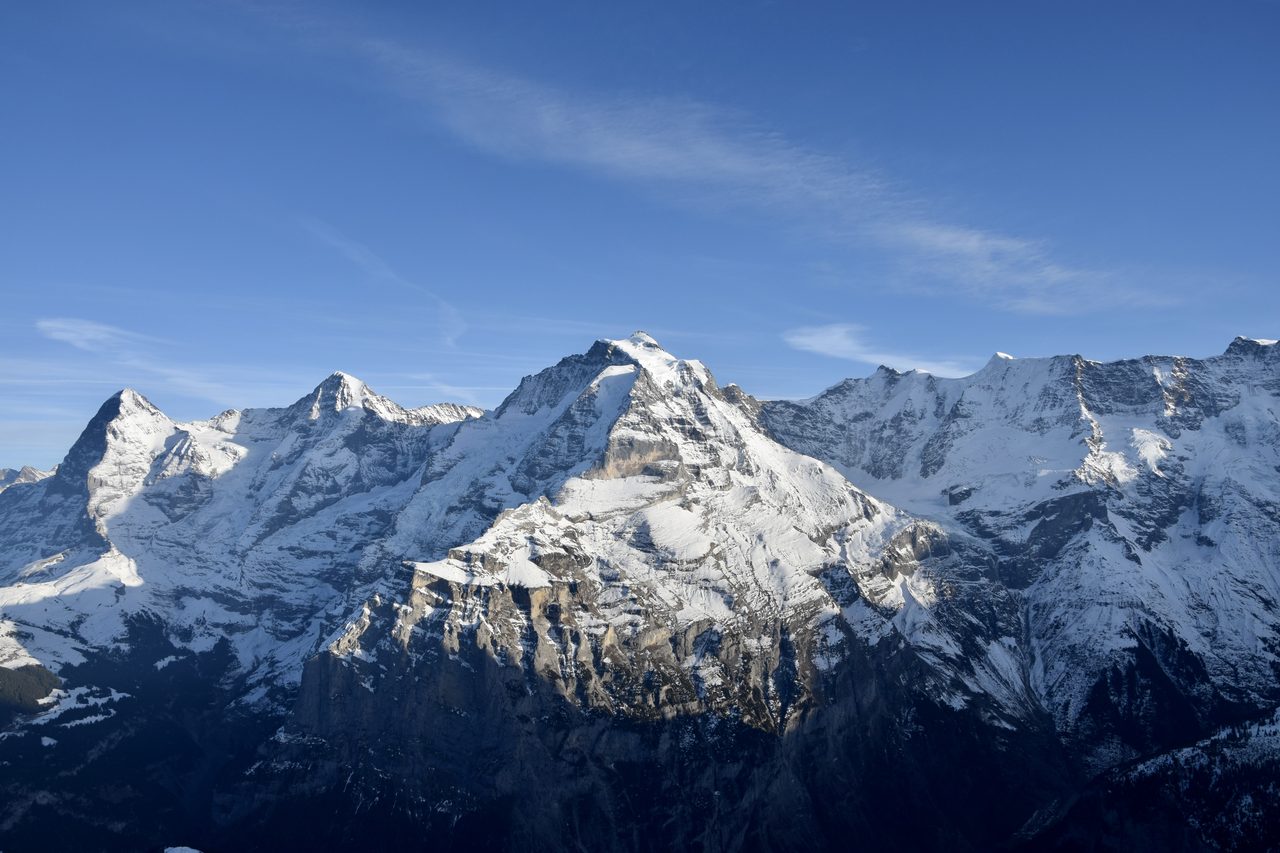
Why Jungfrau punishes underprepared climbers
Jungfrau is the slightly more demanding sibling of Mönch in the Bernese Oberland trio. The normal route is graded PD+ and is considered a classic alpine 4000m, but it is meaningfully more committing than Mönch: more vertical, a heavily crevassed glacier traverse, and a 45 degree snow ridge near the summit. Three reasons cause most turnarounds.
The first is timing. The Jungfraufirn glacier is heavily crevassed, with snow bridges that soften as the day warms. Parties who do not start by 3 AM from the Mönchsjochhütte (3650m / 11,975 ft) end up crossing thin bridges on the way down. The second is the 45 degree summit ridge: it is more exposed than technically difficult, but climbers who have not done sustained snow climbing in mountain boots get nervous on it. The third is altitude. Even with one night at the hut, sea-level climbers can feel the 4158m (13,642 ft) summit, especially on the descent when the day has been long.
The training demand profile
Jungfrau loads five systems. TTM trains four; the fifth is rope-and-glacier skill that comes from a guide or experienced partner.
Altitude reality check
At 4158m (13,642 ft) you have around 63 percent of sea-level oxygen at the summit. The standard trip is two nights of acclimatisation: arrive in Grindelwald or Lauterbrunnen, sleep above 1500m (4,900 ft), then take the Jungfraubahn to Jungfraujoch (3454m / 11,332 ft) and walk to the Mönchsjochhütte (3650m / 11,975 ft) for the second night. That gives the body two nights at progressively higher elevation before summit day - usually enough for most sea-level climbers. Climbers who feel altitude-sensitive should add a day-hike above 2500m (8,200 ft) in the valley before the train, or warm up on a lower 4000m like Mönch first. The deeper guide on this is in our altitude acclimatisation guide.
A weekly distribution that works
The polarised principle applies. A representative week, 10 weeks out from a Jungfrau attempt:
- Mon · easy 60 min Z2
- Tue · threshold or VO2max intervals, 4 x 4 min Z4-Z5
- Wed · rest or 30 min mobility
- Thu · Z2 hike, 2-3 hours, 700-1000m (2,300-3,300 ft) of vertical, light pack
- Fri · easy 45 min Z2 + eccentric strength
- Sat · long mountain day, 5-7 hours mixed Z2 with vertical
- Sun · 2-3 h Z2 on tired legs
Roughly 85 percent of weekly volume sits at Z1-Z2. The 7-9 hour rehearsal day lands 4-6 weeks before the trip. See heart rate zones for mountaineering for the rationale.
How TTM tunes the plan to Jungfrau
Four things the algorithm calibrates to your peak
- Fitness target · Reflects 7-8 hours at altitude with 850m (2,790 ft) of climb on glacier and steep snow.
- Vertical accumulation target · Around 18,000-22,000m (59,000-72,000 ft) across the build.
- Summit-day rehearsal · 7-9 hour single training day scheduled 4-6 weeks out, ideally with an early start.
- Descent eccentric load · Calibrated to 850m (2,790 ft) of glacier-and-snow descent.
Rope skills and steep-snow technique you bring from elsewhere. TTM does not teach crevasse rescue.
Common questions about training for Jungfrau
How do I build endurance for Jungfrau's 7-8 hour summit day?
Jungfrau's normal route from the Mönchsjochhütte (3650m / 11,975 ft) is 7-8 hours roundtrip with 850m (2,790 ft) of vertical gain to the summit at 4158m (13,642 ft).
What altitude work matters for Jungfrau (4158m / 13,642 ft)?
Real. At 4158m (13,642 ft) you have around 63 percent of sea-level oxygen.
Does a Jungfrau plan need to be personalised to me?
Yes, in five specific ways: your starting fitness, your summit date (where the taper lands), the vertical accumulation distributed across the build, one 7-9 hour rehearsal day placed 4-6 weeks out, and the descent eccentric load calibrated to 850m (2,790 ft) of glacier-and-ridge descent on tired legs.
Can I train for Jungfrau with a full-time job?
Yes, with one constraint: budget two days for the trip (hut stay required for the early start) plus a buffer day for acclimatisation. A representative workweek: 60 min Z2 Monday, threshold intervals Tuesday, easy 45 min Friday with eccentric strength, a long mountain day Saturday (5-7 hours with vertical), and a Z2 day Sunday on tired legs.
What does comprehensive Jungfrau prep actually cover?
Three layers. (1) Fitness: an aerobic engine for 7-8 hours at altitude with 850m (2,790 ft) of gain and the same descent, leg endurance, and one 7-9 hour rehearsal day.
What strength work does Jungfrau training need?
Targeted, leg-focused. The 850m (2,790 ft) descent on snow and ice with crampons on tired legs is the main strength demand.
Can I prepare for Jungfrau from sea level without alpine terrain?
Partly. The aerobic engine, leg endurance, descent eccentric load, and core work can all be trained anywhere with hills, stairs, or a treadmill on incline.
How is Jungfrau different from Mönch?
Same Jungfraujoch access, but Jungfrau is meaningfully more demanding. Vertical gain: 850m (2,790 ft) versus Mönch's 650m (2,130 ft).
Tools and deeper reading
Take this further
- Summit Readiness Simulator · Test if you are ready for Jungfrau today. Free, science-backed, 90 seconds.
- Training for Mönch · The friendlier sibling. Same access, less vertical, less crevasse exposure. Good warm-up.
- Training for Mont Blanc · The next step up. Much more vertical and a longer day, with a refuge approach instead of a train.
- Altitude Acclimatisation Guide · The climb-high-sleep-low rule, AMS warning signs, hut-stay strategies.
- Eccentric Descent Training · Why descent destroys quads, and the work that prevents it.
- The Science Behind TTM · The peer-reviewed research the adaptive algorithm is built on.
- Muscular Endurance for Mountaineering · The pillar guide on the quality that turns gym strength into legs that last a summit day. Pair with the free Muscular Endurance Calculator to score where you stand.
The takeaway
Jungfrau is rarely a fitness-only problem. It is a fitness, timing, and rope-comfort problem - one of the three classic Bernese 4000m peaks but the one that most rewards an early start and a competent rope team. The climbers who summit reliably are the ones who trained the engine, slept at the hut, and were on the glacier by 3 AM. The mountain finds the gap.