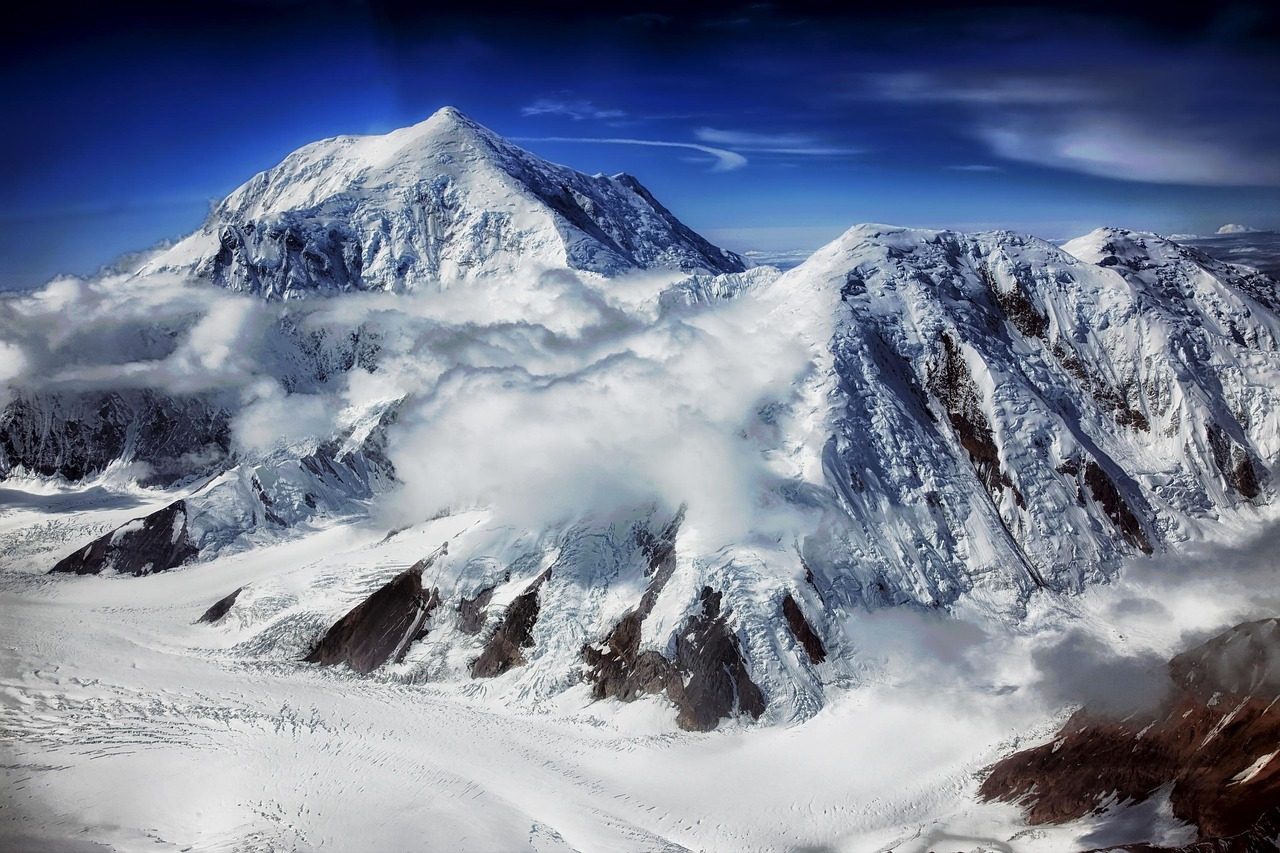
Why Mt Foraker humbles strong climbers
Mt Foraker (known to Athabaskan locals as Sultana, "the Wife") sits 22km west of Denali across the Kahiltna Glacier. Both share the Talkeetna basecamp flight. After that, the two peaks split: Denali is a logistical expedition on a well-trodden ridge with fixed lines and a small village of climbers at Camp 4. Foraker is a technical climb on a remote ridge with no fixed lines, no rescue infrastructure, and most years fewer than ten summits.
Three failure modes account for the 70-80 percent turnaround rate. First, the route's technical demand. The Sultana Ridge (Northeast Ridge) is graded Alaska Grade 3 to 4 - long sections of exposed snow and ice climbing at angles up to 60 degrees, several gendarmes and corniced traverses, and a summit plateau that goes on for hours. There is no easy line up Mt Foraker.
Second, weather. The Alaska Range produces some of the worst storms in mountaineering, and Foraker's ridge has very few sheltered camps. Climbers pinned on the ridge in marginal weather burn supplies fast.
Third, the absence of bailout. Denali's West Buttress is a series of staged camps. Once you commit to the Sultana Ridge above 4,000m, retreat is slow and serious. The training has to match that reality.
The training demand profile
Mt Foraker loads five physiological systems differently than a single-day Alpine peak. A real Mt Foraker plan trains all five.
Altitude reality check
Training builds the engine. Altitude and cold are their own thing - and on Mt Foraker they stack against you. At 5304m you have around 55 percent of sea-level oxygen, but the high latitude effectively makes that worse: barometric pressure at Mt Foraker is lower than at the same altitude in the Andes or Himalaya. Practically, three approaches stack for altitude: time on 4000m+ peaks in the months before (Mt Rainier, the Colorado 14ers, or Alaska sub-peaks all double as training), a hypoxic tent at home for the haematological adaptation, and the 14-18 day expedition format itself which carries most of the acclimatisation work. The most common mistake is compressing the schedule to save days. The mountain does not care about your flight home. The deeper guide is in our altitude acclimatisation guide.
A weekly distribution that works
The polarised principle applies, scaled up for Mt Foraker's expedition format: most of the week at low intensity, one hard session, one long mountain day, one back-to-back load. A representative week, 14 weeks out from a Mt Foraker trip:
- Mon · easy 60 min Z2
- Tue · threshold or VO2max intervals, 4 x 4 min Z4-Z5
- Wed · rest or 30 min mobility
- Thu · Z2 hike with weighted pack, 2-4 hours, 700-1000m vertical, 12-15 kg pack
- Fri · easy 45 min Z2 + eccentric strength (step-downs, weighted lunges)
- Sat · long mountain day, 5-7 hours mixed Z2 with vertical and pack
- Sun · 2.5-4 h Z2 on tired legs with pack (back-to-back loading)
Weekly volume runs higher than a Mont Blanc plan: 12-18 hours typical in Build phase. The single ≥10-hour rehearsal day with a real pack lands 4-6 weeks before the trip, not in the final taper. The deeper rationale is in our heart rate zones for mountaineering guide.
How TTM tunes the plan to Mt Foraker
What the algorithm calibrates to your peak
- Fitness target · Mt Foraker's fitness target reflects the 12 to 18 hour summit day at extreme altitude. Higher than a 4000m Alpine peak; the plan is engineered to hit it by your trip start date.
- Vertical accumulation target · The vertical accumulation target across the build is calibrated to the route's profile. Volume distributes progressively, with recovery weeks every 4th.
- Summit-day rehearsal · The Long Day Score is calibrated to Mt Foraker's 12 to 18 hour summit day. The plan schedules a real ≥10-hour single training day in the 6-week window before your trip, not earlier.
- Descent eccentric load · The Descent Readiness Score accounts for the summit-day descent plus the multi-day trek-out from base camp. Eccentric strength and downhill repeats are programmed in, not bolted on.
- Expedition loading pattern · Back-to-back heavy days build progressively across the plan, mirroring the daily cumulative pattern of a Mt Foraker expedition rotation. By trip day, daily weighted hiking is the easy part.
When you tell TTM your objective is Mt Foraker and your trip date, the plan is built backwards from there with all five demands engineered in. The expedition handles altitude. The training makes sure your engine arrives ready and your legs survive the descent.
Common questions about training for Mt Foraker
How do I build endurance for Mt Foraker's 12 to 18 hour summit day?
Mostly time at low intensity, scaled up. Mt Foraker's summit day is 12-18 hours and the expedition is 14-18 days of cumulative load, so the engine has to be deeper than a Mont Blanc engine.
What altitude work matters for Mt Foraker (5304m / 17,400 ft)?
At 5304m (17,400 ft) you have around 50% of sea-level oxygen, and on Mt Foraker altitude is decisive. Three strategies stack: time on 4000-5000m (13,100-16,400 ft) peaks in the months before (Cascades and Rockies peaks like Mt Rainier double as training); a hypoxic tent at home for the haematological half of adaptation; and respect the 14-18 day expedition format on the mountain itself.
Does a Mt Foraker plan need to be personalised to me?
Yes, in five specific ways: your starting fitness, your trip start date (the taper lands when you fly), the vertical accumulation distributed across the build, one 10+ hour rehearsal day placed 4-6 weeks out, and the expedition loading pattern that progressively builds back-to-back heavy days with weighted carries.
Can I train for Mt Foraker with a full-time job?
Yes, but it requires more weekly volume than a Mont Blanc plan and protection of weekend volume. Weekly volume in Build phase runs 12-18 hours, most of it low-intensity work that fits early mornings or evenings.
What does comprehensive Mt Foraker prep actually cover?
Five trainable demands. (1) An aerobic engine for 12-16 hour summit days at extreme altitude.
What strength and weighted-carry work does Mt Foraker training need?
Two priorities: eccentric leg strength and weighted-carry endurance. Eccentric work (weighted step-downs, slow-tempo split squats, controlled downhill repeats) builds descent resilience for summit day plus the multi-day trek-out.
Can I prepare for Mt Foraker from sea level without high-altitude terrain?
Yes, with one honest constraint: altitude adaptation has to come from pre-trip exposure plus the expedition itself, not from sea-level training alone. The aerobic engine, weighted carry endurance, descent eccentric load, and back-to-back fatigue tolerance can all be trained anywhere with hills, stairs, or a treadmill on incline.
How is Mt Foraker training different from a 4000m Alpine peak?
Three differences. First, expedition format: a 4000m Alpine peak is a single hard day; Mt Foraker is 14-18 days of cumulative loading where back-to-back days are the norm.
Tools and deeper reading
Take this further
- Summit Readiness Simulator · Test if you are ready for Mt Foraker today. Free, science-backed, 90 seconds. Enter your peak, your trip date, and your current fitness; get a readiness score.
- Altitude Acclimatisation Guide · The climb-high-sleep-low rule, the 300-500m (1,000-1,650 ft) per-night ceiling, AMS warning signs, and the three real acclimatisation strategies - critical for the 5304m (17,400 ft) summit.
- Eccentric Descent Training · Why the summit-day descent plus the multi-day trek-out grinds quads, and the specific eccentric work that protects them.
- Heart Rate Zones for Mountaineering · The polarised 85/15 distribution, why Z2 dominates, and how to pace 12-16 hour summit days at extreme altitude.
- The Science Behind TTM · Banister's model, polarised distribution, altitude physiology, eccentric load - the peer-reviewed research the adaptive algorithm is built on.
- Muscular Endurance for Mountaineering · The pillar guide on the quality that turns gym strength into legs that last a summit day. Pair with the free Muscular Endurance Calculator to score where you stand.
The takeaway
Mt Foraker is rarely a willpower problem. It is a technical-and-specificity problem combined. The climbers who summit reliably are the ones whose training matched the mountain's real demand profile: aerobic depth, sled-and-pack carry endurance, a long technical summit day, descent precision on tired legs at altitude, and the multi-week cold tolerance to absorb storms on a remote ridge with no shelter. Foraker finds the gap, and the consequences of finding it on the Sultana Ridge are larger than on a busier peak.