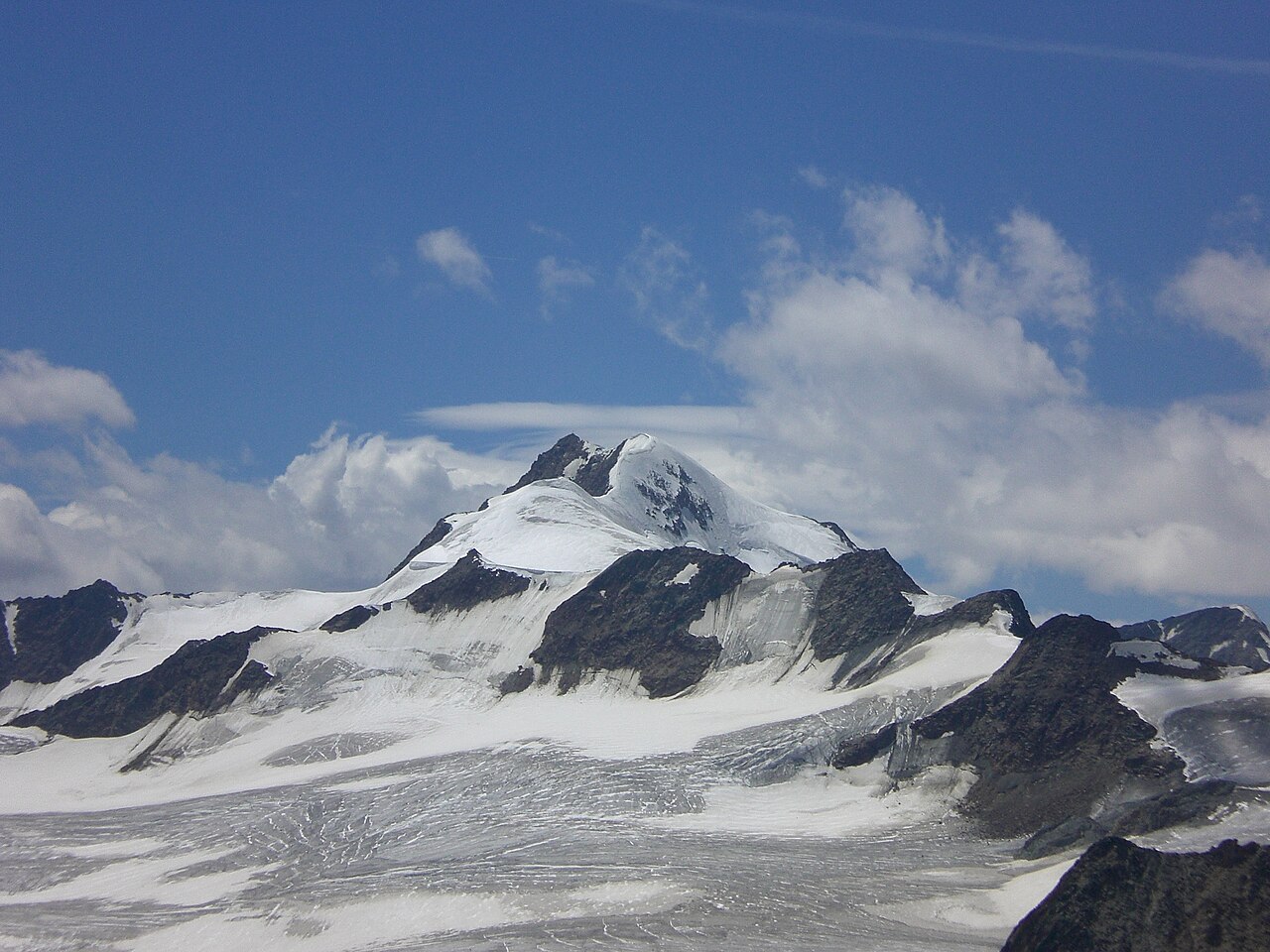
Why the Wildspitze punishes underprepared climbers
The Wildspitze sits at the heart of the Otztal Alps in Tyrol, and at 3,768m (12,362 ft) it is the second highest mountain in Austria and the highest of the Otztal Alps. The normal route starts from the Breslauer Hut (about 2,840m / 9,320 ft), crosses the Mitterkarferner glacier to the Mitterkarjoch, then takes the Taschachferner and the rocky south-west ridge to the south summit. It is a big glaciated ascent that demands full glacier equipment and a rope team for crevasse hazard, with an overall alpine grade of PD-. It is not a hard rock climb. It is a long, glaciated, crevassed day that finishes on a short rocky ridge near 3,800m.
Several failure modes turn climbers around. The first is the glacier itself. The Mitterkarferner and the Taschachferner carry real crevasse terrain, and a party that is slow or untrained on glacier travel, rope management, and steady pacing burns through time and reserves before the summit ridge even begins. The second is the rocky summit ridge. The short south-west ridge to the south summit is straightforward by alpine standards but it comes at the end of a long day, on tired legs, and climbers who have not rehearsed moving on rock when fatigued slow to a crawl. The third is altitude. At nearly 3,800m, arriving under-acclimatised turns a manageable route into a grinding one, and fast Otztal weather can shut the upper mountain down with little warning. The fourth is the sheer length of the day: the Wildspitze is a sustained glaciated ascent, and parties who trained for a short, sharp objective rather than a long aerobic one run out of engine long before the top.
None of this is bad luck. All of it is trainable.
Physical benchmarks to hit before the Wildspitze
The Wildspitze loads five physiological systems in different ways. A real preparation plan trains all five, not just the obvious one.
Altitude and terrain reality check
Training builds the engine. Altitude is its own thing. At 3,768m (12,362 ft) you have roughly two thirds of sea-level oxygen, and the only honest way to adapt is to spend time up there. No algorithm replaces that (Bartsch and Saltin, 2008). Practically, three options: spend time at 3000m+ (9,800 ft+) on lower Alpine peaks in the weeks before, use a hypoxic tent at home (real for haematological adaptation, less so for ventilatory), or build a 2 to 3 day acclimatisation rotation into the trip itself before the summit push. The deeper guide on this is in our altitude acclimatisation guide.
The 12-16 week the Wildspitze preparation timeline
The block runs backwards from your climb date. Five phases, each with a distinct target.
- Weeks 1-4 · Aerobic base. Build the deep engine that keeps a long day efficient.
- Weeks 5-8 · Base plus strength. Add eccentric leg strength and progressive weighted carries.
- Weeks 9-11 · Muscular endurance. Long days with vertical and a building pack.
- Weeks 12-13 · Peak simulation. A long mountain day near your summit-day length, 4-6 weeks out.
- Week 14 · Altitude and skills. Time high where you can, plus the specific mountain craft the Wildspitze needs.
- Weeks 15-16 · Taper. Volume drops; skills stay sharp; arrive fresh.
A weekly distribution that works
The polarised principle applies: most of the week at low intensity, one hard session, one long mountain day (Seiler and Kjerland, 2006). A representative week, 12 weeks out from a Wildspitze summit:
- Mon · easy 60 min Z2
- Tue · threshold intervals or VO2max, 4 x 4 min Z4-Z5
- Wed · rest or 30 min mobility
- Thu · long Z2 hike, 2 to 3 hours with 600 to 800m (2,000 to 2,600 ft) vertical, weighted pack
- Fri · easy 45 min Z2 + eccentric strength (step-downs, weighted lunges)
- Sat · long mountain day, 4 to 6 hours mixed Z2 with vertical and surges on steep ground
- Sun · 1.5 to 2.5h Z2 on tired legs (back-to-back loading)
Approximately 80% of weekly volume sits at Z1-Z2, with one hard intensity session and one back-to-back load, the 80/20 split the polarised model rests on. Vertical accumulates progressively across the block. The single 7+ hour rehearsal day lands 4 to 6 weeks before the trip, not in the final taper. The deeper rationale is in our heart rate zones for mountaineering guide.
Technical skills you must bring to the Wildspitze
TTM trains the body. the Wildspitze's glaciated route demands mountain craft - bring these or climb with a certified guide.
- Cramponing and ice-axe technique on moderate snow, up and down.
- Roped glacier travel and crevasse awareness.
- Self-arrest and secure movement on firm snow.
- Altitude judgement - turning around calmly when the body says so.
How TTM tunes the plan to the Wildspitze
Five things the algorithm calibrates to your peak
- Fitness target · The Wildspitze is set at a fitness target the model associates with completing the normal route safely with margin. Your plan is engineered to hit that number by your summit date.
- Vertical accumulation target · The plan distributes a sustained weekly vertical load progressively across the build, with recovery weeks every fourth week.
- Summit-day rehearsal · The Long Day Score is calibrated to the Wildspitze's long, glaciated summit day. The plan schedules a real 7+ hour single training day in the 6-week window before your trip, not earlier.
- Descent eccentric load · The Descent Readiness Score is calibrated to reversing the rocky summit ridge and the long glacier on tired legs. Eccentric strength and downhill repeats are programmed in, not bolted on.
- Hut-day + summit-day pattern · Back-to-back heavy days build progressively across the plan, mirroring the loaded walk-in plus summit pattern the Wildspitze actually demands.
When you tell TTM your objective is the Wildspitze and your summit date, the plan is built backwards from that date with all five demands engineered in. This is personalised mountaineering training: the algorithm recalibrates each Sunday based on the week you actually completed, so the plan stays honest as your real training data arrives. You do not need to assemble the pieces yourself. You can sanity-check the shape of a build against our peak progression planner, and read the reasoning behind it on the science page.
Common questions about training for the Wildspitze
How long is the Wildspitze summit day from the Breslauer Hut?
Plan on a long glaciated day from the Breslauer Hut (about 2,840m / 9,320 ft) to the 3,768m (12,362 ft) summit and back. The normal route crosses the Mitterkarferner glacier to the Mitterkarjoch, then takes the Taschachferner and the rocky south-west ridge to the south summit, with full glacier equipment and a rope team for crevasse hazard, overall grade PD-. The crevasse terrain and the short rocky summit ridge drive the timing more than raw distance, so the training priority is efficient glacier travel plus eccentric descent capacity for the return.
How hard is the Wildspitze normal route?
The Wildspitze normal route is graded PD- overall. It is glaciated, crossing the Mitterkarferner to the Mitterkarjoch and then the Taschachferner, with real crevasse terrain that needs full glacier equipment and a rope team, and it finishes on a short rocky south-west ridge to the south summit. It is not technically extreme, but it is a big glaciated ascent near 3,800m where rope-team competence and steady pacing matter more than raw rock difficulty.
What altitude work matters for the Wildspitze (3,768m / 12,362 ft)?
At 3,768m (12,362 ft) you have roughly two thirds of sea-level oxygen, and the only honest way to adapt is to spend time up there.
Does a Wildspitze training plan need to be personalised to me?
Yes, in five specific ways: your starting fitness (where the build begins), your summit date (where the taper lands), total vertical accumulation distributed across the block, one 7+ hour rehearsal day placed 4 to 6 weeks out, and the hut-day plus summit-day pattern built in progressively.
What strength work does Wildspitze training need?
Targeted, eccentric-heavy, minimal volume. The biggest strength priority is descent resilience: reversing the rocky summit ridge and the long glacier on tired quads is what cracks most parties at the end of summit day.
Tools and deeper reading
Take this further
- Peak Progression Planner · See where the Wildspitze sits in a full progression and the graded ways to build up to it, from a fast line to a cautious foundation.
- Summit Readiness Simulator · Test whether you are ready for the Wildspitze today. Free, science-backed, about 90 seconds.
- Training for Mountaineering · How TTM builds personalised mountaineering training plans backwards from your summit date, recalibrated each Sunday.
- Train for the Grossvenediger · A roped glacier walk at grade F, a gentler high glacier step in the Hohe Tauern.
- Train for the Grossglockner · The highest summit in Austria, an exposed PD+ glacier ridge and the natural step up.
- Altitude Acclimatisation Guide · The four acclimatisation training protocols and how to fit them into your build.
- Muscular Endurance for Mountaineering · The pillar guide on the quality that turns gym strength into legs that last a summit day. Pair with the free Muscular Endurance Calculator to score where you stand.
The takeaway
The Wildspitze is rarely a fitness problem in the abstract. It is a specificity problem. The climbers who summit reliably are the ones whose training matched the mountain's actual demand profile across all five dimensions: the aerobic engine, the vertical, the long glaciated summit-day character, the descent, and the back-to-back load. The athletes who turn around usually trained one or two of them well and ignored the others.