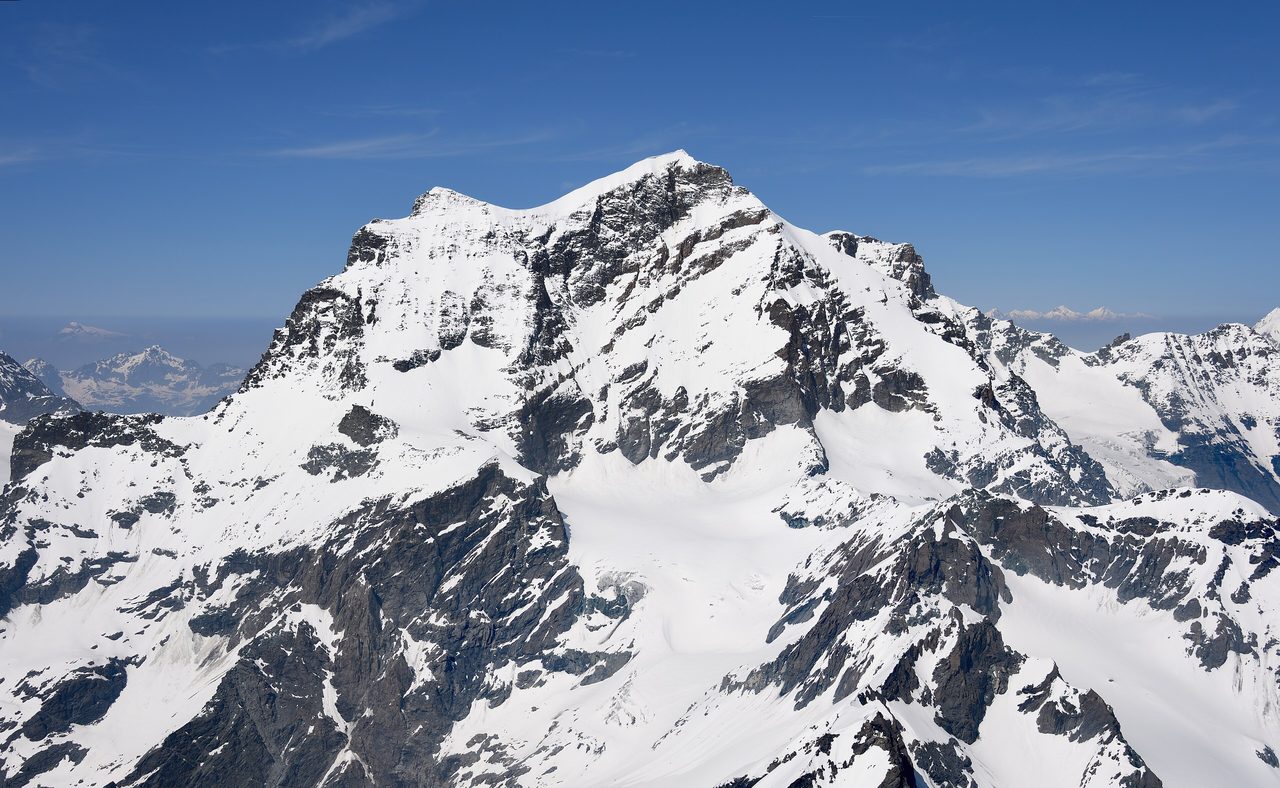
Training for the Grand Combin takes about 12 to 16 weeks, and it is more technical than most Alps 4000ers. At 4314m (14,154 ft) the Meitin ridge is graded AD III with a 10 to 12 hour summit day, so it demands a deep aerobic base, long-day endurance, and confident movement on steeper mixed ground.
Why Grand Combin punishes underprepared climbers
Important route note
The historic normal route via Le Corridor from the Cabane de Panossière is no longer recommended. Rising rates of serac collapse have produced repeated fatalities. The current recommended normal route is the Arête du Meitin from the Cabane de Valsorey, rated AD III° - more technical but far less exposed to objective hazard. This guide is written for the Arête du Meitin.
Grand Combin is less travelled than Mont Blanc or Monte Rosa, partly because the historic normal route has become too dangerous and partly because the Arête du Meitin asks for more alpine skill than the average 4000m peak. Climbers who turn around usually fail on one of three things.
The first is technical mismatch: climbers who trained for a PD glacier walk and arrive on AD III° terrain are out of their depth. The second is fitness underestimation: the 5-hour summit climb from Valsorey, plus the approach the previous day, plus the descent, adds up to 10-12 hours of total moving across two days. The third is altitude under-preparation: a single night at the Valsorey hut (3030m / 9,941 ft) is rarely enough for sea-level climbers to summit 4314m (14,154 ft) reliably.
Physical benchmarks to hit before Grand Combin
Grand Combin loads five systems. TTM trains four; the fifth is alpine skill at AD grade plus objective-hazard literacy.
Altitude and terrain reality check
At 4314m (14,154 ft) you have around 61 percent of sea-level oxygen. The Cabane de Valsorey at 3030m (9,941 ft) is a useful intermediate exposure but not enough alone for most sea-level climbers. Strategies that work: warm up on a lower 4000m peak in the same region (Mont Vélan, Allalinhorn) before the Grand Combin attempt, or stay in Bourg-Saint-Pierre several days early and tag high day-hikes. Acclimatisation pays off proportionally above 4000m. The deeper guide on this is in our altitude acclimatisation guide.
How long does it take to train for the Grand Combin?
The block runs backwards from your climb date. Five phases, each with a distinct target.
- Weeks 1-4 · Aerobic base. Build the deep engine that keeps a long day efficient.
- Weeks 5-8 · Base plus strength. Add eccentric leg strength and progressive weighted carries.
- Weeks 9-11 · Muscular endurance. Long days with vertical and a building pack.
- Weeks 12-13 · Peak simulation. A long mountain day near your summit-day length, 4-6 weeks out.
- Week 14 · Altitude and skills. Time high where you can, plus the specific mountain craft Grand Combin needs.
- Weeks 15-16 · Taper. Volume drops; skills stay sharp; arrive fresh.
A weekly distribution that works
The polarised principle applies. A representative week, 12 weeks out from a Grand Combin attempt:
- Mon · easy 60 min Z2
- Tue · threshold or VO2max intervals, 4 x 4 min Z4-Z5
- Wed · rest or 30 min mobility
- Thu · Z2 hike, 2-3 hours, 700-1000m (2,300-3,300 ft) of vertical, light pack
- Fri · easy 45 min Z2 + eccentric strength
- Sat · long mountain day, 5-7 hours mixed Z2 with vertical, ideally with scrambling
- Sun · 2-3 h Z2 on tired legs OR a multi-pitch rock day in mountain boots
Roughly 85 percent of weekly volume at Z1-Z2. 8-10 hour rehearsal day 4-6 weeks before the trip. See heart rate zones for mountaineering for the rationale.
Technical skills you must bring to Grand Combin
TTM trains the body. Grand Combin's glaciated route demands mountain craft - bring these or climb with a certified guide.
- Cramponing and ice-axe technique on moderate snow, up and down.
- Roped glacier travel and crevasse awareness.
- Self-arrest and secure movement on firm snow.
- Altitude judgement - turning around calmly when the body says so.
How TTM tunes the plan to Grand Combin
Four things the algorithm calibrates to your peak
- Fitness target · Reflects 10-12 hours of total movement at AD grade with significant vertical. Calibrated higher than a PD 4000m plan.
- Vertical accumulation target · Around 22,000-26,000m (72,000-85,000 ft) across the build, with scrambling work where possible.
- Summit-day rehearsal · 8-10 hour single training day on scrambling terrain, 4-6 weeks out.
- Descent eccentric load · Calibrated to 1284m (4,213 ft) of mixed-terrain descent.
The AD-grade alpine skill and the route-judgement (avoid the Corridor, commit to the Arête du Meitin) you bring from a guide or experienced partner. TTM does not teach alpine route judgement.
Common questions about training for Grand Combin
How do I build endurance for Grand Combin's 10-12 hour summit day?
Grand Combin via the Arête du Meitin from Cabane de Valsorey (3030m / 9,941 ft) is 5 hours up to the summit and a similar descent, plus the approach to the hut the previous afternoon - around 10-12 hours of total moving across two days.
What altitude work matters for Grand Combin (4314m / 14,154 ft)?
Real. At 4314m (14,154 ft) you have around 61 percent of sea-level oxygen at the summit.
Does a Grand Combin plan need to be personalised to me?
Yes, in five specific ways: your starting fitness, your summit date (where the taper lands), the vertical accumulation distributed across the build, one 8-10 hour rehearsal day on scrambling terrain placed 4-6 weeks out, and the descent eccentric load calibrated to 1284m (4,213 ft) of mixed-terrain descent on tired legs.
Can I train for Grand Combin with a full-time job?
Yes, with two constraints: the trip is 3-4 days (approach + hut + summit + return), and the AD grade asks for more alpine skill than a generic 4000m plan accounts for.
What does comprehensive Grand Combin prep actually cover?
Three layers. (1) Fitness: an aerobic engine for 10-12 hours of total movement across the trip, vertical efficiency for 1284m (4,213 ft) of summit-day climb, eccentric descent strength, and one 8-10 hour rehearsal day.
What strength work does Grand Combin training need?
Targeted, with a small grip/core component. The biggest priority is descent resilience on mixed terrain: 1284m (4,213 ft) of descent on tired legs across rock and snow with crampons.
Can I prepare for Grand Combin from sea level without alpine terrain?
Partly. The aerobic engine, leg endurance, descent eccentric load, and core/grip work can all be trained anywhere with hills, stairs, or a treadmill on incline.
Is the Le Corridor route still the normal route?
No. Le Corridor was historically the normal route from the Cabane de Panossière, but rising rates of serac collapse have led to repeated accidents and fatalities.
Tools and deeper reading
Take this further
- Summit Readiness Simulator · Test if you are ready for Grand Combin today.
- Training for Monte Rosa · The natural peer comparison at PD+/AD- with similar engine demand.
- Training for the Matterhorn · The technical peer at AD with sustained rock; useful comparison for the skill demands.
- Altitude Acclimatisation Guide · The climb-high-sleep-low rule and AMS warning signs.
- Eccentric Descent Training · Why descent destroys quads, and the work that prevents it.
- The Science Behind TTM · The peer-reviewed research the adaptive algorithm is built on.
- Muscular Endurance for Mountaineering · The pillar guide on the quality that turns gym strength into legs that last a summit day. Pair with the free Muscular Endurance Calculator to score where you stand.
The takeaway
Grand Combin is rarely a fitness-only problem. It is a fitness + alpine-skill + route-judgement problem. The climbers who summit reliably are the ones who trained the engine for two days of movement, brought AD III° alpine skill from prior trips, and made the right call about which line to climb. The mountain finds the gap.