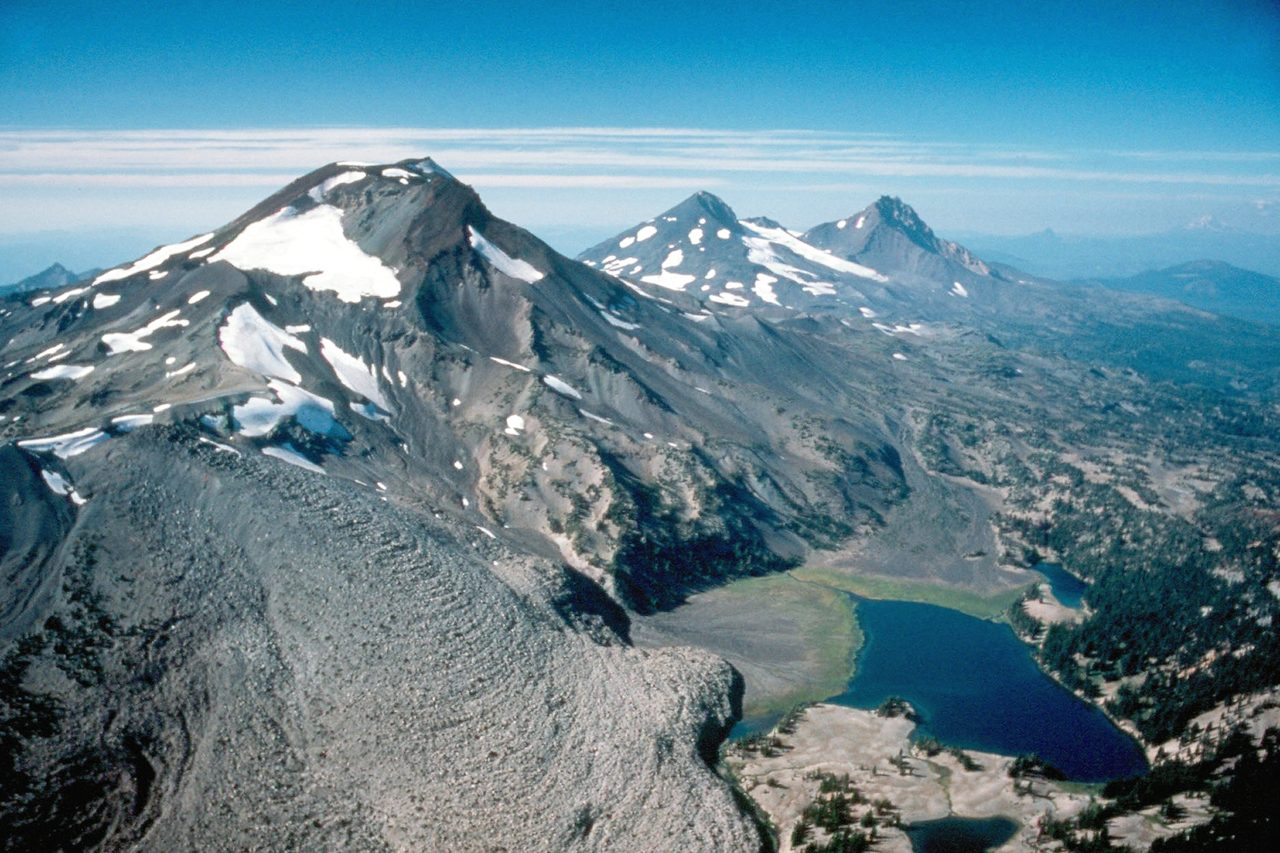
Why South Sister is the right first volcano
South Sister is Oregon's third-highest peak at 3,158m (10,358 ft), sitting in the Three Sisters Wilderness inside the Deschutes National Forest. The standard South Ridge route from the Devils Lake trailhead is a steep, sustained, non-technical hike-up volcano. In typical summer conditions it does not require a rope, crampons, or an ice axe; the route skirts the west edge of Lewis Glacier rather than crossing it. That makes South Sister the canonical first volcano summit in the Pacific Northwest, and a useful stepping stone between long hiking and full glaciated mountaineering.
"Non-technical" is not "easy." The round trip is roughly 19km (12 miles) with around 1,615m (5,300 ft) of gain. Most of the climbing is steep, with a final summit cone of loose scree that is unrelenting on the way up and brutal on the way down. The mountain rewards trained legs and an honest aerobic engine; it punishes people who treat it as a long day hike.
Physical benchmarks to hit before South Sister
South Sister loads four physiological systems differently. A real preparation plan trains all four, not just the obvious one.
Altitude and terrain reality check
South Sister reaches 3,159 m (10,364 ft). That is high enough to feel, but altitude is rarely the deciding factor here; terrain, weather and the long day matter more. The honest levers are steady acclimatisation where the height warrants it and the mountain sense the terrain demands. Train the body, and respect the weather window and the descent.
The 12-16 week South Sister preparation timeline
The block runs backwards from your climb date. Five phases, each with a distinct target.
- Weeks 1-4 · Aerobic base. Build the deep engine that keeps a long day efficient.
- Weeks 5-8 · Base plus strength. Add eccentric leg strength and progressive weighted carries.
- Weeks 9-11 · Muscular endurance. Long days with vertical and a building pack.
- Weeks 12-13 · Peak simulation. A long mountain day near your summit-day length, 4-6 weeks out.
- Week 14 · Altitude and skills. Time high where you can, plus the mountain craft South Sister needs.
- Weeks 15-16 · Taper. Volume drops; skills stay sharp; arrive fresh.
A weekly distribution that works
The polarised principle applies: most of the week at low intensity, one hard session, one long mountain day. A representative week, 8 weeks out from a South Sister summit:
- Mon · easy 50 min Z2
- Tue · threshold intervals or VO2max, 4 x 4 min Z4-Z5
- Wed · rest or 30 min mobility
- Thu · long Z2 hike, 2 to 3 hours with 500 to 800m (1,640 to 2,600 ft) vertical, weighted pack
- Fri · easy 40 min Z2 + eccentric strength (step-downs, weighted lunges)
- Sat · long mountain day, 3 to 5 hours mixed Z2 with vertical
- Sun · 1.5 to 2 hour Z2 on tired legs (back-to-back loading)
Roughly 80 percent of weekly volume sits at Z1 to Z2, with one hard intensity session and one back-to-back load. Vertical accumulates progressively across the block. The single 7+ hour rehearsal day lands 3 to 5 weeks before the trip, not in the final taper. The deeper rationale is in our heart rate zones for mountaineering guide and the broader how to train for mountaineering primer.
Technical skills you must bring to South Sister
TTM trains the body. South Sister's exposed, often loose ground demands mountain craft - bring these or go with a guide.
- Confident exposed scrambling, up and down.
- Route-finding to hold the easiest line under fatigue.
- Steady movement on loose or broken rock.
- Descent control on tired legs.
How TTM tunes the plan to South Sister
Five things the algorithm calibrates to your peak
- Fitness target · South Sister is calibrated to a Mountain Fitness threshold our model associates with finishing the South Ridge safely with margin. Your plan is engineered to hit that number by your summit date.
- Vertical accumulation target · approximately 14,000 to 18,000m (46,000 to 59,000 ft) of climbing across the build. The plan distributes that volume progressively week by week, with recovery weeks every 4th.
- Summit-day rehearsal · the Long Day Score is calibrated to South Sister's 8 to 12 hour summit day. The plan schedules a real 7+ hour single training day in the 5-week window before your trip, not earlier.
- Descent readiness · the Descent Readiness Score is calibrated to the roughly 1,615m (5,300 ft) descent down loose ground. Eccentric strength and downhill repeats are programmed in, not bolted on.
- Weekly adaptation · the plan recalibrates every Sunday based on the previous week of training. Not real-time, not daily. One careful update per week, the way adaptation actually works (Banister et al., 1975).
When you tell TTM your objective is South Sister and your summit date, the plan is built backwards from that date with all five demands engineered in. You do not need to assemble the pieces yourself. Curious what your fitness needs to look like? Try the summit simulator.
Where it sits in the progression
It helps to be honest about what South Sister is, and is not, on the route most people climb it.
It is a sustained 8 to 12 hour day on a real volcano above 3,000m (9,800 ft), with steep terrain, loose ground, and weather that can turn. It is not an alpine climb in the technical sense for the summer South Ridge: no glacier crossing, no rope work, no crampon footwork on hard ice. Compared with Mt Adams, the next step up the Cascades ladder, South Sister is shorter, lower, and non-glaciated. Compared with Mt Hood, it is far less technical, with no steep summit ice and no rope-and-axe commitment. Mt St Helens via Monitor Ridge sits in a similar bracket: another non-glaciated, steep, scree-laden Cascade volcano you can train for the same way.
Used well, South Sister is a stepping stone. It is the mountain that tells you whether your aerobic base, your pack-loaded legs, and your descent quads are ready for a bigger objective. The athletes who summit it cleanly are the ones who trained for the demands, not the ones who showed up fit "in general".
Season and permits
South Sister is typically climbable from late June into early October, with the snow-free season for the South Ridge usually settling in from late July onward. Early-season attempts in June and July can encounter substantial snow on the upper mountain; an ice axe and self-arrest practice become sensible if you are going early. Late September into October brings shorter days, colder nights, and the risk of a first snowfall on the summit cone. Check the latest conditions with the Deschutes National Forest before the trip.
A Central Cascades Wilderness Permit is required for day use from the Devils Lake / Wickiup Plains (South Sister) trailhead between June 15 and October 15. Permits are issued on a quota basis via Recreation.gov, with a portion released roughly 10 days in advance and a portion 2 days in advance. Weekends in July and August sell out fast; plan ahead. A separate parking fee or Northwest Forest Pass also applies at the trailhead. Verify current rules and fees at Recreation.gov before booking your trip; the permit system is the real friction point for most parties, not the climb itself.
Common questions about training for South Sister
How long is summit day on South Sister?
Plan for approximately 8 to 12 hours round trip from the Devils Lake trailhead, depending on conditions, snow coverage, and party speed. The route is roughly 19km (12 miles) round trip with about 1,615m (5,300 ft) of gain.
Is South Sister a technical climb?
No. The standard South Ridge route from Devils Lake skirts the west edge of Lewis Glacier and climbs a non-glaciated ridge to the summit.
Do I need a permit to climb South Sister?
Yes. The Central Cascades Wilderness Permit System applies from June 15 to October 15 each year.
How does South Sister compare to Mt Adams or Mt Hood for training?
South Sister is a clear step below Mt Adams and Mt Hood in technical commitment. The standard South Ridge route is non-glaciated and non-technical in summer.
Does altitude matter at 3,158m (10,358 ft)?
It matters, but mildly. At 3,158m (10,358 ft) you are above the threshold where unacclimatised sea-level climbers may start to feel meaningful performance loss and early AMS symptoms (headache, mild nausea, slower pace).
What weekly distribution works for a South Sister build?
Polarised. Around 80 percent of weekly volume at Z1 to Z2, one hard intensity session, and one long mountain day.
Tools and deeper reading
Take this further
- Peak Progression Planner · See where South Sister sits in a full progression and the graded paths around it, from a fast line to a cautious foundation.
- Summit Readiness Simulator · Test whether you are ready for South Sister today. Free, science-backed, about 90 seconds.
- Training for Mountaineering · How TTM builds personalised mountaineering training plans backwards from your summit date, recalibrated each Sunday.
- Train for Mt St Helens · A non-glaciated Cascades scramble, the natural pre-mountaineering start.
- Train for Mt Adams · A big Cascades volcano and a first taste of glacier travel.
- Altitude Acclimatisation Guide · The four acclimatisation training protocols and how to fit them into your build.
- Muscular Endurance for Mountaineering · The pillar guide on the quality that turns gym strength into legs that last a summit day. Pair with the free Muscular Endurance Calculator to score where you stand.
The takeaway
South Sister rewards specificity. It is not a fitness problem in the abstract: it is a steep, non-technical volcano with a punishing scree descent and a permit you cannot fake your way around. The climbers who summit it cleanly are the ones whose training matched the demand profile across the four dimensions that matter here: aerobic engine, vertical accumulation, descent eccentric load, and summit-day rehearsal. Done right, it is the cleanest entry point in the Cascades for a first volcano, and a real test before stepping up to Mt Adams, Mt Hood, or the bigger glaciated peaks.