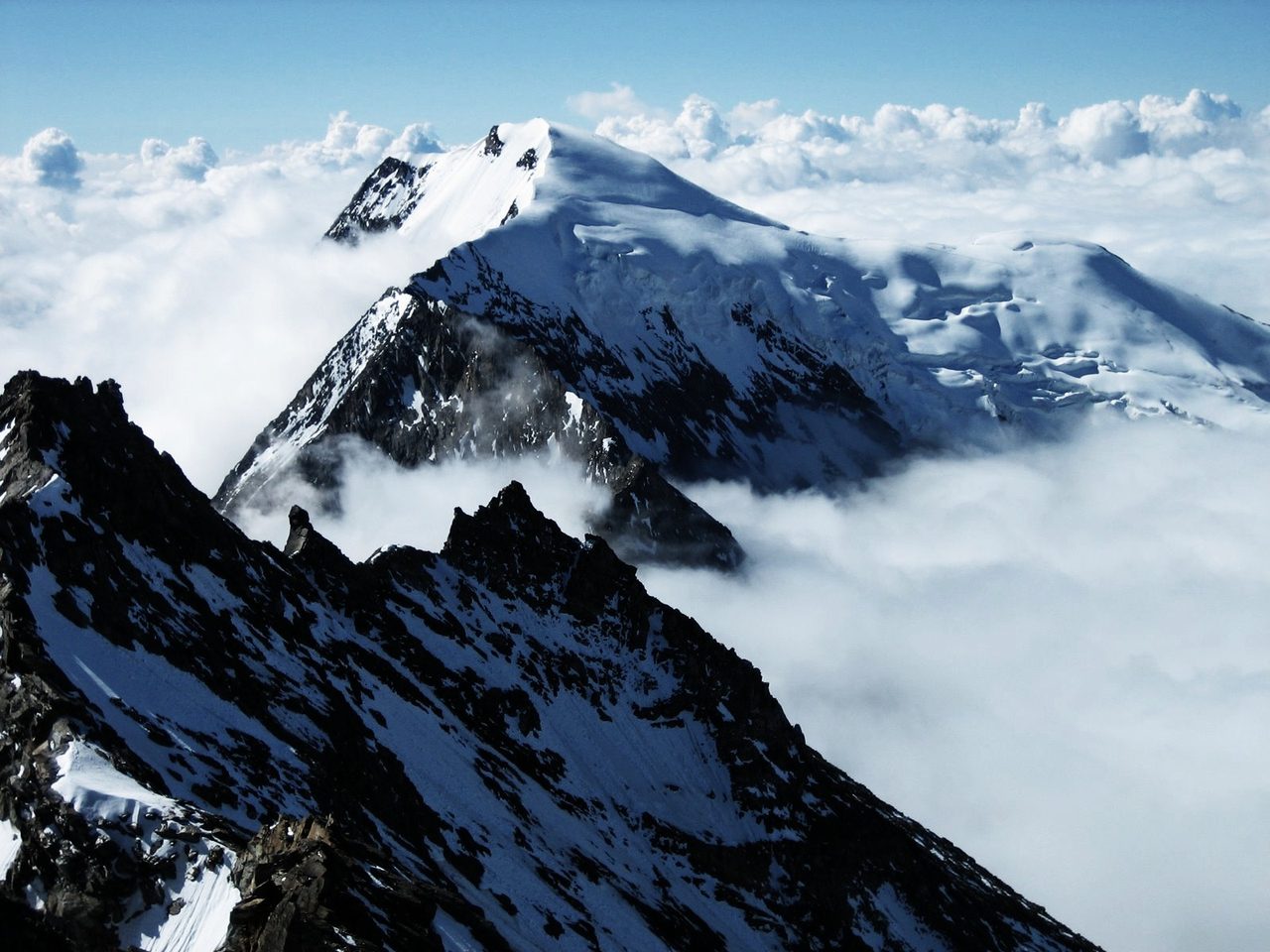
Training for Weissmies takes about 12 to 16 weeks. A cable car reaches the edge of the Triftgletscher and the route is graded F to PD, which makes it a common Saas Valley first 4000er, but at 4017m (13,179 ft) the altitude, the glacier travel, and the longer summit day still demand an aerobic base and basic glacier skills.
Why Weissmies is the canonical Saas-Valley starter 4,000er
Weissmies sits on the main alpine chain above the Saas Valley, between Saas-Grund and Saas-Fee. At 4,017m (13,179 ft) it is one of the lower peaks in the 4,000er bracket, which is exactly why the British Mountaineering Council lists it as a beginner-friendly objective: lower altitude makes acclimatisation easier, and the normal route is a snow climb without rock difficulty (BMC, 2024). IFMGA guides routinely use it as a first 4,000er, often paired with neighbouring Lagginhorn (4,010m / 13,156 ft) for a two-peak weekend out of the Weissmieshütte (Explore-Share IFMGA, 2024).
If Breithorn is the Zermatt-side textbook starter, Weissmies is the Saas-Valley counterpart. Same idea, different valley, slightly longer day, and a noticeably lower crowd profile than the Klein Matterhorn cable-car traffic. It is also a natural next step after Allalinhorn for athletes already familiar with the Saas-Fee side and wanting to broaden their Alps experience without raising the technical difficulty.
Physical benchmarks to hit before Weissmies
Weissmies loads six physiological systems. The total volume sits between Breithorn and a more committed objective like Gran Paradiso. The kinds of work that matter are the same, but the dose is larger than a 2 to 3 hour Breithorn day.
Altitude and terrain reality check
Weissmies reaches 4,013 m (13,166 ft). At that height you have roughly 60 percent of sea-level oxygen, enough that a rushed ascent bites, so arrive with some recent time up high. The honest levers are steady acclimatisation where the height warrants it and the mountain sense the terrain demands. Train the body, and respect the weather window and the descent.
How long does it take to train for Weissmies?
The block runs backwards from your climb date. Five phases, each with a distinct target.
- Weeks 1-4 · Aerobic base. Build the deep engine that keeps a long day efficient.
- Weeks 5-8 · Base plus strength. Add eccentric leg strength and progressive weighted carries.
- Weeks 9-11 · Muscular endurance. Long days with vertical and a building pack.
- Weeks 12-13 · Peak simulation. A long mountain day near your summit-day length, 4-6 weeks out.
- Week 14 · Altitude and skills. Time high where you can, plus the mountain craft Weissmies needs.
- Weeks 15-16 · Taper. Volume drops; skills stay sharp; arrive fresh.
A weekly distribution that works
The polarised principle still applies: most of the week at low intensity, one hard session, one longer mountain day. A representative week, around 6 to 8 weeks out:
- Mon · easy 45 to 60 min Z2
- Tue · threshold or VO2max intervals, short and focused
- Wed · rest or 30 min mobility
- Thu · Z2 hike, 90 to 120 min with 500 to 700m (1,640 to 2,300 ft) vertical, weighted pack
- Fri · easy 30 to 45 min Z2 + eccentric strength
- Sat · long mountain day, 4 to 6 hours mixed Z2 with vertical and loaded descent
- Sun · easy 60 to 90 min Z2 on tired legs
Roughly 80 percent of weekly volume sits at Z1 to Z2, with one hard intensity session and a back-to-back weekend load. Rationale in our heart rate zones for mountaineering guide. For the altitude piece, work through our acclimatisation training guide in the final 4 to 6 weeks.
Technical skills you must bring to Weissmies
TTM trains the body. Weissmies's glaciated route demands mountain craft - bring these or climb with a certified guide.
- Cramponing and ice-axe technique on moderate snow, up and down.
- Roped glacier travel and crevasse awareness.
- Self-arrest and secure movement on firm snow.
- Altitude judgement - turning around calmly when the body says so.
How TTM tunes the plan to Weissmies
Five things the algorithm calibrates to your peak
- Fitness target · Weissmies sits between Breithorn and Gran Paradiso on Mountain Fitness target. The summit day is longer than Breithorn but still a single push, so the target is set accordingly.
- Vertical accumulation target · A cumulative climbing volume that prepares you for a 900m (2,950 ft) loaded summit-day climb and descent, distributed progressively with a recovery week every fourth week.
- Summit-day rehearsal · The Long Day Score is calibrated to roughly 6 to 7 hours of mountain time, scheduled in the 4-week window before your trip, not earlier.
- Descent eccentric load · Eccentric strength and downhill work are programmed from week 5, so the long glacier descent is not your first time loading the quads downhill under fatigue.
- Altitude prompt · The plan flags an honest altitude conversation in the final block. The Hohsaas lift skips most natural acclimatisation, and sea-level fitness alone does not cover it.
When you tell TTM your objective is Weissmies and your summit date, the plan is built backwards from that date with the six demands engineered in. The algorithm recalibrates weekly, every Sunday, based on what you trained and how you recovered (Banister et al., 1975). If you are weighing several Saas-Valley peaks, run our summit simulator to see how the demand profile shifts.
The peak in one paragraph
Weissmies stands above Saas-Grund in the Valais canton of Switzerland, part of the Pennine Alps. The normal route uses the Hohsaas cable car from Saas-Grund to roughly 3,098m (10,164 ft), then crosses the Triftgletscher and follows the northwest flank to the summit at 4,017m (13,179 ft). The grade is F (Facile) to PD- on the alpine scale, with snow slopes to around 40 degrees and real crevasse hazard on the glacier. A more committed PD line follows the south ridge from the Almageller Hut, and a classic traverse links Weissmies with Lagginhorn for parties with the conditioning to handle a back-to-back 4,000er weekend. First ascent in 1855; long-established starter peak ever since.
Season, lift, and hut logistics
The standard alpine season for Weissmies runs from early July to mid-September. Earlier in July often has better snow on the Triftgletscher; by late August crevasses are more open and the route can become more technical. The Saas Valley sits on the main alpine chain and weather can change quickly, so plan a flexible three to four day window around your summit date.
Access is via the Hohsaas cable car from Saas-Grund, which lifts you to roughly 3,098m (10,164 ft) at the edge of the Triftgletscher. The lift runs in summer, typically late June through September, but dates and first-lift times shift year to year. Confirm directly with Saas-Grund Bergbahnen before booking your trip.
Most parties on the normal route spend the night before at the Weissmieshütte (2,726m / 8,944 ft) above Saas-Grund, run by the Swiss Alpine Club (SAC), or at the Hohsaas hut higher up. The south-ridge variant from the Almageller Hut (2,894m / 9,495 ft) is a longer and more committed day, generally graded PD-. Book either hut well in advance for summer weekends; the SAC reservation system is the standard channel.
Common questions about training for Weissmies
Is Weissmies a good first 4,000er in the Alps?
Yes. Weissmies (4,017m / 13,179 ft) is one of five peaks the British Mountaineering Council highlights as a good starter 4,000er, and IFMGA guides routinely use it as a first-4,000er objective.
How much training do I need for Weissmies?
A reasonable arc is 10 to 14 weeks of structured aerobic training with around 80 percent of volume at Z1 to Z2, one weekly intensity session, one long mountain day with vertical, and a weekly eccentric strength session for the descent.
How does Weissmies compare to Breithorn as a first 4,000er?
Breithorn is the textbook easiest 4,000er, with a 2 to 3 hour summit day from the Klein Matterhorn cable car. Weissmies is a step up in volume but not in technical difficulty.
What is the Hohsaas lift and how does it shape the route?
Hohsaas is the upper station of the cable-car system above Saas-Grund, at roughly 3,098m (10,164 ft). It sits effectively at the edge of the Triftgletscher and is the standard start point for the normal Weissmies route.
When is the best season to climb Weissmies?
The standard alpine season runs from early July to mid-September. Earlier in July often has better snow on the glacier; by late August crevasses are more open and the route can become more technical.
Do I need a guide or rope-team experience for Weissmies?
Even though the normal route is graded F to PD, it crosses the Triftgletscher with real crevasse hazard. You need rope-team movement, crevasse rescue skills, harness, crampons, and ice axe at minimum.
Tools and deeper reading
Take this further
- Peak Progression Planner · See where the Weissmies sits in a full progression and the graded paths around it, from a fast line to a cautious foundation.
- Summit Readiness Simulator · Test whether you are ready for the Weissmies today. Free, science-backed, about 90 seconds.
- Training for Mountaineering · How TTM builds personalised mountaineering training plans backwards from your summit date, recalibrated each Sunday.
- Train for the Allalinhorn · A lift-accessed first 4,000er from Saas-Fee at grade F.
- Train for the Bishorn · A BMC-cited beginner 4,000er with a full hut walk-in at grade F.
- Altitude Acclimatisation Guide · The four acclimatisation training protocols and how to fit them into your build.
- Muscular Endurance for Mountaineering · The pillar guide on the quality that turns gym strength into legs that last a summit day. Pair with the free Muscular Endurance Calculator to score where you stand.
The takeaway
Weissmies is a great first or second 4,000er because the route is simple, the altitude is forgiving, and the Saas-Valley logistics are clean. It is a real mountain day because the glacier is real and the descent is long. Train the engine, train the descent, refresh your glacier skills, respect the altitude. The full personalised plan starts with our mountaineering training framework.