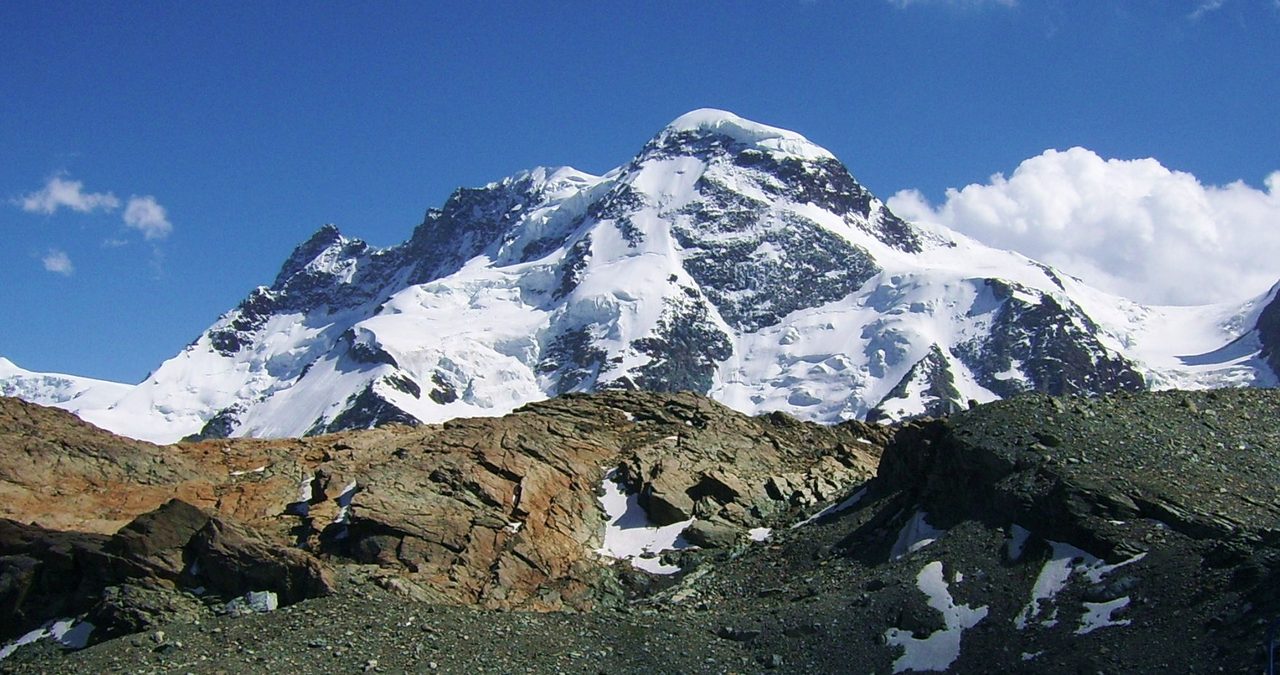
The Breithorn is one of the most accessible 4000m (13,100 ft) peaks: a cable car leaves only a short, easy-graded climb to the 4164m (13,661 ft) summit, which makes it a popular first 4000er. What still needs training is the altitude, the glacier travel, and the descent on tired legs, so arrive with an aerobic base and basic crampon and rope skills.
Why the Breithorn punishes underprepared climbers
The Western Breithorn is widely called the easiest 4,000er in the Alps, and on paper it earns the label. The standard route from the Klein Matterhorn cable car is graded F (Facile) and the summit is roughly 2 to 3 hours of climbing from the lift. That reputation is exactly why it gets people in trouble.
Three common failure modes show up. First, altitude: the cable car lifts climbers to about 3,883m (12,740 ft) in minutes, and the summit at 4,164m (13,661 ft) is often a person's first time above 4,000m. Headaches, nausea, and loss of pace turn an easy day into a turnaround. Second, weather: the route is exposed glacier and a Pennine Alps weather flip can swing visibility, wind, and temperature within an hour. Third, the deceptive ease itself. Parties show up undertrained because the grade is F, and discover that "easy at altitude on a glacier" is still a real mountain day.
Physical benchmarks to hit before the Breithorn
The Breithorn loads five physiological systems. The total volume is lower than for a long Alpine objective, but the kinds of work that matter are the same.
Altitude and terrain reality check
This is the section most Breithorn write-ups skip and most parties wish they had read. The Klein Matterhorn cable car deposits you at approximately 3,883m (12,740 ft) in a few minutes. If you arrived in Zermatt that morning from a sea-level home, your body has done nothing to prepare for altitude that already feels significant. Three options help: arrive in the Zermatt area two or three days early and sleep and walk at altitude before you climb; build a short rotation on lower Alpine peaks at 3,000m+ (9,800 ft+) in the weeks before; or use a hypoxic tent at home for haematological adaptation. Climb-high-sleep-low rules and AMS warning signs are in our altitude acclimatisation guide.
How long does it take to train for the Breithorn?
The block runs backwards from your climb date. Five phases, each with a distinct target.
- Weeks 1-4 · Aerobic base. Build the deep engine that keeps a long day efficient.
- Weeks 5-8 · Base plus strength. Add eccentric leg strength and progressive weighted carries.
- Weeks 9-11 · Muscular endurance. Long days with vertical and a building pack.
- Weeks 12-13 · Peak simulation. A long mountain day near your summit-day length, 4-6 weeks out.
- Week 14 · Altitude and skills. Time high where you can, plus the specific mountain craft the Breithorn needs.
- Weeks 15-16 · Taper. Volume drops; skills stay sharp; arrive fresh.
A weekly distribution that works
The polarised principle still applies: most of the week at low intensity, one hard session, one longer mountain day. A representative week, around 6 to 8 weeks out:
- Mon · easy 45 to 60 min Z2
- Tue · threshold or VO2max intervals, short and focused
- Wed · rest or 30 min mobility
- Thu · Z2 hike, 90 to 120 min with 400 to 600m (1,300 to 1,970 ft) vertical, weighted pack
- Fri · easy 30 to 45 min Z2 + eccentric strength
- Sat · long mountain day, 3 to 5 hours mixed Z2 with vertical
- Sun · easy 60 to 90 min Z2 on tired legs
Roughly 80 percent of weekly volume sits at Z1 to Z2, with one hard intensity session and a back-to-back weekend load. Rationale in our heart rate zones for mountaineering guide.
Technical skills you must bring to the Breithorn
TTM trains the body. the Breithorn's glaciated route demands mountain craft - bring these or climb with a certified guide.
- Cramponing and ice-axe technique on moderate snow, up and down.
- Roped glacier travel and crevasse awareness.
- Self-arrest and secure movement on firm snow.
- Altitude judgement - turning around calmly when the body says so.
How TTM tunes the plan to the Breithorn
Five things the algorithm calibrates to your peak
- Fitness target · The Breithorn is set to a lower Mountain Fitness target than the long 4,000ers, because the summit day is shorter and the limiting factor is altitude readiness, not duration.
- Vertical accumulation target · A more modest cumulative climbing volume across the build, distributed progressively, with a recovery week every fourth week.
- Summit-day rehearsal · The Long Day Score is calibrated to roughly 4 to 5 hours of mountain time, scheduled in the 4-week window before your trip, not earlier.
- Descent eccentric load · Eccentric strength and downhill work are programmed in from week 5, so the descent is not your first time loading the quads downhill under fatigue.
- Altitude prompt · Because the cable car skips natural acclimatisation, the plan flags an honest altitude conversation in the final block rather than pretending sea-level fitness covers it.
When you tell TTM your objective is the Breithorn and your summit date, the plan is built backwards from that date with the five demands engineered in. The algorithm recalibrates weekly, every Sunday, based on what you trained and how you recovered (Banister et al., 1975).
Common questions about training for the Breithorn
Is the Breithorn really the easiest 4,000er in the Alps?
Technically, yes. The standard southwest slope route from the Klein Matterhorn cable car is graded F (Facile, easy) in the alpine grading system, the summit is roughly 2 to 3 hours of climbing from the top of the lift, and there is no rock climbing on the route.
How much training do I need for the Breithorn?
Less than for a long Alpine objective, but more than people assume. A reasonable arc is 8 to 12 weeks of structured aerobic training with around 80 percent of volume at Z1 to Z2, one weekly intensity session, one long mountain day with vertical, and a weekly eccentric strength session for descent resilience.
What altitude work matters for the Breithorn (4,164m / 13,661 ft)?
This is the part most parties underestimate. The Klein Matterhorn cable car lifts you to roughly 3,883m (12,740 ft) in minutes, with no acclimatisation.
Do I need a guide or rope-team experience for the Breithorn?
Even though the route is graded F (easy), it crosses an active glacier with crevasse hazard. You need rope-team movement, crevasse rescue skills, harness, crampons, and ice axe at minimum. If you do not already have that competence, hire a qualified guide or take a glacier travel course before the trip. The technical simplicity of the climbing does not remove the glacier risk.
Tools and deeper reading
Take this further
- Peak Progression Planner · See where the Breithorn sits in a full progression and the graded paths around it, from a fast line to a cautious foundation.
- Summit Readiness Simulator · Test whether you are ready for the Breithorn today. Free, science-backed, about 90 seconds.
- Training for Mountaineering · How TTM builds personalised mountaineering training plans backwards from your summit date, recalibrated each Sunday.
- Train for the Allalinhorn · A lift-accessed first 4,000er from Saas-Fee at grade F.
- Train for Gran Paradiso · The friendliest first independent 4,000er, a glacier walk at grade F+.
- Altitude Acclimatisation Guide · The four acclimatisation training protocols and how to fit them into your build.
- Muscular Endurance for Mountaineering · The pillar guide on the quality that turns gym strength into legs that last a summit day. Pair with the free Muscular Endurance Calculator to score where you stand.
The takeaway
The Breithorn is a great first 4,000er because the climbing is simple. It is a hard first 4,000er because the cable car removes natural acclimatisation. Train the engine, train the descent, refresh your glacier skills, respect the altitude.