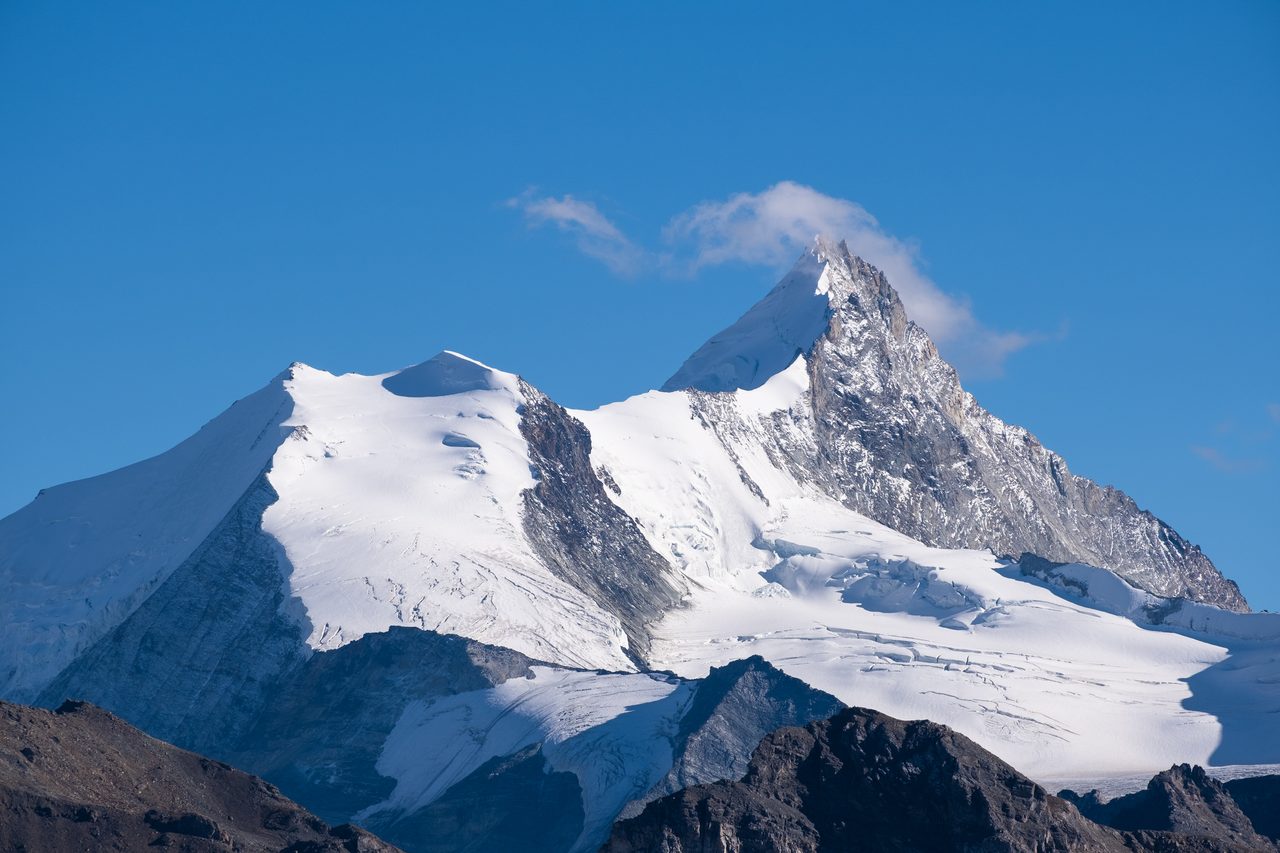
Training for the Bishorn takes about 12 to 16 weeks. One of the canonical beginner 4000ers, it still means a long hut walk-in from Zinal and a glaciated summit day at 4153m (13,625 ft) with a long descent on tired legs, so it demands a real aerobic base, long-day endurance, and basic glacier skills.
Why the Bishorn is a real day, not an easy day
The Bishorn (4,153m / 13,625 ft) sits in the Pennine Alps above the Val d'Anniviers and the village of Zinal, in the canton of Valais, Switzerland. The British Mountaineering Council names it as their favourite 4,000m peak for beginners, and Swiss alpine sources commonly group it with the Breithorn, the Allalinhorn, the Strahlhorn, and the Alphubel as the technically easy 4,000ers of the Alps. The normal route is the NW Flank from the Cabane de Tracuit (3,256m / 10,683 ft), graded F (Facile): broad glacier slopes on the Turtmanngletscher up to the summit, with no technical climbing. It is also known historically as "le 4000 des Dames", for its association with early women's alpine ascents in the Valais.
The problem with calling it "easy" is that the grade describes the climbing, not the day. There is no lift. You walk in from Zinal to the Cabane de Tracuit on day one, roughly 5 hours and around 1,600m (5,250 ft) of vertical under a full pack. You sleep at the hut, start before dawn, cross the glacier, summit, and descend back, typically 5 to 6 hours round trip. Then you walk back down to Zinal. Parties that treat the Bishorn as a short outing because the grade is F tend to discover the demand on the walk-out, not the summit ridge.
Physical benchmarks to hit before the Bishorn
The Bishorn loads five physiological systems in different ways. A real preparation plan trains all five, not just the obvious one.
The peak in one paragraph
The Bishorn (4,153m / 13,625 ft) is the northernmost summit of the Weisshorn group, a snow dome above the Turtmann glacier in Valais. The standard line is the NW Flank from the Cabane de Tracuit (3,256m / 10,683 ft), reached by a 5-hour hut walk from Zinal. The route is glaciated throughout but graded F with no technical climbing; summit day from the hut is typically 5 to 6 hours round trip. It is the natural step up after a lift-served 4,000er like the Breithorn for climbers who want a more committing, more independent day, and a reasonable prerequisite before its bigger neighbour, the Weisshorn.
Altitude and terrain reality check
Training builds the engine. Altitude is its own thing. At 4,153m (13,625 ft) the altitude is meaningful, and you reach it after accumulating 1,600m (5,250 ft) of vertical the day before, which compounds the cost. Sea-level fitness will not substitute for time spent up high. Three options work: time at 3000m+ (9,800 ft+) on lower Alpine peaks in the weeks before, a hypoxic tent at home for haematological adaptation, or a 2 to 3 day acclimatisation rotation built into the trip itself before moving up to the hut. The deeper guide is in altitude acclimatisation guide.
Typical season, hut logistics, and glacier safety
The Bishorn season runs from roughly mid-July through early September, when the glacier is in summer condition and the Cabane de Tracuit is open and staffed. Book the hut well in advance through the Swiss Alpine Club (cabane-tracuit.ch); weekend slots in high season fill out months ahead. Plan to arrive by mid-afternoon to allow for the long walk-in, an evening meal, and an early alpine start the next morning.
How long does it take to train for the Bishorn?
The block runs backwards from your climb date. Five phases, each with a distinct target.
- Weeks 1-4 · Aerobic base. Build the deep engine that keeps a long day efficient.
- Weeks 5-8 · Base plus strength. Add eccentric leg strength and progressive weighted carries.
- Weeks 9-11 · Muscular endurance. Long days with vertical and a building pack.
- Weeks 12-13 · Peak simulation. A long mountain day near your summit-day length, 4-6 weeks out.
- Week 14 · Altitude and skills. Time high where you can, plus the specific mountain craft the Bishorn needs.
- Weeks 15-16 · Taper. Volume drops; skills stay sharp; arrive fresh.
A weekly distribution that works
The polarised principle applies: most of the week at low intensity, one hard session, one back-to-back weekend. A representative week, 12 weeks out from a Bishorn summit attempt:
- Mon · easy 60 min Z2
- Tue · threshold or VO2max intervals, 4 x 4 min Z4 to Z5
- Wed · rest or 30 min mobility
- Thu · long Z2 hike, 2 to 3 hours with 600 to 800m (2,000 to 2,600 ft) vertical, weighted pack
- Fri · easy 45 min Z2 plus eccentric strength (step-downs, weighted lunges)
- Sat · long mountain day, 4 to 6 hours Z2 with full pack and meaningful vertical
- Sun · 1.5 to 2.5 hour Z2 on tired legs (back-to-back loading)
Roughly 80 percent of weekly volume sits at Z1 to Z2, with one hard session and one back-to-back load that mirrors the Bishorn's two-day pattern (Seiler and Kjerland, 2006).
Technical skills you must bring to the Bishorn
TTM trains the body. the Bishorn's glaciated route demands mountain craft - bring these or climb with a certified guide.
- Cramponing and ice-axe technique on moderate snow, up and down.
- Roped glacier travel and crevasse awareness.
- Self-arrest and secure movement on firm snow.
- Altitude judgement - turning around calmly when the body says so.
How TTM tunes the plan to the Bishorn
Five things the algorithm calibrates to your peak
- Fitness target · The Bishorn target sits in the entry-level 4,000er band of our model, reflecting an F-grade route on a sustained two-day commitment. The plan is engineered to hit that number by your summit date.
- Vertical accumulation · The plan distributes weekly vertical progressively, with a recovery week every fourth week, building toward the demand of the 1,600m (5,250 ft) hut day with a full pack.
- Back-to-back day pattern · The plan schedules a weekend back-to-back deliberately, so that the Bishorn's two-day shape is rehearsed in training rather than discovered on the walk-out.
- Descent eccentric load · Eccentric strength and downhill repeats are programmed in directly, calibrated to the long total descent across both days.
- Glacier-day timing · The plan biases weekend volume toward real terrain in the final block, so you arrive used to time on snow under load rather than treadmill familiarity.
When you tell TTM your objective is the Bishorn and your summit date, the plan is built backwards from that date with all five demands engineered in. Every Sunday the algorithm recalibrates based on what you actually completed and reshapes the next week. The adaptation is weekly, not real-time, which matches how training stress consolidates into fitness across recovery (Banister et al., 1975).
Common questions about training for the Bishorn
How fit do I need to be for the Bishorn (4,153m / 13,625 ft)?
Fitter than most people guess. The Bishorn is graded F (Facile) with no technical climbing on its normal route, and the BMC names it as one of the best 4,000m peaks in the Alps for beginners.
Is the Bishorn a good first 4000m peak?
It is one of the canonical first 4,000ers in the Alps. The BMC lists it as their favourite beginner 4,000m peak, and Swiss alpine sources commonly group it with the Breithorn, Allalinhorn, Strahlhorn, and Alphubel as technically straightforward summits.
How is the Bishorn different from the Breithorn or Allalinhorn?
Two things make the Bishorn more demanding than the most popular beginner 4,000ers. First, no lift: you climb the full vertical from Zinal to the Cabane de Tracuit (3,256m / 10,683 ft) on foot, around 1,600m (5,250 ft) of gain.
What altitude work matters for the Bishorn?
At 4,153m (13,625 ft) the altitude is meaningful, especially given how much vertical you accumulate on the hut day. The most useful preparation is real exposure: a 2 to 3 day acclimatisation rotation in the Alps on a lower peak in the days before, or training time at 3000m+ (9,800 ft+) in the weeks before.
How long is a typical Bishorn summit day from the hut?
From the Cabane de Tracuit, fit parties typically reach the summit in 2.5 to 3 hours.
Can I prepare for the Bishorn from a sea-level country?
Yes, with one honest constraint: altitude exposure has to come from the trip itself, not training. The aerobic engine, vertical accumulation, descent eccentric load, and back-to-back day fatigue tolerance can all be trained anywhere with hills, stairs, or a treadmill on incline.
How does TTM adapt the plan when life gets in the way?
Every Sunday the algorithm recalibrates based on the data you have logged that week: completed sessions, perceived effort, sleep, and any wearable signals you connect. The next week is reshaped to keep you trending toward your summit-day target without overreaching. The adaptation is weekly, not real-time, which matches how training adaptation actually consolidates (Banister et al., 1975).
Tools and deeper reading
Take this further
- Summit Readiness Simulator · Test if you are ready for the Bishorn today. Free, science-backed, 90 seconds. Enter your peak, your summit date, and your current fitness; get a readiness score.
- Training for Mountaineering · How TTM builds personalised mountaineering training plans backwards from your summit date, with weekly recalibration based on what you actually trained.
- Train for the Breithorn · The natural lift-served prerequisite. A reasonable first 4,000er before stepping up to the Bishorn for a more independent day.
- Train for the Weisshorn · The Bishorn's bigger neighbour and the obvious step up after a successful Bishorn ascent: a long AD ridge day at 4,506m (14,783 ft).
- Train for Monte Rosa · An alternative path forward into longer high-altitude objectives in the Pennine Alps.
- Altitude Acclimatisation Guide · The climb-high-sleep-low rule, the 300 to 500m (1,000 to 1,650 ft) per-night ceiling, AMS warning signs, and the three real acclimatisation strategies.
- Muscular Endurance for Mountaineering · The pillar guide on the quality that turns gym strength into legs that last a summit day. Pair with the free Muscular Endurance Calculator to score where you stand.
The takeaway
The Bishorn is one of the most welcoming 4,000ers in the Alps, and it still asks for serious preparation. The grade is F. The day is not. Climbers who turn the Bishorn into a good day are the ones who trained the hut walk-in as much as the summit push, who built descent strength before the trip, and who did not mistake "beginner-friendly" for "no training required".