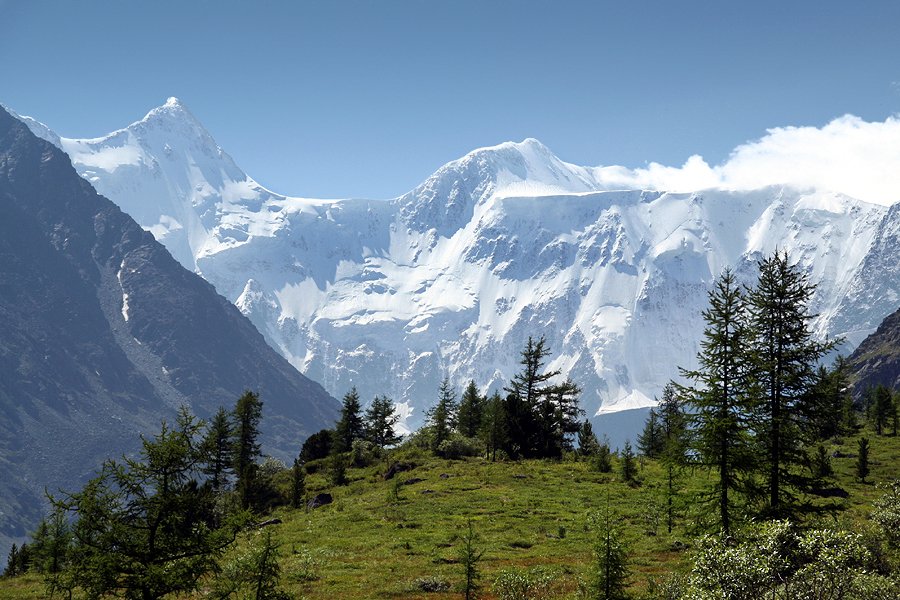
Why Belukha is an expedition, not a trek
Belukha is not a walk-up. The standard lines - via the Delone Pass and the Tomsk saddle, or comparable routes - involve roped glacier travel, crevasse hazard, and steep snow and ice slopes (the Delone Pass alone is a sustained pitch of around 45 degrees). Overall it sits at roughly Russian grade 3A, or Alpine PD+ to AD - real mountaineering, not scrambling.
Two things compound the technical demand. The first is remoteness: the approach through the Altai is multi-day and far from help, so self-sufficiency and margin matter. The second is the mix of altitude and objective hazard - crevasses, weather, and steep ground - that has to be managed while tired, deep in a wilderness range. Fitness here is not about speed for its own sake; it is the reserve that lets you handle technical ground and hazard safely, far from rescue.
Physical benchmarks to hit before Mount Belukha
Belukha loads the full mountaineering picture: aerobic base, steep-snow technique, glacier skills, altitude, and multi-day expedition endurance. A real plan trains all of it.
Altitude and terrain reality check
At 4,506 m altitude is real but not the defining challenge for a fit, acclimatising climber - you have around 58 percent of sea-level oxygen. What defines Belukha is the combination of remoteness, glaciated technical ground, and self-sufficiency far from rescue.
The expedition starts with a multi-day approach through the Altai to a base and high camps, then climbs glaciated terrain - crevasses, steep snow, and passes such as the Delone - to the summit. It is a committing wilderness objective where weather and conditions can pin you down. The standard season is July to August, the short Altai summer, when the snow and glaciers are in their most reliable state.
The 16-22 week Mount Belukha preparation timeline
The block runs backwards from your climb date. Each phase has a distinct target.
- Weeks 1-5 · Aerobic base. Build low-intensity volume, 5-7+ hours per week at Zone 1-2. The engine the expedition rides on.
- Weeks 6-10 · Base plus strength and load. Add strength (squat, deadlift, calf and eccentric work) and load-carrying; begin steep booted climbing. Long day grows to 4-5 hours with real vertical.
- Weeks 11-16 · Muscular endurance and steep-ground specificity. Long loaded days with 1,000-1,400 m of gain, steep snow or stair work in crampons, and downclimbing. Volume 8-11 hours per week.
- Weeks 17-19 · Peak simulation. One or two long, loaded, steep days back-to-back to rehearse expedition rhythm.
- Weeks 20-21 · Skills and consolidation. Time on real alpine terrain - glacier travel, front-pointing, crevasse rescue - or a guided refresher.
- Week 22 · Taper. Volume drops 30-50 percent. Arrive fresh and ready for a committing range.
A weekly distribution that works
The polarised principle applies: most volume easy, a little hard, one long day. A representative week, 12 weeks out from a Mount Belukha attempt:
- Mon · easy 60 min Z2
- Tue · threshold or VO2max intervals, 4 x 4 min Z4-Z5
- Wed · rest or 30 min mobility
- Thu · Z2 hike with weighted pack, 2-3 hours, 700-1000m (2,300-3,300 ft) of vertical
- Fri · easy 45 min Z2 + eccentric strength (step-downs, weighted lunges)
- Sat · long mountain day building toward 10 hours, mixed Z2 with vertical and progressive pack weight
- Sun · 2-3 h Z2 on tired legs (back-to-back loading, lighter pack)
Roughly 85 percent of weekly volume sits at Z1-Z2, with one hard intensity session and one back-to-back load. The single long rehearsal day lands 4-6 weeks before the trip, not in the taper.
Technical skills you must bring to Mount Belukha
TTM trains the body; Belukha demands real mountain craft on top of it. The standard routes are around Russian grade 3A (Alpine PD+ to AD) - glaciated, with steep snow and ice and crevasse hazard, in a remote range. Bring these skills, or join a guided expedition with an IFMGA/Russian Mountaineering Federation guide.
- Steep snow and ice. Confident front-pointing and self-arrest on sustained slopes to around 45 degrees.
- Glacier travel and crevasse rescue. Roped movement on crevassed glacier and the ability to run a rescue.
- Expedition self-sufficiency. Camp craft, load management and decision-making far from rescue.
- Objective-hazard and weather judgement. Reading crevasse, avalanche and weather danger in a committing range.
If glaciated mountaineering or expedition travel is new, build that experience on less remote objectives first and climb Belukha as a guided expedition. TTM's plan builds the engine and the reserve; the mountain demands genuine alpine competence on top.
How TTM tunes the plan to Mount Belukha
What the algorithm calibrates to your peak
- Fitness target · Belukha is set to the high Mountain Fitness threshold for a remote glaciated expedition - your plan is engineered to reach it by departure.
- Vertical and load target · calibrated to load-carrying and a technical summit day, built progressively with recovery weeks.
- Steep-ground and descent load · calf, front-pointing and eccentric strength are programmed in for the steep snow and ice.
- Back-to-back rehearsal · the plan schedules consecutive hard days to mirror the expedition's approach-and-summit rhythm.
- Skills flag · the plan is explicit that glacier, ice and self-sufficiency skills - or a guided expedition - are prerequisites the fitness plan sits on top of.
Common questions about training for Mount Belukha
How hard is Belukha?
It is a genuine glaciated mountaineering expedition - around Russian grade 3A, or Alpine PD+ to AD - with roped glacier travel, crevasse hazard, and steep snow and ice to about 45 degrees, in a remote range. It is a serious objective, not a trek.
Do I need technical skills?
Yes. You need steep snow and ice technique, glacier travel and crevasse rescue, and expedition self-sufficiency. Most climbers do Belukha as a guided expedition. Bring the skills or bring a guided team - do not learn them here.
How fit do I need to be?
Very fit. This is a multi-day expedition with load carries and a technical summit day, far from support. A deep Zone 2 base, front-pointing endurance, and load-carrying capacity are the core preparation.
Is altitude the main challenge?
No. At 4,506 m altitude is real but not the defining factor for a fit, acclimatising climber. The defining challenges are the remoteness, the glaciated technical ground, and self-sufficiency far from rescue.
When is the best season?
July to August, the short Altai summer, when the snow and glaciers are in their most reliable condition.
Is Belukha a good first glaciated peak?
Not really. It is remote and committing, so a sensible progression is to climb a glaciated Alpine PD/AD summit first, then approach Belukha as a step up with real glacier experience already in the bank.
Tools and deeper reading
Take this further
- Summit Readiness Simulator · Test if you are ready for Mount Belukha today. Free, 60 seconds.
- Altitude Acclimatisation Guide · Climb-high-sleep-low and AMS warning signs.
- Eccentric Descent Training · The work that stops the late-day quad breakdown.
- Heart Rate Zones for Mountaineering · The polarised 85/15 distribution.
- The Science Behind TTM · The peer-reviewed research behind the algorithm.
The takeaway
Belukha is the roof of Siberia and a real expedition: remote, glaciated, and committing. Fitness here is not about speed for its own sake - it is the reserve that lets you handle steep snow, crevasses and altitude safely, days from the nearest road. Build a deep engine and the steep-ground strength, bring genuine glacier competence or a guided team, and the high point of the Altai becomes a wilderness summit to remember rather than an objective that overwhelms you.