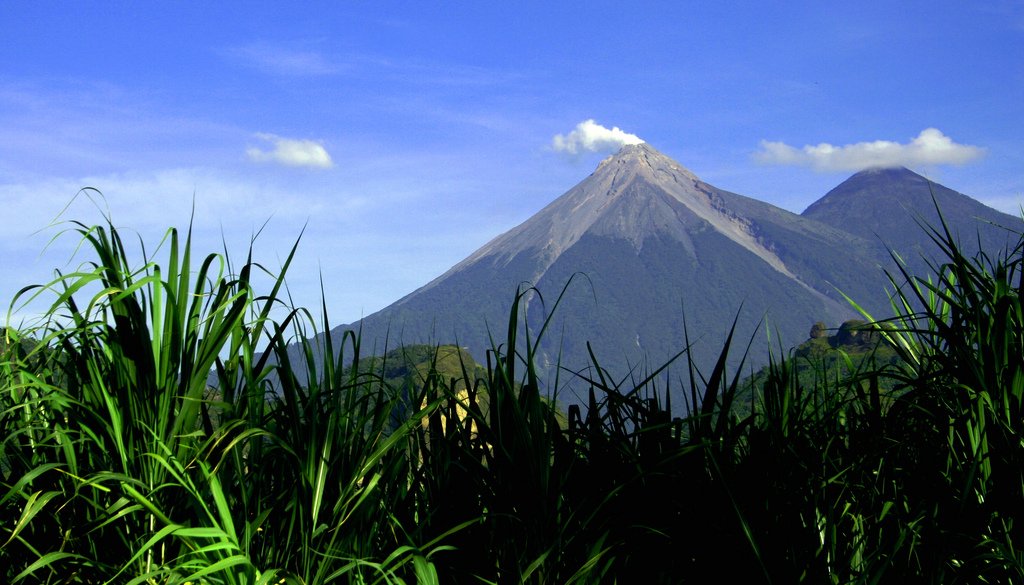
Why Acatenango is harder than the photos suggest
The climb to the high camp gains roughly 1,500 m over some 5-6 kilometres - a sustained, unrelenting uphill on loose volcanic ground, often with a heavy pack of overnight gear. That is a serious day's effort for anyone not conditioned for steep sustained climbing, and it is where most of the suffering happens.
Two things then compound it. The altitude - camp sits around 3,600 m and the summit is just under 4,000 m - is high enough to slow you and, for some, to bring on mild altitude sickness after a fast ascent from low elevation. And the cold: the summit push is a pre-dawn start in near-freezing temperatures at altitude, on tired legs, to catch sunrise and Fuego. None of that is technical, but together they turn a 'hike' into a real objective.
Physical benchmarks to hit before Acatenango
Acatenango is a steep, sustained climb at altitude with a cold summit push. A good plan trains the uphill engine, load-carrying, and comfort moving cold and high.
Altitude and terrain reality check
Altitude is a genuine factor here, mostly because of how fast you gain it. Many climbers start the day near 2,400 m and camp at ~3,600 m, then summit just under 4,000 m the next morning - a big, quick altitude gain from a low base. At the summit you have around 63 percent of sea-level oxygen. Arriving fit and hydrated, and pacing the climb, keeps altitude sickness at bay for most people.
The route is a steep, non-technical trail on volcanic terrain - loose soil, sand and rock - to a high camp with a direct view of Volcán de Fuego, then a short but cold pre-dawn scramble to the Acatenango summit for sunrise. The reliable dry season is roughly November to April; the wet season brings mud, cloud and cold, which makes the same trail considerably harder.
The 8-12 week Acatenango preparation timeline
The block runs backwards from your climb date. Each phase has a distinct target.
- Weeks 1-3 · Aerobic base. 3-5 hours per week at Zone 1-2, building comfortable uphill volume.
- Weeks 4-6 · Base plus strength and load. Add a strength session (squat, deadlift, step-ups) and start hiking uphill with a loaded pack.
- Weeks 7-9 · Sustained-climb specificity. Long uphill days with 900-1,300 m of gain, loaded, plus eccentric descent work. Volume 5-8 hours per week.
- Weeks 10-11 · Peak simulation. One big loaded climb of 1,200-1,500 m gain on steep ground with a real descent, a few weeks out.
- Week 12 · Taper. Volume drops 30-40 percent. Arrive fresh for a steep, cold, high effort.
A weekly distribution that works
The polarised principle applies: most volume easy, a little hard, one long day. A representative week, 12 weeks out from a Acatenango attempt:
- Mon · easy 60 min Z2
- Tue · threshold or VO2max intervals, 4 x 4 min Z4-Z5
- Wed · rest or 30 min mobility
- Thu · Z2 hike with weighted pack, 2-3 hours, 700-1000m (2,300-3,300 ft) of vertical
- Fri · easy 45 min Z2 + eccentric strength (step-downs, weighted lunges)
- Sat · long mountain day building toward 5 hours, mixed Z2 with vertical and progressive pack weight
- Sun · 2-3 h Z2 on tired legs (back-to-back loading, lighter pack)
Roughly 85 percent of weekly volume sits at Z1-Z2, with one hard intensity session and one back-to-back load. The single long rehearsal day lands 4-6 weeks before the trip, not in the taper.
Technical skills you must bring to Acatenango
TTM trains the body, and Acatenango asks little else - it is a strenuous non-technical volcano trek. There is no scrambling of consequence, ice or exposure. What it demands is a strong uphill engine, load-carrying, and comfort moving cold at altitude.
- Steep-trail fitness. The ability to climb over a kilometre of sustained ascent on loose ground.
- Load carrying. Moving efficiently uphill with an overnight pack.
- Cold-weather comfort. Layering for a near-freezing night and a cold pre-dawn summit at altitude.
- Altitude self-care. Pacing, hydration and fuelling on a fast climb to nearly 4,000 m.
None of this is technical climbing - it is fitness, warmth and sensible pacing. Most people go with a trekking operator who provides the camp and guide; TTM's plan is what makes the steep, cold, high climb enjoyable instead of an ordeal.
How TTM tunes the plan to Acatenango
What the algorithm calibrates to your peak
- Fitness target · Acatenango is set to the Mountain Fitness threshold for a steep, sustained, loaded climb at altitude - your plan is built to reach it by departure.
- Vertical and load target · calibrated to a ~1,500 m ascent with an overnight pack, built progressively with recovery weeks.
- Descent load · eccentric strength is programmed for the long, loose descent that pounds the legs.
- Long-climb rehearsal · a real loaded uphill day with a descent is scheduled before the trek.
- Altitude flag · the plan notes the fast altitude gain from a low base and the value of arriving fit and hydrated.
Common questions about training for Acatenango
How hard is Acatenango?
Non-technical but genuinely strenuous: roughly 1,500 m of sustained, steep ascent on loose volcanic ground to a high camp near 3,600 m, often with a heavy pack, then a cold pre-dawn push to just under 4,000 m. The difficulty is the gradient, the altitude and the cold, not the terrain.
Do I need any climbing skills?
No. Acatenango is a trek. You need uphill fitness, load-carrying, cold-weather layering and sensible altitude pacing - not ropework or scrambling skills.
How fit do I need to be?
Fit enough to climb over a kilometre of steep ground with a pack, then do a cold summit push on tired legs the next morning. A solid Zone 2 base, loaded hill training and eccentric descent work are the key preparation.
Is altitude a problem?
It can be, because you gain it fast from a low start. At just under 4,000 m you have around 63 percent of sea-level oxygen. Arriving fit and hydrated and pacing the climb keeps altitude sickness at bay for most people.
When is the best season?
The dry season, roughly November to April, gives the most reliable trail and views. The wet season brings mud, cloud and cold that make the same climb much harder.
Why is it so popular?
Because from the high camp you have a front-row view of Volcán de Fuego erupting through the night - one of the most spectacular sights in trekking. That reward is what draws people; the climb to earn it is the part to train for.
Tools and deeper reading
Take this further
- Summit Readiness Simulator · Test if you are ready for Acatenango today. Free, 60 seconds.
- Altitude Acclimatisation Guide · Climb-high-sleep-low and AMS warning signs.
- Eccentric Descent Training · The work that stops the late-day quad breakdown.
- Heart Rate Zones for Mountaineering · The polarised 85/15 distribution.
- The Science Behind TTM · The peer-reviewed research behind the algorithm.
The takeaway
Acatenango is proof that 'non-technical' and 'easy' are not the same thing. The terrain is simple; the effort is not - over a kilometre of steep climbing to a cold camp at altitude, then a pre-dawn push to the summit. Train the uphill engine, the loaded legs and the cold, and you will spend the night watching Fuego erupt instead of dreading the climb down.