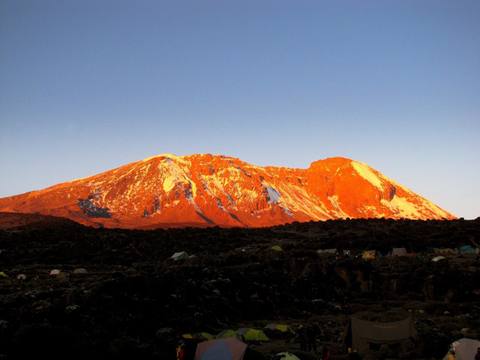
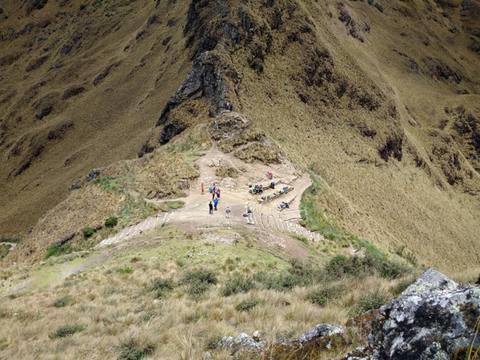
Kilimanjaro needs no ropes or technical skills, but it is not an easy trek. On the 7-day Machame route you walk five days in a row before summit night, which starts at midnight from Barafu Camp at 4,673 m (15,331 ft), gains 1,222 m (4,009 ft) to Uhuru Peak at 5,895 m (19,341 ft) and then descends 2,827 m (9,275 ft) to Mweka Camp: 10 to 14 hours on the move, with roughly half of sea-level oxygen at the top. The altitude, the accumulated days and the descent are what make it hard.
Pick the tests you want and get one report with your biggest gap before day one. Free, a few minutes, no signup.
Is Kilimanjaro hard? Easy on paper, hard on the body
Kilimanjaro is the easiest of the Seven Summits on paper. The standard routes are walks: no rope, no crampons, no technical skills. That is exactly why it turns fit people around. People read "no technical skills required", train for a long hike, and arrive at a seven-day trek whose sixth day is 10 to 14 hours on the move at up to 5,895 m (19,341 ft).
The difficulty is not one thing. It is three things stacked on top of each other, and the hardest one arrives last.
The three things that make it hard
Altitude. Summit night starts at Barafu Camp, 4,673 m (15,331 ft), and tops out at Uhuru Peak, where the air holds roughly half of sea-level oxygen. On the 7-day Machame route you sleep at 2,850, 3,810, 3,975, 3,994 and 4,673 m: a fast gain compared with longer treks. Day 3 walks you up to Lava Tower at 4,630 m (15,190 ft) and back down to Barranco at 3,975 m to sleep, the climb-high-sleep-low day that is the itinerary's acclimatisation plan.
Accumulation. Days 1 to 5 are 4 to 8 hours each, 400 to 1,200 m (1,300 to 3,900 ft) of gain a day, with no rest day, including a short hands-on scramble up the Barranco Wall on day 4. By summit night you have walked five days in a row and slept four nights above 3,000 m (9,800 ft).
The descent. Summit night does not end at the top. It ends 2,827 m (9,275 ft) lower, at Mweka Camp, and the next morning adds about 1,430 m (4,700 ft) more down to the gate. That is eccentric work, the quads braking under load, and it is the part almost nobody trains for. It causes far more muscle soreness than walking uphill, and the protection comes from having done it before (LaStayo et al., 2003).
Summit night, hour by hour
This is the day that decides how hard Kilimanjaro feels. On the standard 7-day Machame itinerary:
- Evening, day 5: early dinner at Barafu Camp, 4,673 m, and a few hours of sleep, usually 3 to 4.
- Around midnight: start in the dark. About 5 km (3 mi) of steep scree to Stella Point on the crater rim, then along the rim to Uhuru Peak at 5,895 m. Typically 6 to 8 hours at the slow pace the guides enforce.
- After the summit: back down the same scree to Barafu, a short stop, then on.
- Afternoon: about 12 km (7.5 mi) of descent to Mweka Camp at 3,068 m (10,066 ft), another 4 to 6 hours.
In total: 17 km (10.6 mi), 1,222 m (4,009 ft) up, 2,827 m down, 10 to 14 hours, the only day above 5,000 m (16,400 ft) and the most tired legs of the week. Hours are typical walking times, and your operator's itinerary may differ slightly.
Which route is hardest?
Summit night is much the same on every standard route. What changes is how much time your body gets to adapt before it. The 6-day Machame drops the Karanga Camp night and walks from Barranco to Barafu in one day. The 7-day Machame keeps that night. The 8-day Lemosho starts further west and adds a day on the Shira plateau. Operators consistently report clearly higher summit rates on 7 and 8 day itineraries than on 6 day ones, because the extra nights are acclimatisation. If you can choose, choose the longer itinerary.
Kilimanjaro vs Everest Base Camp
The two treks people compare most are hard in different ways. Kilimanjaro is higher and faster, with one very big day. Everest Base Camp is longer and spends more time high.
- Kilimanjaro (7-day Machame): 7 days, about 62 km (38.5 mi), high point 5,895 m. Hardest day 10 to 14 hours, 1,222 m up and 2,827 m down.
- Everest Base Camp: 11 days, about 113 km (70 mi), high point 5,545 m (18,192 ft) at Kala Patthar. Hardest day 7 to 9 hours, 380 to 450 m (1,250 to 1,500 ft) up and about 1,300 m (4,300 ft) down, with five nights at or above 4,000 m (13,100 ft).
Kilimanjaro asks for a bigger single effort with less time to acclimatise. Everest Base Camp asks you to keep going, day after day, at altitude. The Everest Base Camp trek page has its full stage profile.
What training can and cannot do
Training cannot acclimatise you. Nothing you do at sea level changes how your body adapts to 5,895 m; the itinerary and the pace do that. The altitude acclimatisation guide for trekkers covers the rules that prevent most altitude sickness.
What training does is make every walking hour cheaper, so the altitude is the only hard thing. A Kilimanjaro build trains five things:
- Aerobic engine: long Zone 2 walking, three to four sessions a week, building to weekend days of 3 to 5 hours.
- Multi-day durability: back-to-back long days every weekend, the closest a weekend gets to days 3, 4 and 5 on the mountain.
- Summit-night rehearsal: one 8 to 10 hour day with about 1,200 m (3,900 ft) up and a long descent, 4 to 6 weeks before you fly, starting before dawn.
- Descent strength: weighted step-downs, stair descents and downhill repeats from about week 6. The eccentric training guide for trekkers and the muscular endurance exercises show the sessions.
- Your daypack: porters carry the camp; you carry 5 to 8 kg (11 to 18 lb). Train every long day with that pack.
Twelve to sixteen weeks covers this for most people. The 16-week Kilimanjaro training plan lays it out week by week, and the Kilimanjaro trek page has the full stage table.
A plan built backwards from your departure date
Train to Mountain builds the Kilimanjaro plan around the stages you will actually walk: the weekend pair, the midweek vertical, the summit-night rehearsal and a two-week taper, sized to your starting fitness and recalculated every Sunday from what your watch recorded. Trek plans open in the app on 5 November; join the waiting list or start with Trek Check.
Common questions
How hard is Kilimanjaro?
Kilimanjaro needs no ropes or technical skills, but it is not an easy trek. On the 7-day Machame route you walk five days in a row before summit night, which starts at midnight from Barafu Camp at 4,673 m (15,331 ft), gains 1,222 m (4,009 ft) to Uhuru Peak at 5,895 m (19,341 ft) and then descends 2,827 m (9,275 ft) to Mweka Camp: 10 to 14 hours on the move, with roughly half of sea-level oxygen at the top. The altitude, the accumulated days and the descent are what make it hard.
How hard is Kilimanjaro summit night?
It is the hardest day of the trek and one of the hardest single days in mainstream trekking. You start around midnight after a few hours of sleep at 4,673 m, walk about 5 km of scree to Uhuru Peak in 6 to 8 hours, then descend about 12 km to Mweka Camp in another 4 to 6 hours. It is the only day above 5,000 m (16,400 ft), and it comes on the most tired legs of the week.
Can a beginner do Kilimanjaro?
Yes, a beginner with no mountaineering experience can, because the standard routes need no technical skills. What a beginner needs is preparation: an aerobic base for 4 to 8 hour walking days, legs that can repeat those days back to back, and descent strength for summit night. A 12 to 16 week build covers that for most people. Training cannot acclimatise you, so choose a 7 or 8 day itinerary and follow your guide on pace and symptoms.
How fit do you need to be for Kilimanjaro?
Fit enough that a long walking day is easy and a second one the next day is still comfortable. Before you go, aim to manage weekend pairs of long hikes with your daypack, a rehearsal day of 8 to 10 hours with about 1,200 m (3,900 ft) of gain and a long descent, and regular descent work so 2,800 m (9,200 ft) down on summit night does not wreck your quads. Trek Check gives you a readiness report against these demands.
Is Kilimanjaro harder than Everest Base Camp?
They are hard in different ways. Kilimanjaro is higher, 5,895 m against 5,545 m (18,192 ft) at Kala Patthar, faster and has the bigger single day: summit night is 10 to 14 hours with 1,222 m up and 2,827 m down, against 7 to 9 hours on the Kala Patthar day. Everest Base Camp is longer, 11 days against 7, and spends more nights high, five at or above 4,000 m, which gives the body more time to adapt but more days to accumulate fatigue.
Which Kilimanjaro route is the easiest?
The longer itineraries are easier on the body because the extra nights are acclimatisation. Operators consistently report clearly higher summit rates on 7 and 8 day itineraries than on 6 day ones. The 6-day Machame drops the Karanga Camp night, the 7-day Machame keeps it, and the 8-day Lemosho adds a day on the Shira plateau. Summit night itself is similar on all of them.
The takeaway
Kilimanjaro is not technical, and that is the trap. It is hard because of altitude, five days of accumulation and a summit night that ends 2,800 m below the top. Choose the longer itinerary, train the weekend pairs and the descent, and arrive fit enough that the altitude is the only hard thing.