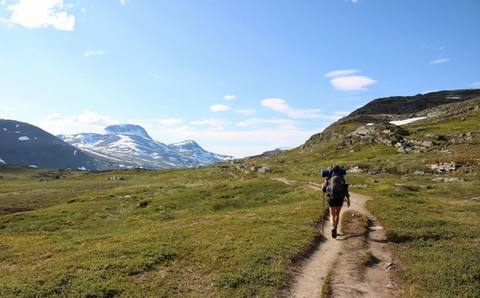
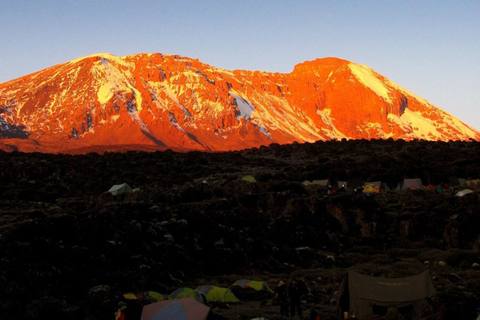
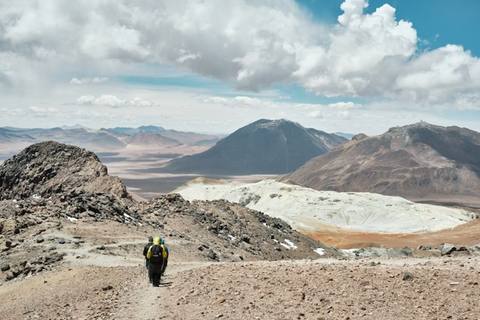
Train the descent by loading your legs eccentrically (the muscle lengthens under tension to brake each step) two or three times a week: slow step-downs, slow-tempo squats and one downhill walk with your trek pack. Ten to fifteen minutes of eccentric work twice a week builds descent tolerance in about four to six weeks. Start by the middle of your plan: on a trek the big descents come late, on legs that have already walked for days.
Pick the tests you want and get one report with your biggest gap before day one. Free, a few minutes, no signup.
Why trek descents hurt more than the ascents
Going up, your leg muscles contract concentrically: they shorten under load. Going down, they contract eccentrically: they lengthen under load, braking your bodyweight and your pack against gravity on every step. It is a different kind of stress, and the body handles it differently (LaStayo et al., 2003).
Eccentric load damages muscle fibres at a far higher rate per unit of effort than concentric work. That is why your quads are sore after a long descent and fine after the same height of ascent, and why knee pain, slips and rolled ankles tend to show up on the way down, when the legs are tired.
A trek adds two things a day hike does not. The descent arrives tired: the biggest descent days usually come at the end of the trek or straight after its high point, on legs that have walked for days. The damage carries over: eccentric soreness peaks 24 to 48 hours later, which on a trek is the next stage, not a rest day.
Where the descent sits on twenty famous treks
Every trek has its descent somewhere different. Read the table as a training brief: how much descent, how big the biggest day, and how much of it lands at the end.
| Trek | Total descent | Biggest descent day | Descent in the closing days |
|---|---|---|---|
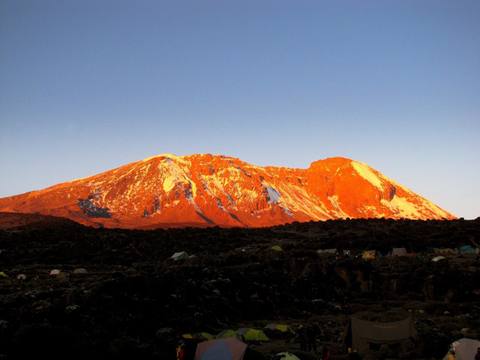
| Kilimanjaro | 5,320 m | 2,827 m on day 6 of 7 (10 to 14 h) | Days 6 to 7: 4,255 m |
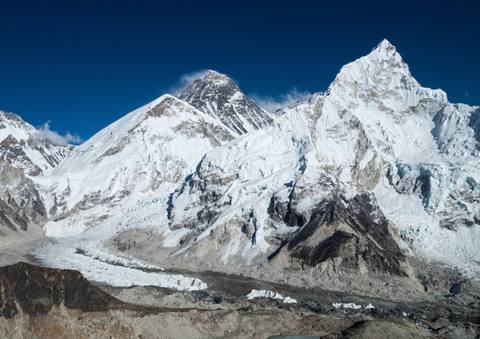
| Everest Base Camp | 6,108 m | 1,485 m on day 11 of 11 (7 to 9 h) | Days 9 to 11: 4,302 m |
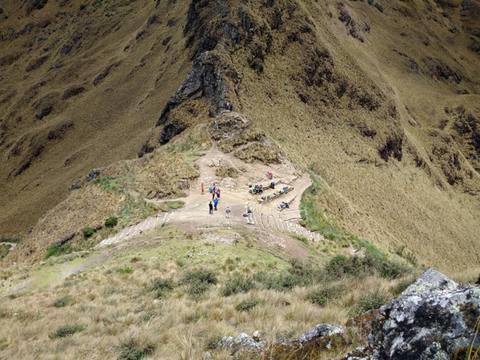
| Inca Trail | 2,460 m | 1,370 m on day 3 of 4 (8 to 10 h) | Days 3 to 4: 1,700 m |
| Tour du Mont Blanc | 10,300 m | 1,760 m on stage 11 of 11 (7 h) | Stage 11: 1,760 m |
| Annapurna Circuit | 3,289 m | 1,656 m on day 8 of 8 (8 to 10 h) | Day 8: 1,656 m |
| Walker's Haute Route | 13,443 m | 1,820 m on stage 10 of 14 (6 h) | Stage 14: 1,720 m |
| Alta Via 1 | 7,200 m | 1,400 m on stage 11 of 11 (4.3 h) | Stages 10 to 11: 2,160 m |
| Tour of Monte Rosa | 11,223 m | 1,749 m on stage 4 of 9 (6.3 to 7 h) | Stage 9: 1,720 m |
| GR20 | 13,014 m | 1,359 m on stage 6 of 16 (8 h) | Stages 15 to 16: 2,398 m |
| Laugavegur Trail | 1,826 m | 636 m on day 2 of 4 (4 to 5 h) | Days 2 to 4: 1,658 m |
| Toubkal Circuit | 6,250 m | 2,442 m on day 6 of 6 (8 to 10 h) | Day 6: 2,442 m |
| Huayhuash Circuit | 5,820 m | 1,100 m on day 9 of 9 (4 to 5 h) | Days 8 to 9: 1,930 m |
| Santa Cruz Trek | 2,190 m | 950 m on day 4 of 4 (2.5 to 5 h) | Days 3 to 4: 1,350 m |
| Salkantay Trek | 4,925 m | 1,810 m on day 2 of 5 (8 to 11 h) | None: the last day goes up more than down |
| Condor Trek | 1,588 m | 741 m on day 4 of 4 (5 to 8 h) | Day 4: 741 m |
| Quilotoa Loop | 1,207 m | 515 m on day 2 of 3 (5 to 8 h) | None: the last day goes up more than down |
| Inca Trail to Ingapirca | 1,437 m | 929 m on day 3 of 3 (4 to 6 h) | Day 3: 929 m |
| Torres del Paine W Trek | 2,903 m | 1,047 m on day 1 of 5 (8 to 10 h) | Day 5: 364 m |
| Torres del Paine O Circuit | 4,394 m | 1,200 m on day 4 of 8 (8 to 12 h) | None: the last day goes up and down the same |
| Michinoku Coastal Trail | 2,745 m | 508 m on day 5 of 8 (4 to 6 h) | Day 8: 225 m |
Standard itineraries from the canonical trek database (two independent itineraries plus a terrain measurement of each route, checked 2026-10-18). "Closing days" are the final run of days that go down more than up. Operators and camp choices differ; check yours. The Annapurna Circuit ascent total is confirmed by one source only and is still under review; the per-stage figures used here are checked.
Six of them in more detail:
- Kilimanjaro. Summit night goes up 1,222 m from Barafu Camp to Uhuru Peak at 5,895 m, then down 2,827 m to Mweka Camp, 10 to 14 hours on the move after five days of walking. The next morning descends another 1,428 m to the gate.
- Everest Base Camp. The last three days descend 4,302 m, starting with the Kala Patthar day; two of them are over 19 km. The walk-out is where unprepared legs give up.
- The Inca Trail. Day 2 goes up 1,250 m to Dead Woman's Pass at 4,215 m. Day 3, the longest at 8 to 10 hours, descends 1,370 m, much of it on stone steps.
- The Tour du Mont Blanc. A col most days and your own 8 to 10 kg pack. Five of its eleven stages descend 1,000 m or more, and the biggest, 1,760 m, is the last.
- The Annapurna Circuit. The Thorong La day goes up 966 m to 5,416 m and then down 1,656 m to Muktinath, 8 to 10 hours, after a week of gaining height.
- The Walker's Haute Route. The most descent of the twenty: 13,443 m across fourteen stages with your own pack, six of them 1,000 m or more. The biggest, 1,820 m from the Cabane de Moiry to Zinal, comes on stage 10; the last, 1,720 m along the Europaweg into Zermatt, on stage 14.
Eccentric vs concentric: the actual difference
Picture a squat. As you stand up, your quads shorten: that is the concentric phase. As you lower back down, they lengthen while controlling the movement: that is the eccentric phase. Same muscle, same movement, two different loads. Three things make eccentric work distinct:
- Higher force per unit of effort. Eccentric contractions can produce roughly 1.3 times the force of equivalent concentric ones (Lieber & Friden, 2002). You can handle more load lowering than lifting.
- More micro-damage to muscle fibres. Lengthening under load disrupts the muscle's structure more aggressively, hence the delayed-onset muscle soreness (DOMS) 24 to 48 hours later.
- Slower recovery. Eccentric work takes longer to recover from than equivalent concentric work. On a trek you do not get that recovery between stages, which is why the adaptation has to happen in training.
Train only the uphill and you arrive at the high point ready and at the finish broken. On a trek, the descent has to be its own block.
How do you train for the descent?
You do not need a gym. The most effective exercises for trek descents are bodyweight or lightly loaded. Pick two or three and rotate them through the week:
Reverse step-downs
Stand on a 30 to 50 cm box or step. Lower one foot to the floor over 4 to 5 seconds, touch lightly, push back up. 3 sets of 8 to 10 per leg, twice a week. The slow lowering is pure eccentric work for the quad and glute.
Downhill walking with your trek pack
20 to 30 minutes of steady downhill walking at Zone 1 to 2 effort, once a week, carrying the pack you will trek with: a daypack where porters carry the camp, 8 to 10 kg on the Tour du Mont Blanc where you carry your own. Start with 10 minutes if you are new to it; the soreness will surprise you. Targeted downhill work improves descent tolerance within 4 to 6 weeks (Vogt & Hoppeler, 2014). Stairs work too: walk down them, not only up, especially for the stepped descents of the Inca Trail and the Everest trail.
Slow tempo squats
A 5-second lowering, a 1-second hold at the bottom, a normal-pace rise. 3 sets of 8 with bodyweight or light dumbbells. The rise is incidental; the lowering is the work.
Backward walking on a treadmill incline
Counter-intuitive, but useful. Walking backward up a 10 percent incline loads the quads eccentrically in a different range of motion. 5 to 10 minutes, twice a week.
How should you move on the descent to protect your knees?
Technique saves your legs as much as strength does, and it matters most on day five, not day one. Five cues that cut the load on every step:
- Shorten your stride and raise your cadence. Small, quick steps absorb load in a shorter range than long, reaching strides that jar the knee.
- Keep a soft bend in the knee and never lock it out. A locked knee sends impact straight into the joint; a bent knee lets the quad do the braking.
- Stay stacked over your feet with weight slightly forward. Leaning back to feel safer loads the quads fully and makes slips more likely.
- Use trekking poles to offload. Poles take a real share of braking force off the legs on steep ground, especially late in the day and late in the trek.
- Look two or three steps ahead and place each foot deliberately. Last-second foot placement is where tired ankles roll and knees twist. On high stone steps, lead with one leg for a few steps and then switch, so one quad does not take every drop.
How it fits a trek training week
Eccentric work supplements the walking; it does not replace it. A build-phase week, the same shape as our 16-week trek plans:
- Mon · easy 60 minutes in Zone 2, plus reverse step-downs (3 sets)
- Tue · intervals: 4 x 4 minutes in Zone 4, or hill repeats
- Wed · rest or mobility
- Thu · midweek vertical: stairs, incline or hills, Zone 2, pack on; walk the stairs down as well as up
- Fri · strength, about 40 minutes: 10 to 15 minutes of eccentric work (step-downs, slow split squats), then calf and hip work
- Sat · long walk with deliberate downhill sections, full trek pack
- Sun · a second walk on tired legs: descending on legs that walked yesterday is where training meets the trek
Keep the eccentric blocks small and never on two days in a row. In the first two weeks, while the work still makes you sore, do the strength session on Wednesday or Thursday so the soreness peak passes before the weekend; once it settles, usually by week three, Friday works. The point is consistency and progressive overload, not heroic single sessions.
How do you know if your knees are ready for descent training?
Eccentric work is demanding, so screen before you load it hard. For each question, read across to what your answer likely means and what to do. This is general guidance, not a diagnosis.
- Do stairs, especially going down, provoke pain at the front of the knee or around the kneecap?
Yes, most times: a classic pattern of kneecap irritation under eccentric load. Hold off on heavy step-downs and downhill volume and get it assessed first.
Now and then, mild: start with a low box and few reps, and stop the progression if the pain grows.
No: clear to load descents progressively. - Does the knee swell or ache the day after a long walk?
Visible swelling: the load exceeded what the joint can handle. Cut descent volume, let it settle, and see a professional if it recurs.
Mild ache that clears within a day: acceptable for now. Keep progressions small and watch the trend; on a trek there is no day off for it to clear.
No: a good sign the joint tolerates the load. - Have you felt the knee give way or catch?
Yes: giving way or catching can point to a mechanical issue. Get it checked before loading descents at all.
Only when very tired: treat it as a fatigue signal, end the session, and build strength before adding volume.
No: proceed. - Is there sharp pain, not just muscle soreness, during or right after a squat or step-down?
Sharp and localised: stop the exercise. Sharp joint pain is different from muscle burn and is a reason to pause and assess.
A mild niggle that warms up and fades: reduce range and load and see if it settles over a week.
No, just soreness: expected and fine; that is the training working.
Occasional soreness is normal from eccentric work. If any of the red-flag answers persist, get the knee assessed by a physiotherapist or doctor before adding heavy descent load. Building strength on top of an unresolved issue makes it worse, and a trek is days of descent with no way to stop halfway.
Recovery from eccentric load
If you have never done dedicated eccentric work, the first week will hurt. The soreness arrives 24 to 48 hours later and lingers. By week three the same load produces far less soreness, because the muscle has adapted: the repeated bout effect. That adaptation is the whole reason to train it before you go, so that the trek's descents meet legs that have seen the load before.
- Do not panic-dose. Resist the urge to test your descent fitness with a huge downhill day in week one. Build gradually.
- Eat and drink for repair. Eccentric repair is protein-hungry; eat enough protein on training days and on the trek itself.
Common questions
What is eccentric training?
Eccentric training emphasises the muscle-lengthening phase of a movement: lowering a weight slowly, stepping down from a height, walking downhill. It produces more force per unit of muscle than concentric (lifting) work and is the specific stimulus that prepares quads, knees and connective tissue for a long descent (LaStayo et al., 2014).
Why do my knees hurt more going downhill on a trek?
Because going down, the quads lengthen under load to brake your bodyweight and your pack on every step. That eccentric load damages muscle fibres faster than the same height of ascent, and on a trek the big descents come late, on legs that have walked for days. Tired quads brake less, so more of the load reaches the knee.
What are the best eccentric exercises for trekking?
Three high-leverage moves: slow reverse step-downs from a 30 to 50 cm box, slow-tempo squats or split squats (a 5-second lowering), and a weekly downhill walk or stair descent with the pack you will trek with. All three train the quads and connective tissue in the descent pattern.
How often should I train eccentrics before a trek?
Two or three short doses a week from the middle of your plan: step-downs or slow squats on an easy day, the weekly strength session, and a downhill walk. Ten to fifteen minutes of eccentric work twice a week builds descent tolerance in about four to six weeks. Keep sessions off consecutive days, and while the work still makes you sore, keep it away from the day before your long walk.
Can eccentric training prevent knee pain on a trek?
It reduces the risk by building the muscle and connective-tissue resilience that absorbs descent load. It does not remove it: slips, rolled ankles and fatigue-driven mistakes still happen. A prepared quad keeps braking actively on the last day instead of giving way.
What is the best descent technique to protect your knees?
Shorten your stride and raise your cadence, keep a soft bend in the knee, stay stacked over your feet with weight slightly forward, use trekking poles to offload braking force, and look two or three steps ahead so each foot lands deliberately. Technique works alongside strength, not instead of it.
How do you know if your knees are ready for descent training?
Screen for four things first: pain at the front of the knee going down stairs, swelling or ache the day after a long walk, the knee giving way or catching, and sharp joint pain (not muscle soreness) during squats or step-downs. If any of those persist, get the knee assessed by a physiotherapist or doctor before adding heavy descent load. This is general guidance, not a diagnosis.
Which of the big treks has the hardest descent?
By a single day, Kilimanjaro: 2,827 m down on summit night, then another 1,428 m the next morning. By total, the Walker's Haute Route: 13,443 m across fourteen stages with your own pack, ahead of the Tour du Mont Blanc's 10,300 m. For descent on tired legs, the Everest Base Camp walk-out: 4,302 m over the last three days.
Keep reading
Take this further
- All trek guides · Twenty 16-week training plans built from each trek's stage profile, and the physiology behind them.
- Altitude Acclimatisation for Trekkers · Sleeping altitude, go high, sleep low, and what your itinerary does that training cannot.
- Heart Rate Zones for Trekking · Why Zone 2 carries a trek plan, and how to find your zones.
- The Science Behind TTM · Banister's fitness-fatigue model, polarised training and periodisation, applied to consecutive days.
The takeaway
A trekker who trains the descent reaches the high point prepared and the finish intact. The exercises take 10 to 15 minutes, twice a week, and the progression is straightforward. The only thing that has to change is the assumption that the ascent is the hard part. In our 16-week plans for Kilimanjaro, Everest Base Camp, Inca Trail, Tour du Mont Blanc, Annapurna Circuit, Walker's Haute Route, Alta Via 1, Tour of Monte Rosa, GR20, Laugavegur Trail, Toubkal Circuit, Huayhuash Circuit, Santa Cruz Trek, Salkantay Trek, Condor Trek, Quilotoa Loop, Inca Trail to Ingapirca, Torres del Paine W Trek, Torres del Paine O Circuit and Michinoku Coastal Trail, eccentric work starts in week 5, and from week 5 the Sunday walk trains descent on tired legs most weekends.