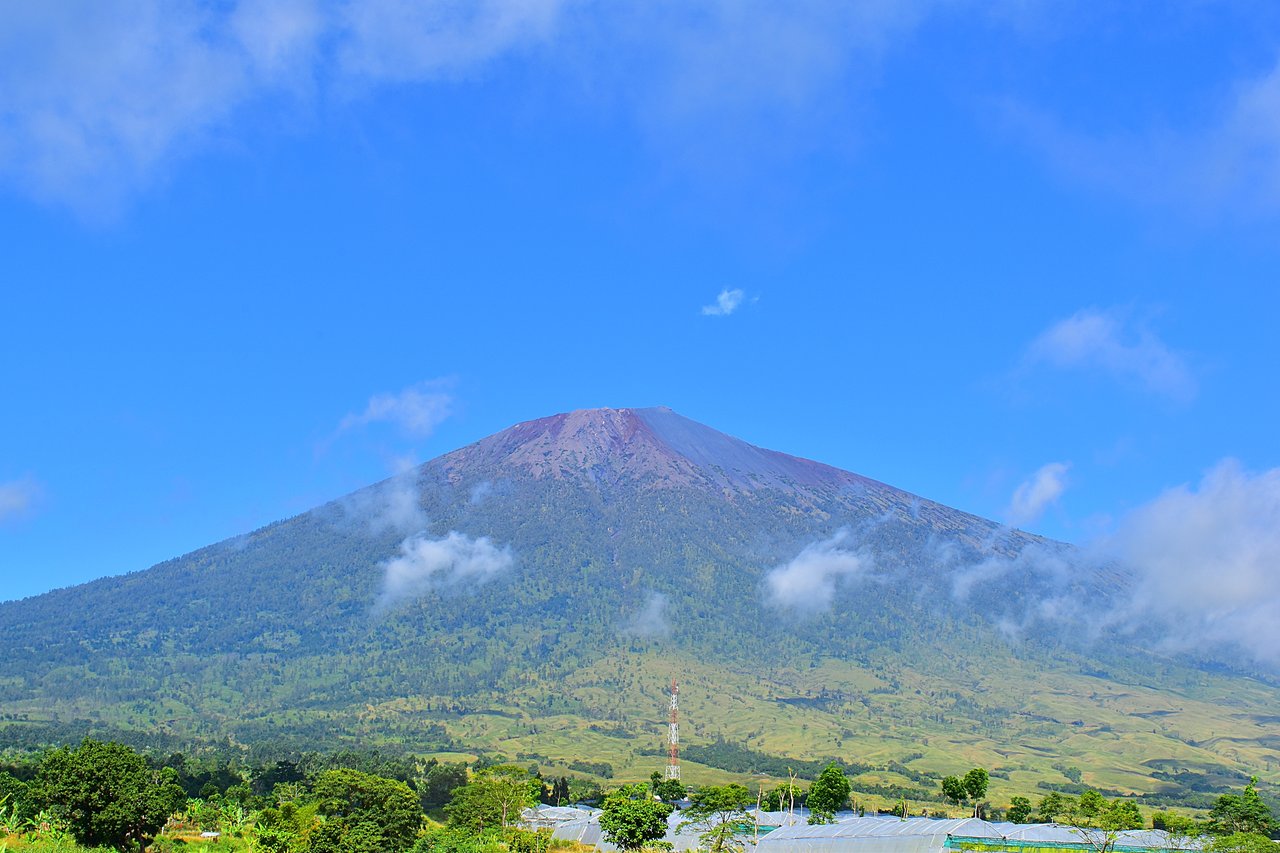
Why Rinjani's summit morning humbles people
The trek itself is a big multi-day effort with long days of climbing and descending between the crater rim and the lake. But it is the summit push that defines Rinjani. From the Sembalun crater rim camp at around 2,700 m, you start near midnight and climb roughly a thousand metres up a relentless slope of loose volcanic sand and scree to the 3,726 m summit for sunrise.
On that scree, every step slides back - the classic 'two steps up, one step down' - so the effort to gain height is far greater than the metres suggest, and it comes in the cold and dark on tired legs. People who arrive undertrained, or who have not experienced deep loose ground, find the summit morning demoralising and often turn back. Fitness, and specifically the leg endurance to keep grinding on unstable ground, is what gets you to the top.
Physical benchmarks to hit before Mount Rinjani
Rinjani is a multi-day trek with a savage scree summit push. A good plan trains multi-day endurance, leg strength for loose ground, and the pre-dawn grind.
Altitude and terrain reality check
Altitude is moderate but not trivial. At 3,726 m you have around 63 percent of sea-level oxygen - enough to slow the summit push, especially after limited sleep, but not the primary obstacle. That honour goes to the scree and the multi-day fatigue.
The classic route is a multi-day loop: up to the Sembalun crater rim, the pre-dawn summit push and back, then down to the crater lake and hot springs before exiting. The summit slope is deep volcanic sand and scree; the rest is steep trail. Rinjani is closed during the wet season and typically open roughly April to November (often reopening around April) - the dry months give firmer ground and safer conditions.
The 10-14 week Mount Rinjani preparation timeline
The block runs backwards from your climb date. Each phase has a distinct target.
- Weeks 1-4 · Aerobic base. 4-6 hours per week at Zone 1-2, building trekking volume.
- Weeks 5-8 · Base plus strength. Add strength (squat, lunge, step-ups, calf work) and start back-to-back weekend days.
- Weeks 9-11 · Loose-ground and multi-day focus. Consecutive long days with 900-1,300 m of gain, ideally including loose or sandy ground, plus descent work. Volume 6-9 hours per week.
- Weeks 12-13 · Peak simulation. A long steep day on loose ground and a back-to-back weekend, a few weeks out.
- Week 14 · Taper. Volume drops 30-40 percent. Arrive fresh and strong-legged.
A weekly distribution that works
The polarised principle applies: most volume easy, a little hard, one long day. A representative week, 12 weeks out from a Mount Rinjani attempt:
- Mon · easy 60 min Z2
- Tue · threshold or VO2max intervals, 4 x 4 min Z4-Z5
- Wed · rest or 30 min mobility
- Thu · Z2 hike with weighted pack, 2-3 hours, 700-1000m (2,300-3,300 ft) of vertical
- Fri · easy 45 min Z2 + eccentric strength (step-downs, weighted lunges)
- Sat · long mountain day building toward 6 hours, mixed Z2 with vertical and progressive pack weight
- Sun · 2-3 h Z2 on tired legs (back-to-back loading, lighter pack)
Roughly 85 percent of weekly volume sits at Z1-Z2, with one hard intensity session and one back-to-back load. The single long rehearsal day lands 4-6 weeks before the trip, not in the taper.
Technical skills you must bring to Mount Rinjani
TTM trains the body, and Rinjani asks little else technically - it is a non-technical but savage trek. There is no scrambling or exposure of consequence; the difficulty is the loose scree, the multi-day fatigue and the cold summit morning.
- Loose-ground movement. Efficient technique on deep scree and volcanic sand, up and down.
- Multi-day trekking fitness. Walking big days repeatedly and recovering overnight.
- Cold-weather comfort. Layering for a cold, dark, high summit push.
- Altitude self-care. Pacing and hydration at moderate altitude on little sleep.
No technical climbing is involved - Rinjani is won by legs and resolve. Most trekkers go with a local operator who provides porters and camps; TTM's plan is what turns the summit scree from a heartbreak into a hard-won sunrise.
How TTM tunes the plan to Mount Rinjani
What the algorithm calibrates to your peak
- Fitness target · Rinjani is set to the Mountain Fitness threshold for a multi-day trek with a scree summit push - your plan is built to reach it by departure.
- Leg strength-endurance · the plan emphasises the leg conditioning that loose-ground climbing demands.
- Back-to-back load · consecutive long days are programmed to match the multi-day loop.
- Descent load · eccentric strength is built for the long, loose descents.
- Early-start flag · the plan can rehearse the pre-dawn summit-push pattern.
Common questions about training for Mount Rinjani
How hard is Mount Rinjani?
Non-technical but very demanding: a multi-day loop with big daily ascents and descents, and a summit morning that climbs roughly 1,000 m of deep, loose volcanic scree in the pre-dawn cold. The scree - where every step slides back - is the crux, not any technical terrain.
Do I need climbing skills?
No. Rinjani is a trek. You need strong legs, multi-day endurance, comfort on loose ground, and cold-weather trekking habits - not ropework or scrambling skills.
Why is the summit push so hard?
Because it is deep, loose scree: you climb two steps and slide back one, so the real effort far exceeds the metres gained - and it all happens in the cold and dark on tired legs. Leg strength-endurance is what gets you up it.
How fit do I need to be?
Fit enough for several long trekking days plus a brutal 1,000 m scree summit push. A solid Zone 2 base, real leg strength-endurance, and back-to-back long days are the key preparation.
Is altitude a problem?
Moderately. At 3,726 m you have around 63 percent of sea-level oxygen, enough to slow the summit push but not the main obstacle - the scree and multi-day fatigue are.
When can I climb it?
Rinjani is closed in the wet season and generally open in the dry months, roughly April to November. The dry season gives firmer, safer ground - always check current park status before booking.
Tools and deeper reading
Take this further
- Summit Readiness Simulator · Test if you are ready for Mount Rinjani today. Free, 60 seconds.
- Altitude Acclimatisation Guide · Climb-high-sleep-low and AMS warning signs.
- Eccentric Descent Training · The work that stops the late-day quad breakdown.
- Heart Rate Zones for Mountaineering · The polarised 85/15 distribution.
- The Science Behind TTM · The peer-reviewed research behind the algorithm.
The takeaway
Rinjani is a trek that climbs like a mountain and a summit push that punishes anyone who underestimates it. The lake and the crater are the reward; the scree is the price. Train multi-day endurance, real leg strength for loose ground, and the cold pre-dawn grind, and you will crest the rim at sunrise instead of sliding back down it.