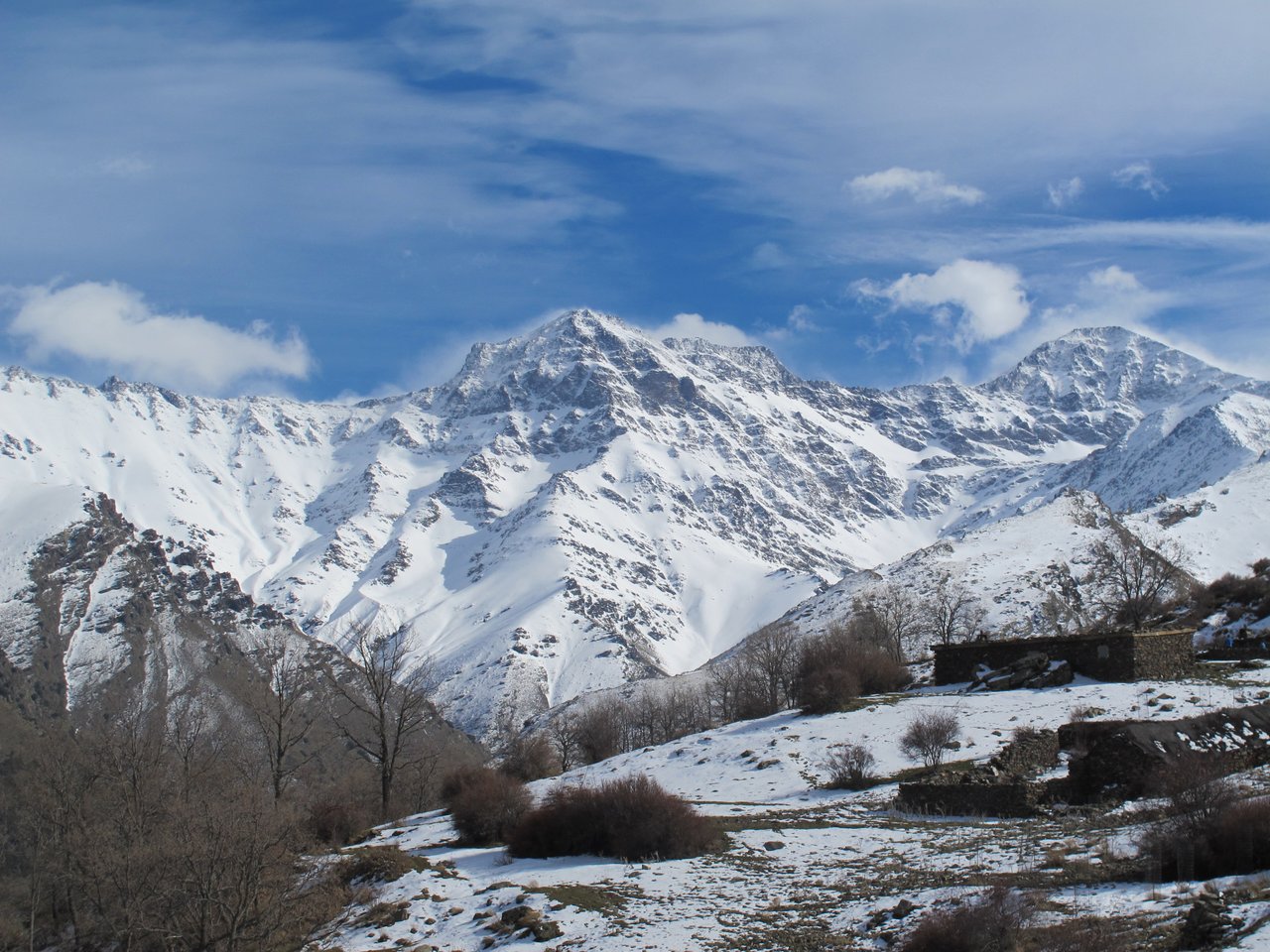
Why Mulhacén is a real mountain, not just a hill
In good summer conditions Mulhacén asks for no technical skills at all - it is a hiking route to the summit. But the day is big. Depending on where you start - from the high road access, from Capileira, or from a hut - the ascent ranges from around 1,200 m to nearly 1,900 m, much of it already above 2,500 m where the air is noticeably thinner.
That combination - a long day, real altitude, and a rough high-mountain environment where weather changes fast - is what makes Mulhacén a genuine objective rather than a stroll. And in winter or after snow it transforms into an alpine climb needing an axe, crampons and the skills to use them. The fit hiker's version is summer; even then, arriving properly conditioned is what separates a great day from a long, hard slog.
Physical benchmarks to hit before Mulhacén
Mulhacén is a big-vertical mountain day at moderate altitude. A good plan trains the sustained climb, the descent, and comfort moving high.
Altitude and terrain reality check
Altitude is moderate but real, and it starts early - much of the route sits above 2,500 m. At the 3,479 m summit you have around 68 percent of sea-level oxygen, enough to slow you if you have come straight from sea level. A night at altitude beforehand, or simply arriving fit, makes the summit day feel far easier.
The standard summer ascent is a non-technical hike, with route length depending on your starting point - the high mountain-road access shortens it considerably, while starting from a village like Capileira makes for a much bigger day. The reliably snow-free window is roughly June to October; earlier in the year, and all winter, Mulhacén holds snow and becomes an alpine climb requiring axe, crampons and winter skills.
The 8-12 week Mulhacén preparation timeline
The block runs backwards from your climb date. Each phase has a distinct target.
- Weeks 1-3 · Aerobic base. 3-5 hours per week at Zone 1-2, building comfortable climbing volume.
- Weeks 4-6 · Base plus strength. Add a strength session and eccentric step-downs; grow the long day to 3-4 hours with 700-900 m of gain.
- Weeks 7-9 · Muscular endurance. Long days with 900-1,300 m of vertical on rough ground, plus descent work. Volume 5-8 hours per week.
- Weeks 10-11 · Peak simulation. One long day of 1,200-1,600 m gain on rough ground with a real descent, a few weeks out.
- Week 12 · Taper. Volume drops 30-40 percent. Arrive fresh for a big high day.
A weekly distribution that works
The polarised principle applies: most volume easy, a little hard, one long day. A representative week, 12 weeks out from a Mulhacén attempt:
- Mon · easy 60 min Z2
- Tue · threshold or VO2max intervals, 4 x 4 min Z4-Z5
- Wed · rest or 30 min mobility
- Thu · Z2 hike with weighted pack, 2-3 hours, 700-1000m (2,300-3,300 ft) of vertical
- Fri · easy 45 min Z2 + eccentric strength (step-downs, weighted lunges)
- Sat · long mountain day building toward 6 hours, mixed Z2 with vertical and progressive pack weight
- Sun · 2-3 h Z2 on tired legs (back-to-back loading, lighter pack)
Roughly 85 percent of weekly volume sits at Z1-Z2, with one hard intensity session and one back-to-back load. The single long rehearsal day lands 4-6 weeks before the trip, not in the taper.
Technical skills you must bring to Mulhacén
TTM trains the body. In summer Mulhacén is a non-technical high-mountain hike - no scrambling or ice of consequence. What it asks is a strong engine, comfort at altitude, and sensible mountain judgement. In winter it is a different, alpine, objective.
- High-mountain hiking fitness. The ability to climb well over a kilometre of rough ground at altitude.
- Altitude self-care. Pacing, hydration and fuelling above 2,500 m.
- Mountain-weather judgement. Reading fast-changing high-mountain conditions and turning around if needed.
- Winter-skills awareness. Recognising when snow makes Mulhacén an alpine climb needing axe and crampons.
In summer this is fitness and judgement, not technical climbing. In winter, treat it as a full alpine objective with the right skills or a guide. TTM's plan gets you physically ready; good timing and conditions do the rest.
How TTM tunes the plan to Mulhacén
What the algorithm calibrates to your peak
- Fitness target · Mulhacén is set to the Mountain Fitness threshold for a big-vertical day at moderate altitude - your plan is built to reach it by your climb date.
- Vertical target · calibrated to your chosen start and its ascent, built progressively with recovery weeks.
- Descent load · eccentric strength is programmed for the long descent.
- Long-day rehearsal · a real big day on rough ground with a descent is scheduled before the trip.
- Altitude flag · the plan notes the high approach and the value of arriving fit and, ideally, pre-acclimatised.
Common questions about training for Mulhacén
How hard is Mulhacén?
In summer it is a non-technical hike to the highest point in mainland Spain, but a big day - between roughly 1,200 m and 1,900 m of ascent depending on your start, much of it above 2,500 m. The difficulty is the vertical and the altitude, not the terrain. In winter it becomes an alpine climb.
Do I need climbing skills?
In summer, no - just hiking fitness, altitude sense and mountain judgement. In winter or after snow, you need an axe, crampons and the skills to use them, or a guide.
How fit do I need to be?
Fit enough for a big-vertical mountain day at altitude and a long descent. A solid Zone 2 base, some rough long days and eccentric descent strength are the key preparation.
Is altitude a challenge?
Moderately. Much of the route is above 2,500 m and the summit gives you around 68 percent of sea-level oxygen. Arriving fit, and ideally spending a night high beforehand, makes it comfortable.
How long is the climb?
It depends heavily on your starting point - the high mountain-road access makes for a much shorter day than starting from a village like Capileira, which is a long outing. Choose your start to match your fitness and the experience you want.
When is the best season?
Roughly June to October for a reliably snow-free hike. Outside that window Mulhacén holds snow and is a winter alpine objective.
Tools and deeper reading
Take this further
- Summit Readiness Simulator · Test if you are ready for Mulhacén today. Free, 60 seconds.
- Altitude Acclimatisation Guide · Climb-high-sleep-low and AMS warning signs.
- Eccentric Descent Training · The work that stops the late-day quad breakdown.
- Heart Rate Zones for Mountaineering · The polarised 85/15 distribution.
- The Science Behind TTM · The peer-reviewed research behind the algorithm.
The takeaway
Mulhacén is the perfect 'real mountain, no rope' objective: a big high day that rewards fitness and respect without demanding technical skill - in summer. Train the sustained climb, the altitude and the descent, pick a start that matches your fitness, and the roof of mainland Spain is a superb summit. Just remember that once snow arrives, it becomes a genuine alpine climb.