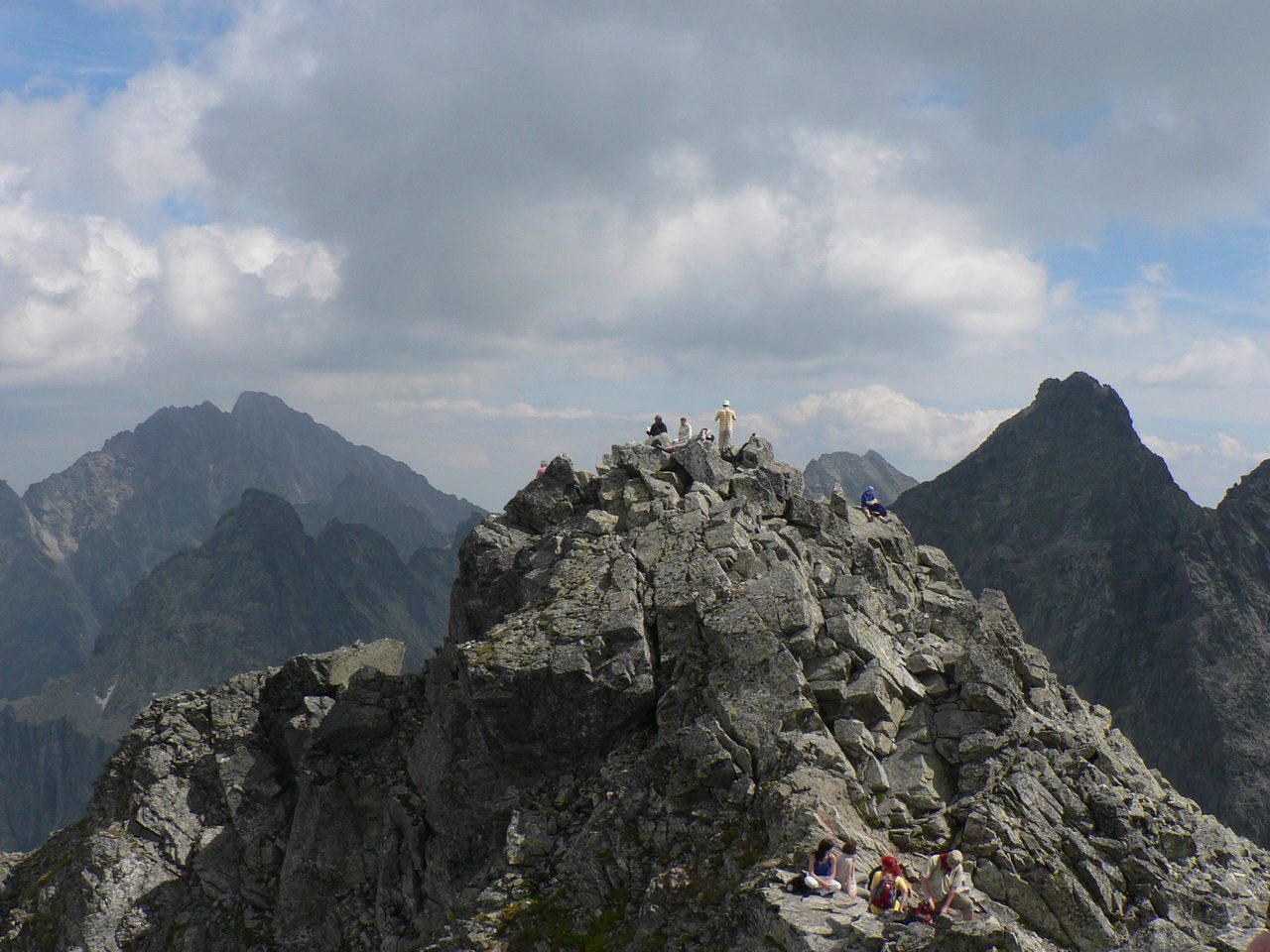
Why Rysy punishes underprepared hikers
Rysy looks easy on paper. At 2,499m (8,199 ft) it sits below the altitude where most hikers expect a real problem. That is the trap. The Polish route from Morskie Oko (around 1,400m / 4,590 ft) gains roughly 1,100m (3,610 ft) in one sustained push past Czarny Staw, with steep ground, exposed sections, and chains near the top. Round-trip is commonly 9 to 11 hours for fit hikers.
Three things catch underprepared parties. Duration: people train as if Rysy is a short peak day and arrive without the engine for nine hours on their feet. Steep, chained terrain in the upper section that slows movement when you are already tired. And the descent, which puts the same steep ground under tired legs with no eccentric base.
In winter Rysy becomes a different mountain: snow, ice, real avalanche risk, short daylight, chains buried or iced. Polish climbers have long used winter Rysy as preparation for bigger objectives. Modest altitude does not mean modest commitment.
Physical benchmarks to hit before Rysy
Rysy loads five physiological systems in different ways. A real preparation plan trains all five, not just the obvious one.
Altitude and terrain reality check
At 2,499m (8,199 ft), hypoxia is rarely the constraint on Rysy. You may feel slightly slower than at sea level, but the day is won by the aerobic engine, vertical accumulation, and descent strength, not oxygen saturation. Rysy is often a stepping stone, though. If your trajectory includes higher peaks, learning the principles now (progressive exposure, climb-high-sleep-low, AMS warning signs) saves you a steeper curve at 3,500m+ (11,500 ft+). The deeper guide is in altitude acclimatisation guide.
The 12-16 week Rysy preparation timeline
The block runs backwards from your climb date. Five phases, each with a distinct target.
- Weeks 1-4 · Aerobic base. Build the deep engine that keeps a long day efficient.
- Weeks 5-8 · Base plus strength. Add eccentric leg strength and progressive weighted carries.
- Weeks 9-11 · Muscular endurance. Long days with vertical and a building pack.
- Weeks 12-13 · Peak simulation. A long mountain day near your summit-day length, 4-6 weeks out.
- Week 14 · Altitude and skills. Time high where you can, plus the specific mountain craft Rysy needs.
- Weeks 15-16 · Taper. Volume drops; skills stay sharp; arrive fresh.
A weekly distribution that works
The polarised principle applies: most of the week at low intensity, one hard session, one long mountain day. This 80/20 split is one of the most robust findings in endurance training (Seiler and Kjerland, 2006). A representative week, 10 weeks out from a Rysy summit:
- Mon · easy 60 min Z2
- Tue · threshold intervals or VO2max, 4 x 4 min Z4 to Z5
- Wed · rest or 30 min mobility
- Thu · long Z2 hike, 2 to 3 hours with 600 to 800m (2,000 to 2,600 ft) vertical, weighted pack
- Fri · easy 45 min Z2 + eccentric strength (step-downs, weighted lunges)
- Sat · long mountain day, 4 to 6 hours mixed Z2 with vertical and surges
- Sun · 1.5 to 2.5h Z2 on tired legs (back-to-back loading)
Roughly 80 percent of weekly volume sits at Z1 to Z2, with one hard session and one back-to-back load. The 8 to 10 hour rehearsal lands 4 to 6 weeks before the trip, not in the taper. The deeper rationale is in our heart rate zones for mountaineering guide.
Technical skills you must bring to Rysy
TTM trains the body. Rysy is non-technical, but a big mountain day still asks for real mountain sense.
- Navigation and pacing over a long day.
- Foul-weather and altitude judgement.
- A steady, efficient uphill rhythm at altitude.
- Descent control on tired legs.
How TTM tunes the plan to Rysy
Five dimensions the algorithm calibrates to your peak
- Fitness target · Rysy is set at a fitness threshold the model associates with completing a long, steep Tatra day with margin. Your plan is engineered to hit that number by your summit date.
- Vertical accumulation target · Progressive weekly climbing load that builds your capacity for the sustained 1,100m (3,610 ft) push, with recovery weeks every fourth.
- Summit-day rehearsal · The Long Day Score is calibrated to a 9 to 11 hour Tatra day. The plan schedules a real 8 to 10 hour single training day in the 6-week window before your trip, not earlier.
- Descent eccentric load · Eccentric strength and downhill repeats are programmed in, not bolted on. The fitness-fatigue model (Banister et al., 1975) underpins how load and recovery are sequenced.
- Direction, not prescription · The algorithm recalibrates weekly on Sunday based on what you actually did. It moves the plan in the right direction; it does not pretend to know you better than your body.
Tell TTM your summit date and starting fitness. The plan is built backwards from that date with all five dimensions engineered in.
Common questions about training for Rysy
Is Rysy hard? It is only 2,499m (8,199 ft).
The altitude number is the trap. Rysy in summer is a long, steep day with chained sections near the top and a quad-shredding descent to Morskie Oko, often 9 to 11 hours car-to-car for fit hikers.
How long should I train for Rysy?
For the summer Polish route via Morskie Oko, 10 to 14 weeks of structured training is realistic for someone with a baseline of regular hiking or running.
Do I need altitude training for Rysy?
At 2,499m (8,199 ft) altitude is rarely the constraint. You may feel slightly slower than at sea level, but hypoxia is not the day's main physiological problem.
What about winter ascent of Rysy?
Winter Rysy is a different mountain. Snow and ice, real avalanche risk, short daylight, and the chains buried or iced.
Can I train for Rysy with a full-time job?
Yes. The polarised distribution fits a busy week well: most training is low-intensity work that fits early mornings or evenings.
Tools and deeper reading
Take this further
- Peak Progression Planner · See where Rysy sits in a full progression and the graded paths around it, from a fast line to a cautious foundation.
- Summit Readiness Simulator · Test whether you are ready for Rysy today. Free, science-backed, about 90 seconds.
- Training for Mountaineering · How TTM builds personalised mountaineering training plans backwards from your summit date, recalibrated each Sunday.
- Train for Triglav · The highest peak in the Julian Alps, steep via ferrata with serious exposure.
- Train for Aneto · The highest peak in the Pyrenees, a short glacier crossing and an exposed summit.
- Altitude Acclimatisation Guide · The four acclimatisation training protocols and how to fit them into your build.
- Muscular Endurance for Mountaineering · The pillar guide on the quality that turns gym strength into legs that last a summit day. Pair with the free Muscular Endurance Calculator to score where you stand.
The takeaway
Rysy is a specificity problem, not an altitude one. Hikers who finish reliably are the ones whose training matched the actual day: the duration, the steep vertical, the chains, the descent. Polish mountaineering culture has always taken this peak seriously. So should your training.