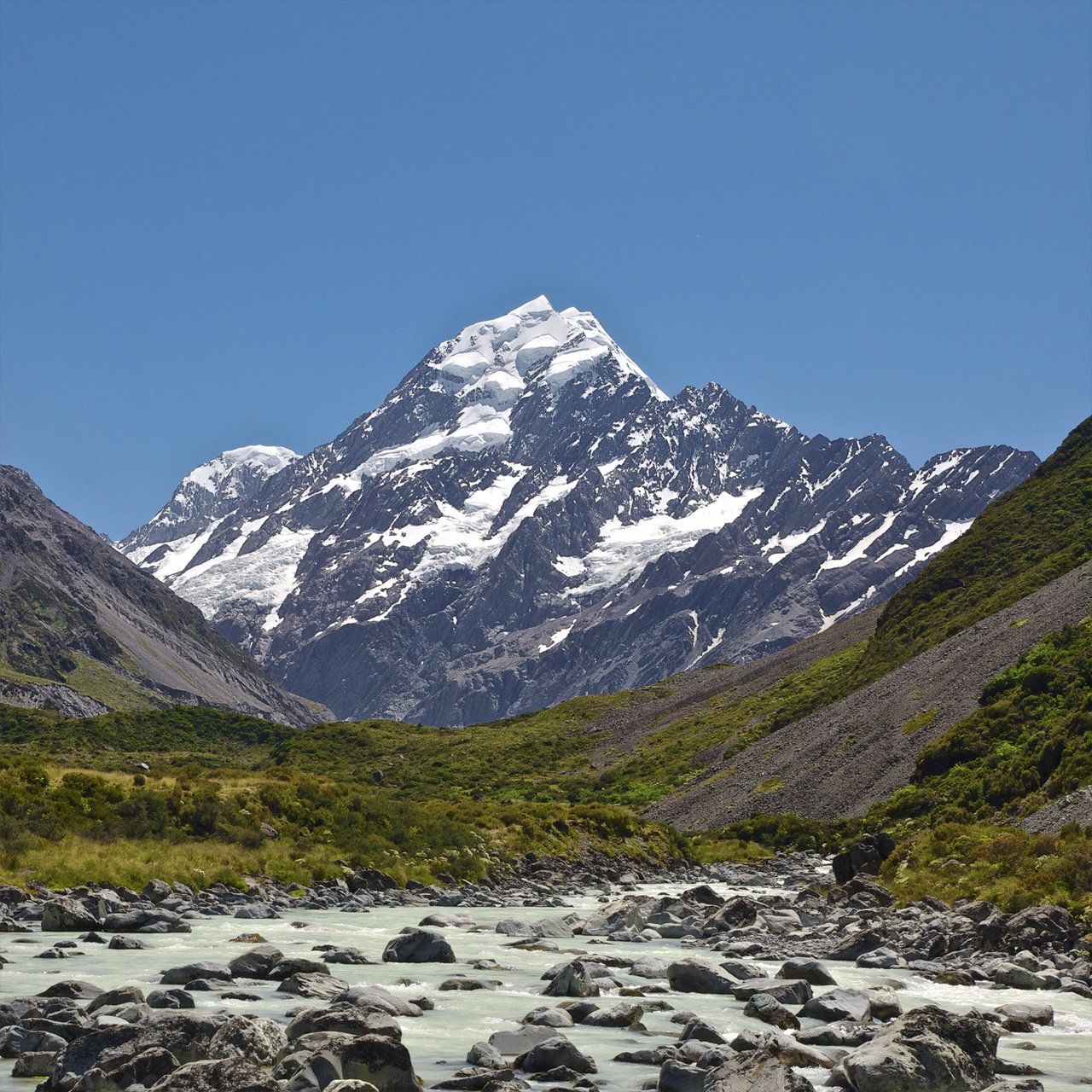
Training for Aoraki / Mount Cook takes about 16 to 24 weeks. At 3724m (12,218 ft) the altitude is modest but the mountain is not: the standard Linda Glacier route is a long, committing, technical alpine day, so it demands deep aerobic fitness, glacier and steep-snow skill, and mental steadiness under objective hazard.
Why Aoraki punishes underprepared climbers
Aoraki is often described as harder than most Alps 4,000ers despite being lower, and the reason is not the altitude - it is the combination of a long technical day, serious objective hazard, and Southern Ocean weather. The standard line from Plateau Hut climbs the Linda Glacier, weaves through its crevasses and beneath its seracs, tackles the Summit Rocks or the ice of the summit ice cap, and finishes on a corniced ridge. It is a full mountaineering day, not a walk-up with a hard bit.
Parties come up short for three reasons, and none of them is raw power. The first is speed. The Linda Glacier icefall is objectively dangerous - the faster you move through it, the less time you spend exposed to serac fall - so fitness here is a safety system, not a vanity metric. The second is the weather. Aoraki sits in the path of Tasman Sea storms; settled windows are short, and you often wait days at the hut, then have to perform on the one clear morning. The third is technical ground under fatigue: steep front-pointing, a corniced summit, and a long descent back through the same hazards on tired legs.
None of that is bad luck. Every one of those failure modes is trainable - or is a skill you bring, or a guide you hire.
Physical benchmarks to hit before Aoraki / Mount Cook
Aoraki loads five systems, and the aerobic engine is only the start. A real preparation plan trains all five, because on this mountain fitness is what buys you speed, and speed is what keeps you safe.
Altitude and terrain reality check
The altitude is not the crux. At 3,724 m you still have roughly 65 percent of sea-level oxygen - meaningful, but not the limiter for a fit climber. What defines Aoraki is everything else: the maritime weather, the objective hazard, and the sustained technical ground.
Most ascents start from Plateau Hut on the Grand Plateau (around 2,200 m), usually reached by ski-plane or helicopter, or by a serious glacier approach. From the hut, the Linda Glacier route threads crevasses and passes beneath seracs before the steep climbing to the Summit Rocks and the corniced summit ice cap. The standard season is November to February - the Southern Hemisphere summer - with the earlier part of that window often giving the most reliable snow and a less broken icefall. Even in season, you plan around weather: it is normal to sit at the hut and wait for the one settled morning.
How long does it take to train for Aoraki / Mount Cook?
The block runs backwards from your climb date. Each phase has a distinct target.
- Weeks 1-4 · Aerobic base. Build low-intensity volume, 4-6+ hours per week at Zone 1-2. The engine everything else rides on.
- Weeks 5-9 · Base plus strength. Add strength work (squat, deadlift, step-ups, calf and eccentric loading) and begin steep booted climbing. Long day grows to 3-4 hours with real vertical.
- Weeks 10-15 · Muscular endurance and steep-ground specificity. Long Z2 days with 1,000-1,400 m of gain, steep snow or stair work in crampons where possible, and deliberate downclimbing. Volume 7-10 hours per week.
- Weeks 16-19 · Peak simulation. One or two long, mountainous days (1,400-1,700 m gain) on steep, mixed ground, ideally back-to-back to rehearse the wait-then-perform pattern.
- Weeks 20-22 · Skills and consolidation. Time on real alpine terrain - glacier travel, front-pointing, crevasse rescue - or a guided refresher. Fitness held, technical readiness sharpened.
- Weeks 23-24 · Taper. Volume drops 30-50 percent. Arrive fresh, so that on the one clear morning you can move fast.
A weekly distribution that works
The polarised principle applies: most volume easy, a little hard, one long day. A representative week, 12 weeks out from a Aoraki / Mount Cook attempt:
- Mon · easy 60 min Z2
- Tue · threshold or VO2max intervals, 4 x 4 min Z4-Z5
- Wed · rest or 30 min mobility
- Thu · Z2 hike with weighted pack, 2-3 hours, 700-1000m (2,300-3,300 ft) of vertical
- Fri · easy 45 min Z2 + eccentric strength (step-downs, weighted lunges)
- Sat · long mountain day building toward 10 hours, mixed Z2 with vertical and progressive pack weight
- Sun · 2-3 h Z2 on tired legs (back-to-back loading, lighter pack)
Roughly 85 percent of weekly volume sits at Z1-Z2, with one hard intensity session and one back-to-back load. The single long rehearsal day lands 4-6 weeks before the trip, not in the taper.
Technical skills you must bring to Aoraki / Mount Cook
TTM trains the body. It does not teach mountain craft, and Aoraki demands a lot of it. The standard route is New Zealand Alpine Grade 3+ - serious, committing alpine climbing. Bring these skills, or climb with an IFMGA/NZMGA guide (most people, even strong climbers, do Aoraki 1:1 guided).
- Steep snow and ice. Confident front-pointing and self-arrest on 40-50 degree ground, in variable maritime snow.
- Glacier travel and crevasse rescue. Roped movement on a heavily crevassed glacier, and the ability to run a rescue if it goes wrong.
- Objective-hazard management. Reading serac and icefall danger, timing, and keeping the rope team moving through exposed ground.
- Corniced-ridge and exposure competence. Moving on a corniced summit and exposed terrain, up and down, under fatigue.
- Weather judgement and turn-around discipline. Reading a fast-changing maritime forecast and having the discipline to wait, or to retreat.
If steep ice, glacier hazard, or maritime alpine climbing is new to you, the honest answer is to build alpine experience on smaller objectives first and to climb Aoraki with a guide. TTM's plan gets you physically ready to move fast and safe; the mountain rewards technical readiness on top of that.
How TTM tunes the plan to Aoraki / Mount Cook
What the algorithm calibrates to your peak
- Fitness target · Aoraki is set to the high Mountain Fitness threshold our model associates with moving fast and safely through a long, hazardous alpine day - your plan is engineered to reach it by your climb date.
- Vertical accumulation target · calibrated to a 1,400-1,700 m technical day, built progressively with recovery weeks.
- Steep-ground and descent load · calf, front-pointing and eccentric strength are programmed in, because the route climbs and descends steep snow and ice.
- Back-to-back rehearsal · the plan schedules the wait-then-perform pattern, so a hard effort after days of waiting is trained, not a shock.
- Skills flag · the plan makes explicit that glacier, ice, and hazard skills - or a guide - are prerequisites the fitness plan sits on top of.
Common questions about training for Aoraki / Mount Cook
How hard is Aoraki / Mount Cook?
The standard Linda Glacier route is New Zealand Alpine Grade 3+ - a long, committing day on a crevassed glacier, through a serac-threatened icefall, up steep snow and ice to a corniced summit. It is widely considered harder than most Alps 4,000ers despite being lower, mainly because of objective hazard and violent maritime weather. It is a serious mountaineering objective, not a trekking peak.
Do I need technical skills for Aoraki?
Yes. You need confident steep snow and ice technique, glacier travel and crevasse rescue, and objective-hazard judgement. Most climbers, including strong ones, climb Aoraki 1:1 with an IFMGA/NZMGA guide. Bring the skills or bring a guide - do not learn them on the route.
How fit do I need to be?
Very. The summit day from Plateau Hut is 10-16 hours of sustained movement on snow and ice, and speed through the icefall is a safety system. You want a deep Zone 2 base, front-pointing endurance, and the leg strength to descend the same ground tired.
Is altitude the main challenge?
No. At 3,724 m altitude is real but not the limiter for a fit climber - you have around 65 percent of sea-level oxygen. The defining challenges are the technical ground, the objective hazard, and the weather.
When is the best season?
November to February, the Southern Hemisphere summer, with the earlier part of that window often giving firmer snow and a less broken icefall. Even in season you plan around short weather windows and often wait days at the hut for a settled morning.
How does it compare to an Alps 4,000er?
Aoraki is lower than Mont Blanc but generally more committing: a longer objective-hazard exposure, more serious weather, and sustained technical climbing. Many climbers treat an Alpine AD-grade summit as a sensible prerequisite before attempting it.
Tools and deeper reading
Take this further
- Summit Readiness Simulator · Test if you are ready for Aoraki / Mount Cook today. Free, 60 seconds.
- Altitude Acclimatisation Guide · Climb-high-sleep-low and AMS warning signs.
- Eccentric Descent Training · The work that stops the late-day quad breakdown.
- Heart Rate Zones for Mountaineering · The polarised 85/15 distribution.
- The Science Behind TTM · The peer-reviewed research behind the algorithm.
The takeaway
Aoraki is rarely a strength problem. It is a speed-and-skill problem wrapped in a weather problem: the climbers who summit and get down cleanly are the ones fit enough to move fast through the hazard, skilled enough to handle the ice, and patient enough to wait for the window. Train the engine and the steep ground, bring the alpine craft or a guide, and respect the weather - and Aoraki becomes the summit of a lifetime rather than an epic.