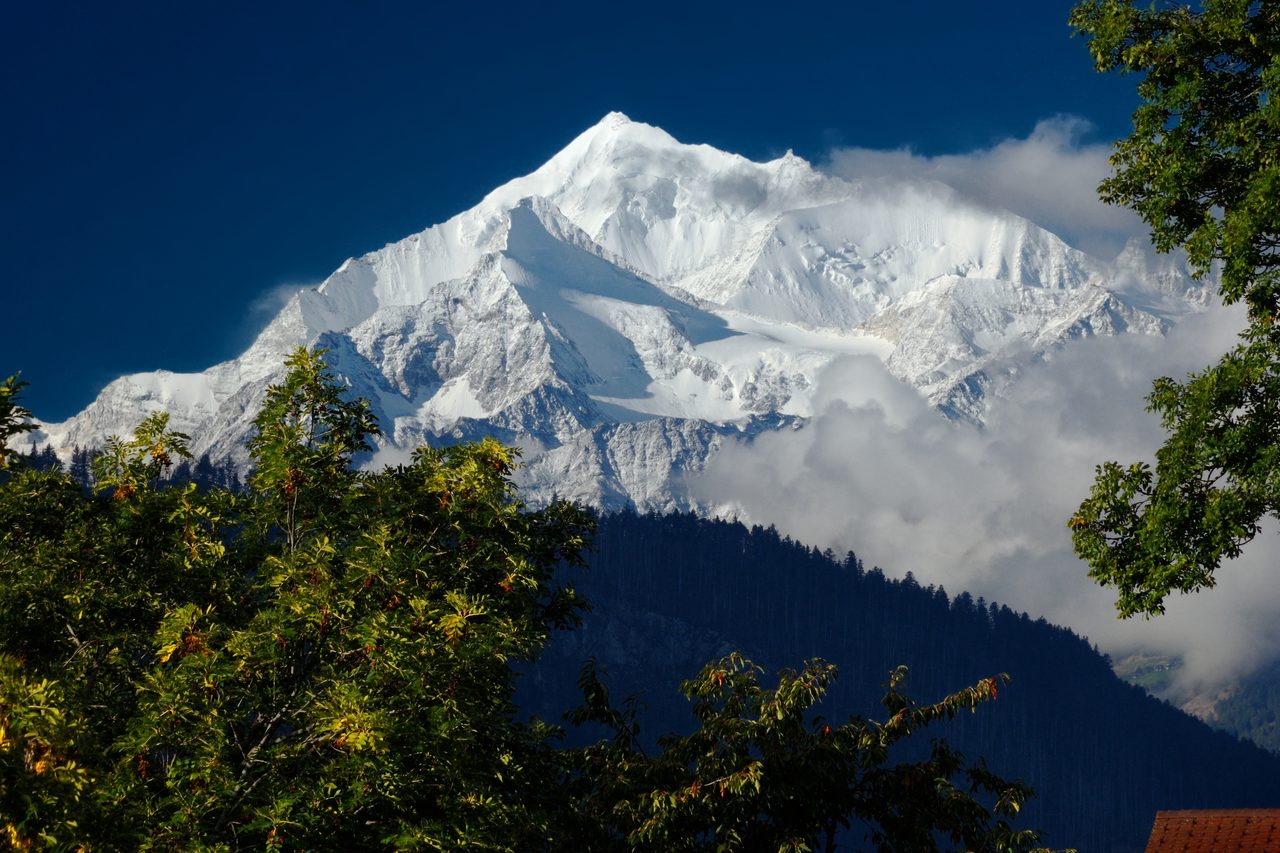
Training for the Weisshorn takes about 12 to 16 weeks. A step up from the easier 4000ers, its East Ridge is a 10 to 14 hour day of sustained mixed ground at 4506m (14,783 ft) with a steep descent on tired legs, so it demands deep aerobic fitness, technical movement, and strong descent legs.
Why the Weisshorn punishes underprepared climbers
The Weisshorn (4,506m / 14,783 ft) sits in the Pennine Alps in the canton of Valais, Switzerland. It is widely regarded as one of the most beautiful pyramid peaks in the range, and by 4,000er standards its normal route is demanding. The standard line is the East Ridge from the Weisshornhutte (approximately 2,932m / 9,620 ft), graded around AD or AD+: a long snow and rock ridge with several rocky steps and sustained exposure. It was first climbed on 19 August 1861 by John Tyndall with guides Johann Joseph Bennen and Ulrich Wenger.
The problem is rarely raw fitness in isolation. It is the combination. Summit day from the hut typically runs 10 to 14 hours round trip with a very early alpine start. Parties move slower than the schedule allows on sustained mixed ground, weather windows close, and fatigue compounds across the long day. The descent off the ridge, after a full day of climbing, is where most underprepared climbers come apart. Quads that were never trained eccentrically start cramping, footwork gets sloppy on exposed steps, and what should be a steady walk-out becomes a careful, slow retreat. None of this is bad luck. The duration, the sustained mixed terrain, and the descent are all trainable demands, and the climbers who put real work into all three rarely turn around for the reasons that turn most parties around.
Physical benchmarks to hit before the Weisshorn
The Weisshorn loads five physiological systems in different ways. A real preparation plan trains all five, not just the obvious one.
Altitude and terrain reality check
Training builds the engine. Altitude is its own thing. At 4,506m (14,783 ft) the altitude is meaningful, and it is paired with a long single push from the hut, which compounds the cost. Sea-level fitness will not substitute for time spent up high. Practically, three options: spend time at 3000m+ (9,800 ft+) on lower Alpine peaks in the weeks before, use a hypoxic tent at home for haematological adaptation, or build a 2 to 3 day acclimatisation rotation into the trip itself on an easier 4,000er. The deeper guide on this is in altitude acclimatisation guide.
How long does it take to train for the Weisshorn?
The block runs backwards from your climb date. Five phases, each with a distinct target.
- Weeks 1-4 · Aerobic base. Build the deep engine that keeps a long day efficient.
- Weeks 5-8 · Base plus strength. Add eccentric leg strength and progressive weighted carries.
- Weeks 9-11 · Muscular endurance. Long days with vertical and a building pack.
- Weeks 12-13 · Peak simulation. A long mountain day near your summit-day length, 4-6 weeks out.
- Week 14 · Altitude and skills. Time high where you can, plus the specific mountain craft the Weisshorn needs.
- Weeks 15-16 · Taper. Volume drops; skills stay sharp; arrive fresh.
A weekly distribution that works
The polarised principle applies: most of the week at low intensity, one hard session, one long mountain day. A representative week, 12 weeks out from a Weisshorn summit attempt:
- Mon · easy 60 min Z2
- Tue · threshold or VO2max intervals, 4 x 4 min Z4 to Z5
- Wed · rest or 30 min mobility
- Thu · long Z2 hike, 2 to 3 hours with 600 to 800m (2,000 to 2,600 ft) vertical, weighted pack
- Fri · easy 45 min Z2 plus eccentric strength (step-downs, weighted lunges)
- Sat · long mountain day, 4 to 6 hours mixed Z2 with vertical and surges
- Sun · 1.5 to 2.5 hour Z2 on tired legs (back-to-back loading)
Roughly 80 percent of weekly volume sits at Z1 to Z2, with one hard intensity session and one back-to-back load (Seiler and Kjerland, 2006). The 10+ hour rehearsal day lands 4 to 6 weeks before the trip, not in the final taper. The deeper rationale is in our heart rate zones for mountaineering guide.
Technical skills you must bring to the Weisshorn
TTM trains the body. the Weisshorn is a technical objective - bring these skills or climb with a certified guide.
- Confident movement on steeper snow, ice or rock at the route's grade, up and down.
- Rope work: pitching, belaying and secure anchors where the ground demands it.
- Composure on exposed, committing terrain.
- The judgement to retreat or abseil cleanly if conditions turn.
How TTM tunes the plan to the Weisshorn
Five things the algorithm calibrates to your peak
- Fitness target · The Weisshorn target sits above the easier 4,000ers in our model, reflecting the longer summit day and sustained mixed ground. The plan is engineered to hit that number by your summit date.
- Vertical accumulation · The plan distributes weekly vertical progressively, with a recovery week every fourth week, building toward the demand of the walk-in plus summit day combined.
- Summit-day rehearsal · The plan schedules at least one 10+ hour single training day in the 6-week window before your trip, not earlier, calibrated to the Weisshorn's day-length.
- Descent eccentric load · Eccentric strength and downhill repeats are programmed in directly, calibrated to a sustained, exposed descent on tired legs.
- Mixed-terrain readiness · The plan biases weekend volume toward real terrain in the final block, so you arrive used to movement on mixed ground rather than treadmill familiarity.
When you tell TTM your objective is the Weisshorn and your summit date, the plan is built backwards from that date with all five demands engineered in. You do not need to assemble the pieces yourself. Every Sunday the algorithm recalibrates based on what you actually completed that week and reshapes the next week to keep you on track for your summit date. The adaptation is weekly, not real-time, which matches how training stress consolidates into fitness across recovery (Banister et al., 1975).
Common questions about training for the Weisshorn
How fit do I need to be for the Weisshorn (4,506m / 14,783 ft)?
Fitter than you needed to be for an easier 4,000er. The Weisshorn East Ridge is graded around AD or AD+ with a summit day that typically runs 10 to 14 hours from the Weisshornhutte (approximately 2,932m / 9,620 ft) and back.
What altitude work matters for the Weisshorn?
At 4,506m (14,783 ft) the altitude is meaningful, especially because you climb it in one long push from the hut. The only honest way to adapt is to spend time up there.
How is training for the Weisshorn different from training for an easier 4,000er?
Two differences matter. First, duration: a typical Weisshorn summit day is 10 to 14 hours of sustained climbing and descending on mixed ground, which is longer than most entry-level 4,000ers.
Can I prepare for the Weisshorn from a sea-level country?
Yes, with one honest constraint: altitude exposure has to come from the trip itself, not training. The aerobic engine, vertical accumulation, descent eccentric load, and long-day fatigue tolerance can all be trained anywhere with hills, stairs, or a treadmill on incline.
How does TTM adapt the plan when life gets in the way?
Every Sunday the algorithm recalibrates based on the data you have logged that week: completed sessions, perceived effort, sleep, and any wearable signals you connect. The next week is reshaped to keep you trending toward your summit-day target without overreaching. The adaptation is weekly, not real-time, which matches how training adaptation actually consolidates (Banister et al., 1975).
Tools and deeper reading
Take this further
- Summit Readiness Simulator · Test if you are ready for the Weisshorn today. Free, science-backed, 90 seconds. Enter your peak, your summit date, and your current fitness; get a readiness score.
- Altitude Acclimatisation Guide · The climb-high-sleep-low rule, the 300 to 500m (1,000 to 1,650 ft) per-night ceiling, AMS warning signs, and the three real acclimatisation strategies.
- Heart Rate Zones for Mountaineering · The polarised distribution, why Z2 dominates, how to find your zones, and the common mistakes that turn long days into junk-zone tempo.
- The Science Behind TTM · Banister's model, polarised distribution, altitude physiology, eccentric load: the peer-reviewed research the adaptive algorithm is built on.
- Muscular Endurance for Mountaineering · The pillar guide on the quality that turns gym strength into legs that last a summit day. Pair with the free Muscular Endurance Calculator to score where you stand.
The takeaway
The Weisshorn is rarely a fitness problem in the abstract. It is a specificity problem. The climbers who summit reliably are the ones whose training matched the mountain's actual demand profile: a long aerobic day, sustained mixed ground, a serious descent, and time spent at altitude before the trip. The athletes who turn around usually trained one or two of these well and ignored the others.